Uncategorized

The key to unlocking your mortgage prison

Fixed rate loans If you’re at risk of negative equity or being turned down when your mortgage term ends, it may be worth refinancing now, writes Lucy Dean.

Fixed rate borrowers whose terms are ending within the next 12 months have been urged to assess whether they will be able to refinance at the end of their term or be better off renegotiating their loan today.

Borrowers face their bank’s revert rate when their fixed term ends, but this rate is ‘‘often horribly uncompetitive’’, says RateCity research director Sally Tindall.

Borrowers with less than 20 per cent in equity may also have to pay lenders’ mortgage insurance to refinance, while those in negative equity may be unable to refinance, she warns.

Another challenge is that lenders are required to stress test borrowers’ capacity to pay off their mortgages with an added 3 percentage points, meaning borrowers need to prove they can handle an effective 9 per cent interest rate if they want to refinance.

RateCity analysis finds an average buyer who bought a house in Sydney in July 2021 for $1.3 million with a 20 per cent deposit would have 17 per cent in equity today, with the median price having fallen to $1.2 million. But if the median price falls to $1.1 million in December this year, as per ANZ’s forecasts, they’d have only 11 per cent. The same buyer in Melbourne, purchasing in July 2021 for $957,000, would have 17 per cent equity today, and 12 per cent by December.

But if the Sydney buyer had a 10 per cent deposit in July 2021, they’d have only 6 per cent equity, falling to negative 1 per cent by December. In Melbourne, they’d have 7 per cent today and 1 per cent in December.

‘‘Falling property prices and soaring mortgage rates mean some people could find they can’t refinance when their fixed term wraps up because they’re in mortgage prison,’’ says Tindall.

”If you are on a fixed rate and think you might end up in mortgage prison, do a quick health check on your finances to make sure you’re on solid ground.’’

She says borrowers who owe more than 80 per cent of the value of their property could be in hot water.

Those who owe less than 80 per cent, but are brushing up against that threshold, should ask whether they’d be better off breaking their fixed term early to access the current fixed rates before projected RBA increases push rates higher, or property price falls nudge borrowers into that equity danger zone.

‘‘Owning less than 20 per cent of your property isn’t an automatic sentence to mortgage prison. It just means your new bank might charge you lenders’ mortgage insurance,’’ says Tindall.

‘‘That might be something you’re happy to pay to refinance, particularly if you’re only just a fraction under the required deposit.

‘‘That said, if your equity is close to zero, or in negative territory, you’ll be hard-pressed to find a bank willing to take you on at all.’’

Brendan Dixon, managing director at Pure Finance says it’s a tough time for borrowers, but proactive mortgage-holders can still find decent home loan products via a rate review with their current lender, or refinancing with another institution. This goes for both variable rate and fixed interest borrowers.

Dixon gives the example of a borrower with a fixed rate of 2.5 per cent, with the fixed term ending in June 2023.

The lender currently offers a variable rate of 5.54 per cent for existing customers, as well as a 5.59 per cent three-year fixed rate.

But if the Reserve Bank of Australia were to raise interest rates another three times, that borrower could expect this variable rate to reach 6.29 per cent by the time their fixed loan ends.

So, the borrower has a choice. Keep the existing 2.5 per cent interest rate and revert to a 6.29 per cent variable interest rate, or break their current fixed rate to lock in the 5.59 per cent fixed rate the lender has on offer.

Assuming this borrower has a $750,000 loan, they’d incur $5700 in interest charges by breaking the fixed rate three months early.

But by locking in that 5.59 per cent fixed rate now, rather than potentially 6.29 per cent in June, they’d be paying 0.7 per cent less in interest, and saving $5250 per year.

‘‘This is approximately $15,000 in interest savings over the three years, minus the added interest paid to break the fixed rate early of $5700, meaning a net benefit of $9300,’’ says Dixon.

He’s had a few clients choosing to break their low fixed rate product earlier to fix rates at the current offer, rather than risk a higher rate down the track. ‘‘This was based on perceived longer-term savings.’’

For example, clients Jonathan and Sophia broke their three-year fixed rate of 2.49 per cent in January, before it was due to expire in April. Then, they refixed with the same lender at 4.74 per cent for one year.

They paid additional 2.25 per cent interest from January at a cost of $4286 over three months. However, by fixing at 4.74 per cent rather than 5.45 per cent, they’re saving $5410 over the year, or $1124 after accounting for the $4286 in extra interest.

‘‘All the [interest rate] predictions have changed since January, and in hindsight, maybe they should have fixed longer,’’ says Dixon.

He says borrowers approaching the end of their fixed term should start looking at their options, whether that involves using a mortgage broker or comparison website.

Then they need to start collecting all the information available, including variable and fixed rates at their lender and other rivals, as well the ramifications of breaking their fixed term.

‘‘It’s not quite as easy to work out, but [look at] the cost of re-fixing at today’s fixed rate, versus fixing in say three, four or five months when your fixed rate expires, and working out whether it’s cheaper to lock in a higher interest rate now,’’ he says. SI

The key to unlocking your mortgage prison2023-03-14T09:31:15+11:00

Tug of war between heart and finances

Downsizing Clinging on to the family home even though your finances are tight? This is what you should consider, writes Michael Hutton.

You own the family home, are enjoying retirement and your children moved out years ago. But your home is showing signs of wear and tear, and you are struggling physically and financially to maintain it. Perhaps now is the time to consider downsizing to a smaller property and rearranging your finances.

You’ve long resisted the urge to move to another property – whether that be downsizing to a smaller home or moving into an aged care facility. Spending your twilight years in the family home has been the goal. It’s not just a property you own – it’s your home, full of family memories and a haven for spending quality time with children and grandchildren in the years to come.

Unfortunately, the sentimentality of the family home may conflict with financial reality.

You are not alone. There are many older people across the country who are living alone or with their partner in valuable, equity-rich family homes. While they may be living in a property worth millions of dollars, they are living frugally – the classic asset-rich, cash-poor dilemma.

Another scenario may be that you also have minimal investment income and are perhaps relying on the government age pension to finance your daily life. You’ve realised that properties don’t remain pristine on their own. You need to spend time, money and effort on upkeep, otherwise it can become poorly maintained or, in some cases, dilapidated.

If you can relate to all or even part of this scenario, you could probably live a more comfortable life by downsizing.

Should you decide to put sentimentality aside to sell the property and move into a smaller but more manageable and lifestyle-appropriate property, you might have a large sum of money left over to invest in other things.

If that’s the case, you may be able to contribute up to $300,000 for each partner into super as part of the downsizer contributions scheme, while the remaining balance could be invested in a personal investment portfolio.

If you are under 75, you might be able to put a further $330,000 (indexed) each of non-concessional contributions into super.

Your financial situation will then be much more liquid, meaning you’re better able to spend your hard-earned money living out your preferred lifestyle rather than having it tied up in a single property.

With the recent increase in income thresholds to $90,000 for singles and $144,000 for couples for the Commonwealth Seniors Health Card, you may still qualify for this valuable concession. Admittedly, though, you may end up missing out on the age pension because of the assets test and your new investment position.

Consider a widow living in a run-down, four-bedroom Sydney house worth $4 million. She might consider selling the house and buying a pristine $2 million apartment instead.

Of the remaining $2 million, perhaps $300,000 or more could be placed into super and the remaining $1.7 million or so invested into a personal investment portfolio of liquid investments such as shares and managed funds. If she drew from the portfolios at 5 per cent per annum, that would equate to $100,000 a year to spend.

In this scenario, minimal personal tax will likely be incurred after franking credits and capital gains discounts are taken into account.

Additionally, there will be much more cash to live on than relying on the government age pension of about $26,000 per annum for singles and $40,000 per annum for couples. This would also remove her from the government system and the need to routinely provide information. Stringent Centrelink gifting restrictions would no longer be applicable.

Not only that, but she might find herself living in a property that is much more pleasant and manageable in terms of upkeep. In this example, wealth has been rearranged from 100 per cent lifestyle (and illiquid) to 50 per cent lifestyle and 50 per cent investment (and liquid). This is a much better ratio.

Through downsizing, you’re more effectively able to address both financial and lifestyle considerations.

While you might be saying goodbye to the home in which so many meaningful memories have been made, you are also freeing up the property for a young family for whom it might now be better suited.SI

Michael Hutton is wealth management partner at HLB Mann Judd Sydney.

Tug of war between heart and finances2023-03-14T09:21:22+11:00

Banks look to adopt ChatGPT as an aid for customers: Microsoft

Customers calling up their bank may soon have inquiries answered with the help of ChatGPT.

Lenders in Australia and the US are preparing to deploy the groundbreaking technology to prompt call centre workers on what questions to ask, and the appropriate letter to dispatch to the customer when the conversation is done.

The chatbot will help employee decision-making by creating background materials to make conversations with business customers more productive. Investment banks could use it to construct pitch books based on conversations recorded on Microsoft Teams.

In January, it was reported that Microsoft had invested $US10 billion in OpenAI, the start-up behind ChatGPT. ChatGPT has more than 100 million users, making it the fastest-growing software application of all time.

This has set the tech world abuzz about ‘‘generative AI’’, which uses ‘‘foundation’’ data models – which draw on a vast quantity of uncategorised data – to allow the chatbots to answer questions in detail in a way that is easy to access.

The Australian Financial Review

explored the initial use cases in banks for ChatGPT’s artificial intelligence (which is being integrated into Microsoft’s Bing search platform and a range of services provided to corporate clients) with Microsoft corporate vice president of worldwide financial services Bill Borden.

He met banks and superannuation funds in Melbourne and Sydney last week, when a major topic of conversation was ChatGPT.

‘‘That is where people are getting really excited, around experience interfacing with frontline workers or the customer service area,’’ Mr Borden said. ‘‘When you think about the response, you can start creating off the dialogue and engagement [with customers]. You can start thinking about modelling activities, and what the approach or response should be. You can solve a problem – and create materials to actually follow up.

‘‘That is where OpenAI and ChatGPT can start to augment the processes.’’

Together with its Azure cloud and popular desktop software, which is used by all the major banks, Microsoft is developing ‘‘outcomes-based AI’’ to enhance consumer experiences and improve productivity.

This time last year it bought Nuance, a developer of conversational AI and ambient intelligence, which allows call centre workers to use biometrics to identify customers and prompt conversations.

Mr Borden points to a relationship banker using Teams or Office talking to a client. New chatbots can give the banker direction on actions, after analysing the customer mood, he says. They will also deliver insights to corporate bankers providing a full view of the company they are about to call and a list of actions to ensure the call is proactive.

It will be up to banks to work out thorny questions on disclosure and ethical application of the AI technology.

As it develops ‘‘industry clouds’’ tailoring its AI services to specific industries, Mr Borden says security, compliance and controls are important in financial services, and banks can access Microsoft’s in-house ethicists to advise on use cases in the market.

‘‘It has to be part of it. We are very focused on responsible AI,’’ he said.

‘‘We have policies and procedures, including on openness and inclusiveness and transparency, built into the products. As we deliver them, we have conversations about how we built it and how we think they should deploy it.’’

As ChatGPT also raises questions about the accuracy of material used to generate answers, including its limited understanding of Australian political history, banks will have to determine what source material is drawn upon and whether customers should be informed.

‘‘That is the learning journey we are on,’’ Mr Borden said. ‘‘Machine learning has been used in decision-making, from thinking about credit decisioning and other [applications]. It is not new.

‘‘Now it is a question of what more you can do, and what will be the approach around policies and governance to ensure it is open, inclusive and understands bias. These are all conversations we have with customers around how to think about using the technology.’’

Microsoft’s ‘‘intelligent cloud’’ division, which includes Azure, generated $US21.5 billion in revenue over the quarter ending December 31, up 18 per cent. The area makes up 40 per cent of revenue.

Asked whether some banks would be willing to pay more in data centre costs to access the models, Mr Borden said cost savings always depended on a bank’s overall tech strategy.

‘‘Will there be savings? Sometimes yes or no, depending on what your strategy is around applications,’’ he said. ‘‘Are you retiring applications, or are you just moving them? And how are you phasing in optimisation?’’

Westpac has a broad contract with Microsoft for a range of cloud services. Other majors banks use it to varying degrees, often part of hybrid cloud strategies that also include Amazon Web Services and Google.

Banks look to adopt ChatGPT as an aid for customers: Microsoft2023-03-14T09:18:52+11:00

Investors pare back RBA rate path on slowdown

Underwhelming gross domestic product and inflation figures prompted financial markets to temper their expectations of interest rate rises by the Reserve Bank ahead of a further slowdown in activity.

Economic growth advanced 0.5 per cent in the December quarter, missing forecasts of 0.8 per cent, as inflation and higher interest rates cooled demand. The annual rate of gross domestic product growth slowed to 2.7 per cent, from 5.9 per cent.

The Australian dollar initially dropped to its lowest in two months but rebounded 0.3 per cent to US67.48¢ after China posted it’s highest monthly gain in manufacturing activity in February in more than a decade.

The $A is often used as a proxy for Chinese growth because of the countries’ strong trade links.

China’s manufacturing purchasing managers index rose to 52.6 last month from 50.1 in January, according to the data, after COVID-19 restrictions were lifted late last year. It was the highest reading since April 2012 and beat forecasts of 50.6.

The non-manufacturing gauge, which measures activity in the services and construction sectors, rose to 56.3 from 54.4, better than a projected rise to 54.9. A reading above 50 indicates expansion from the previous month, while below indicates contraction.

In Australia, the weaker-than-expected GDP and inflation result prompted interbank futures to pare back the scale of interest rate increases. They indicate the Reserve Bank of Australia will lift the cash rate to 4.2 per cent, down from expectations of 4.3 per cent before the report’s release. This would mean at least three more rate increases. On Monday, bond traders had wagered the terminal would hit 4.4 per cent.

Financial markets indicate a 96 per cent chance the RBA will lift the cash rate by 0.25 of a percentage point to 3.6 per cent at its next policy meeting on March 7.

Three-year government bond yields, which reflect interest rate expectations, dropped 13 basis points to 3.5 per cent. They had jumped a whopping 44 basis points in February, the largest monthly gain since August.

Economists said the softer data was unlikely to derail the RBA rate outlook. ‘‘We expect the RBA to remain focused on accelerating labour costs,’’ said Andrew Boak, chief economist for Australia at Goldman Sachs.

He noted nominal unit labour costs had accelerated to an annual rate of 7.1 per cent, far above the pre-COVID-19 decade average of 1.6 per cent, and that would keep upward pressure on CPI.

‘‘We believe the RBA has more work to do to mitigate the risks to broader inflation as global peer central banks continue to lift interest rates,’’ he said.

Goldman Sachs maintained its forecasts of a 0.25 percentage point increase at each of the next three RBA meetings to a 4.1 per cent terminal rate by May.

Other reports released yesterday showed the monthly indicator of consumer prices rose 7.4 per cent in the year to January. The household savings ratio recoiled to a five-year low of 4.5 per cent, from 7.1 per cent in the September quarter.

‘‘The reduction in the savings rate to close to below its pre-pandemic average means the outlook for spending from here is more aligned with growth in household disposable income rather than savings accumulated during the pandemic,’’ said Gareth Aird, head of Australian economics at CBA.

‘‘The very pessimistic levels of consumer sentiment imply the tailwind on the economy from pent-up savings does not have much further to run.’’

CBA expects GDP growth will slow by more than the RBA anticipates over 2023 and the jobless rate will rise above the central bank’s forecast. It also anticipates inflation to recede more quickly than the RBA projects.

Mr Aird forecasts two quarter-point increases to the cash rate before easing policy later this year.

A separate report showed a slight improvement in manufacturing health, which may suggest the economy remains on track for a soft landing in 2023. The seasonally adjusted S&P Global Australia Manufacturing Purchasing Manager’s Index edged up to 50.5 in February, from the neutral level of 50 last month.

‘‘None of the forward-looking indicators are pointing to a recession,’’ said Warren Hogan, an economic adviser at Judo Bank. ‘‘The results support the notion that economic activity is holding up in early 2023.’’

He expects the cash rate to rise to between 4 per cent and 4.5 per cent.

Investors pare back RBA rate path on slowdown2023-03-08T16:27:14+11:00

Off-the-plan sales falling through

Back-to-back interest rate rises have started to hit off-the-plan buyers, with some already moving to offload their unsettled property, according to industry insiders.

Qi Chen, founder of OpenLot.com. au, a listings site for new housing developments said the number of buyers enquiring about selling or nominating another buyer to take over an unconditional off-the-plan contract had surged over the past 12 months.

‘‘We saw a large jump in the number of seller requests in 2022, which had more than doubled compared to 2021. So far, this year is continuing with the same trend,’’ Mr Qi said.

Back in 2021, only 22 per cent of the seller requests on the site were unsettled off-the-plan properties, according to Mr Qi. That rose to 47 per cent in 2022.

‘‘Based on this, we’re anticipating developers could be facing up to 5 per cent of their off-the-plan contracts failing at settlement due to buyers not being able to get finance,’’ Mr Qi warned. ‘‘In this case, the developers will need to find a new buyer to buy this property. Some buyers might be able to get away with a nomination sale if they bought early and the contract price was low. However, some could struggle if the nomination contract isn’t competitive in the resale market.’’

A nomination sale occurs when a buyer nominates another buyer to take over an unconditional off-the-plan contract, which is approved by the developer. This type of sale is usually done at the original contract price.

Diaswati Mardiasmo, chief economist at PRD said with interest rates expected to rise to 4.1 per cent this year, an off-the-plan buyer would face higher borrowing costs than at the time they were conditionally approved by their lender.

‘‘This may prompt the on selling of the contract. Whether or not they will lose the money, this depends on the clauses of the original contract,’’ Dr Mardiasmo said. ‘‘More often than not the deposit is lost, however, it depends on the contract clauses.’’

The risk of failing to qualify for a loan to settle an off-the-plan property has risen as interest rates climb higher than expected, according to Sally Tindall, director of research at RateCity.

‘‘People who might have cleared their bank’s serviceability tests 12 months ago may struggle to pass this same test today as a result of rising interest rates, particularly if they haven’t had a decent pay rise in this time.’’

RateCity estimated that a solo buyer with no dependents and earning $100,000 when they signed the contract could now only borrow a maximum of $582,900 after the recent rate rises, which was $195,100 lower than their borrowing capacity in March 2021.

This assumes a 20 per cent deposit and a pay rise of 2.4 per cent in March 2022 and 3.4 per cent in March 2023.

For a couple with two dependents earning $200,000 at the start, their borrowing capacity has been slashed by $379,700 to $1.077 million or a 26 per cent drop in the maximum loan amount. ‘‘Arguably, the biggest challenge for buyers currently considering an off the plan purchase will be securing credit,’’ said Tim Lawless, CoreLogic research director.

‘‘Borrowing capacity has reduced and demonstrating an ability to service the loan is more challenging, especially when factoring in a three percentage point serviceability buffer.

‘‘Lenders also tend to treat high density housing sectors as higher risk due to the potential for rapid changes in the supply over the term of the loan.’’

The sharp decline in existing home prices in the past year could also drag new home prices lower and leave some off-the-plan buyers with a large shortfall, said Ms Tindall.

‘‘Some borrowers could even find themselves in negative equity before they’ve even stepped foot in the property, making it all but impossible to find finance at all, unless they can find extra cash elsewhere.’’

Anna Porter, a qualified valuer and principal at Suburbanite warned that the burden of higher interest rates and falling values could push many off-the-plan buyers into financial distress.

‘‘I expect there will be a lot of this occurring this year and next. I’ve seen it many times in the past when there’s been market corrections,’’ Ms Porter said.

‘‘The real challenge is interest rates are going up. Even though rents might have increased over the last 12 months, which help investors, higher rates have exceeded that, so they still have very low serviceability.’’

Mark Bainey, chief executive of Capio Property Group said while all the buyers of the company’s developments have so far gained enough capital growth to meet their settlement, the ongoing interest rate rises could start to erase some of those.

‘‘Most of our buyers who purchased during the COVID boom have had enough growth in the property to at least meet the contract price,’’ Mr Bainey said.

‘‘We’re not seeing anyone coming in under contract price so far, but maybe with a couple more rate rises we’ll start to see some of those issues.

‘‘So we’re talking to our buyers a lot sooner than the settlement date. We’re giving them six months’ notice, and we’re actively engaging with them to make sure that they are talking to their banks.’’

Mike Davis, Stockland executive general manager for Masterplanned Communities, said while there was uncertainty around interest rates, structural drivers remained supportive, with a strong labour market, increasing levels of migration, and constrained land supply.

A Mirvac spokeswoman agreed and added that limited new supply and strong resumption of immigration were helping to stabilise prices.

Off-the-plan sales falling through2023-03-08T16:24:35+11:00

Financial Planning Message – December 2022

As 2022 draws to a close we are reminded of the recent period of intense volatility in capital markets and the reality that a global recession is likely next year.


Markets are pricing in a lower probability of a recession in Australia.


This in turn will depress corporate earnings and valuations across all asset classes and significantly increase default rates among high-risk borrowers.


The correction to valuations is likely to be more severe during this economic cycle due to valuations starting from elevated levels compared to previous corrections.


We are also yet to experience a high number of fixed loans move from fixed interest rates of sub 2% to levels of 5%+ prevailing rates, something in the order of $500bn are due to mature in mid to late 2023.


This will no doubt impact the already depressed property market in Australia.


All the major banks and APRA are keeping a close eye on this development as we progress into 2023.


As inflationary pressures persist ( highest in 40 years ), geopolitical tensions and tight labour supply, the  central banks are forced to aggressively press on with higher interest rates and keep for much longer.


The RBA has so far moved the cash rate from .1% in March 2022 to now 3.1%, markets are now pricing in another two .25% increases in early 2023 before a potential pause to evaluate the impact on inflation.


The Federal Reserve was pricing in a rate increase of just 1% in December 2021, it is remarkable that their view now is that it is likely to peak at approximately 5.25%.


Consequently, 2023 is poised to exert added stress to highly leveraged borrowers, specifically those that have acquired property / equities in 2021 / 2022, are now in nil or negative equity positions.


It is worth noting that during this business cycle, we have had an explosion of companies that have become addicted to cheap debt, on the other hand, these same companies are not generating sufficient cashflow to support increased interest payments.


Clearly, there will be consolidation particularly in property related businesses in 2023.


There are no doubt significant headwinds for Australian households and the economy in general as we enter 2023.


Accordingly, extreme caution and sound strategies need to be implemented for the year ahead, including but not limited to :-

  • Be clear on what and who matters given the many conflicting sources of information and ‘investment opportunities’ across the media.
  • Understand your portfolio and position appropriately taking into account your forward plans and risk / return / management costs.
  • Review cashflows and eliminate unnecessary lifestyle costs in light of higher interest rates in 2023.
  • Let’s not forget managing your tax position, this is always relevant be it during your working life, in retirement ( with respect to investments) or as part of your estate plan.
  • Focus on what can be controlled / influenced as opposed to factors over which we have no control or influence.
  • Make incremental ‘dollar cost savings’ as opposed to taking a significant position when investing.
  • Diversification and history are our best friends, reflect and actively rebalance asset allocations.
  • Consider Dividend Reinvestment Plan ( DRP) in light of the attractive valuations.
  • Confirm borrowing / refinancing options well before due dates and explore potential savings across relevant lenders – competition appears to be intensifying across the major lenders.
  • Insurance is always important, however potentially critical during extreme business cycles as are likely to unfold in 2023. It is not desirable to execute forced sales at depressed values.


In closing, we would like to take this opportunity and thank you for placing trust in AMCO since inception 26 years ago and making our Integrated Wealth Management practice what it is today.


We are aware of the challenges you are facing during these uncertain times and are there to advise and navigate all matters with professional care and promptness.


It is vital that fundamental mistakes are prevented during these critical periods, hence the need for sound advice.


From the team at AMCO, we wish you and your loved ones good health, peace of mind and prosperity in the year ahead.


Merry Christmas.


Danny D. Mazevski 

Chartered Tax & Financial Adviser

FIPA   CTA  FTMA  MBA (Un.NSW/SYD)  Dip.FS   JP

Financial Planning Message – December 20222022-12-22T08:01:23+11:00

Bond purchasing has cost the RBA $37b: Westpac

Westpac chief economist Bill Evans estimated the Reserve Bank’s balance sheet has suffered $37 billion in losses from its bond purchasing, but the toll would have been higher had it capitulated and embraced unconventional monetary policy earlier.

It would have cost a further $11.6 billion had the Reserve Bank not adopted the more deliberate policy of implementing a yield target back in March 2020. Its formal quantitative easing, or QE, policy started in November 2020.

As global central banks raise interest rates aggressively to bring down inflation, Mr Evans questioned whether they acted appropriately in deploying QE ‘‘at a time when supply was the dominant constraint to activity’’.

The severity of today’s inflation challenge is a consequence of those policies.

‘‘Boosting demand in the face of constrained supply is the classic scenario for pressuring inflation,’’ Mr Evans said. However, the Westpac chief economist endorsed the Reserve Bank’s resolve in adopting its yield target in the face of widespread use of QE by other central banks, describing it as both cost effective and imaginative.

The Reserve Bank has pledged a review of its pandemic response.

‘‘Perhaps the RBA will be the first central bank to recognise that bond buying was not a necessary policy during COVID,’’ Mr Evans said. ‘‘All central banks are now facing the cost of their policies with massive mark-to-market losses on their balance sheets which are now materialising as negative cash flows and will extend for years to come.’’

The value of the Reserve Bank’s purchases was $281 billion. Mark-to-market returns ascribe a present valuation to those bond holdings, adjusting for the sell-off in bond prices which has taken place against a backdrop of rising inflation and monetary tightening.

If held to maturity, a bond investor will always recover the face value of their investment separate to the benefit of coupon payments.

Bond purchasing has cost the RBA $37b: Westpac2022-07-22T15:59:35+10:00

Go to the core to handle increased market volatility

The first quarter of 2022 has challenged investors with plenty of market volatility, and it would be foolish to expect the rest of the year to be a smooth ride.

If recent fluctuations in the share market are giving you heartburn, your risk appetite and your portfolio’s asset allocation are probably misaligned and in need of attention.

Most financial headlines focus on the here and now. But for investors, attempting to make decisions based on daily developments, making frequent portfolio adjustments and trying to time the market does not help accumulate wealth over the long run. It typically has the opposite effect.

Rather, it is the asset allocation decisions you make and stick with year on year that will drive solid long-term investment outcomes.

If you are losing sleep over how your portfolio will be affected by the day’s headlines, take a moment to reflect on how your portfolio matches your investment goals and risk appetite.

While the concept of putting together a stable mix of investments that helps weather the peaks and troughs of the share market can be daunting, its actually simple – it’s discipline that matters during these periods of market volatility.

This is where the core-satellite portfolio approach may help. The core-satellite approach is about allocating the core of your portfolio – about 80-90 per cent – to broadly diversified index funds or ETFs, and the remainder to active funds or an active strategy.

This combines the best aspects of both strategies – low cost, broader diversification, tax efficiency and lower volatility for the stable indexed core, and the pursuit of outperformance in your active satellite.

The core portfolio should be as diversified as possible, holding a mix of stocks, bonds and other assets across a variety of geographies, sectors and industries.

Index funds or ETFs can fill this role, holding hundreds or thousands of individual securities and minimising the chance of any specific one affecting its overall performance.

Your whole portfolio should also match your risk profile. If you’re investing for a home deposit in the near future, or if you’re close to retirement, then investing more conservatively to reduce the chances of near-term portfolio losses should be considered.

But if you’re far from retirement or an obvious need to use the investment funds, it makes sense to focus on delivering high growth.

Getting the core portfolio aligned to your risk profile is the key to a good night’s sleep and the investment options at your fingertips put that well within reach of every investor.

But don’t forget that your core portfolio may require rebalancing back to its target if the market moves drastically or if your risk profile shifts over time.

While carving out a small portion of your portfolio for active investing in the satellite portion isn’t backed up by academic studies, it may be helpful to some behaviourally.

It could help you avoid tinkering with the core and free up the satellite portion to pursue other opportunities – whether that’s an interest in stock picking or sectors or other elements you feel strongly about.

If doing it yourself sounds a little too complicated, diversified funds (which offer ready-mixed portfolios of stocks and bonds) are a great core option.

Most fund managers offer diversified funds and ETFs ranging across the risk spectrum from high growth (where a portfolio is 90 per cent in equities and 10 per cent in bonds) to conservative funds (where 70 per cent is allocated to bonds and only 30 per cent in equities).

Many investors aspire to have their portfolios consistently outperform the market averages but, as history has shown, it is much harder than most people think.

A well-diversified core portfolio, aligned to your risk appetite, will help spread your risk and afford you a margin of safety over the long term.

Get this right and keep the restless nights at bay.

While you can afford to not be the best investor in the world, none of us can afford to be a bad one.SI

Duncan Burns is chief investment officer for Vanguard Asia Pacific.

Go to the core to handle increased market volatility2022-04-26T12:05:08+10:00

What It Means For Your Money

There are numerous opportunities for astute investors and consumers to take advantage of. Aleks Vickovich and our expert writers break it down.

As expected, the Morrison government’s pre-election budget had plenty of sweeteners. The 2022-23 budget documents revealed total expenditure of $628.5 billion, of which social security and welfare ($221.7 billion) made up the lion’s share, alongside funding for health ($105.8 billion), education ($44.8 billion), defence ($38.3 billion) and transport and communications ($18.9 billion).

Included was a one-off, $8.6 billion package of short-term handouts described by The Australian Financial Review as a ‘‘shameless voter bribe’’.

Whether the cash splash is effective remains to be seen, with voters to go to the polls in May. But the budget’s short- and long-term measures contain a range of opportunities that astute investors and consumers may seek to take advantage of.

Here’s what you need to know.

Women

Australian women remain on track to earn $2 million less than their male counterparts due to what economists and critics deem a lacklustre, pre-election federal budget.

While it included $9 million in funding to support emerging female entrepreneurs and $58 million in funding for endometriosis, experts warn the measures do not go far enough to promote women’s earnings capacity and – in the case of the paid parental leave changes – may even backfire.

The government’s paid parental leave scheme will now be 20 weeks shared at the couple’s discretion at the minimum wage. Previously, primary carers – who tended to be mothers – were eligible for 18 weeks, while partners were eligible for two weeks. The income test will be changed to a household limit of $350,000 each year rather than the individual test.

‘‘It’s done under the guise of flexibility and allowing more leave sharing between partners,’’ says Grattan Institute CEO Danielle Wood. ‘‘That’s great in the small percentage of households that want to do that, but my theory is it will actually lead to more gendered norms around who cares [for children] in the early years.’’

That policy, coupled with no movement on childcare, confirms Grattan modelling that finds the average mother will earn $2 million less over her lifetime compared to the average father, says Wood.

‘‘[The budget] was a missed opportunity to address some of the disincentives to women’s workforce participation, particularly the higher cost of childcare,’’ she adds.

Industry groups also characterised the budget as lacking for women.

Tax Institute analysis of childcare costs and subsidies found the secondary earner, who is often the mother, faces a steep disincentive to return to full-time paid work.

‘‘If they’re back to a full-time schedule, the secondary earner is only gaining $6 extra for the tenth day of work in a fortnight. By the time they’ve commuted to work and bought a morning coffee, they’re paying to go to work that day,’’ says Tax Institute tax policy and advocacy general manager Scott Treatt.

‘‘The secondary earner in a family can be taxed at an effective rate, including net childcare costs, of more than double the top personal marginal tax rate. This makes returning to work financially impossible for many parents who might otherwise like to.’’

LUCY DEAN

Retirees

In a measure foreshadowed by the Financial Review in March, the government committed to extending its changes to the superannuation minimum drawdown requirement for another year. ‘‘The government has extended the 50 per cent reduction of the superannuation minimum drawdown requirement for account-based pensions and similar products for a further year to June 30, 2023,’’ the budget documents said.

‘‘The minimum drawdown requirements determine the minimum amount of a pension that a retiree has to draw from their superannuation in order to qualify for tax concessions.’’

Drawdown rates range from 4 per cent to 14 per cent, depending on age. The extension of the halved rate would drop the rate from 7 per cent to 3.5 per cent for someone aged between 80 and 84.

While the budget billed this measure as ‘‘supporting retirees’’, experts say it would really only benefit retirees who have already accumulated substantial wealth outside super.

Peter Burgess, deputy chief executive of the SMSF Association, says the extension allows individuals who have access to outside funds to withdraw less than they would ordinarily have to under the normal policy conditions.

‘‘This means they can retain more in their super pension account – which is tax-free – for longer,’’ he says.

The tax benefits of keeping more money in a super environment are clear, says Lisa Papachristoforos, a partner at accounting firm Hughes O’Dea Corredig.

Wealth held in a super fund in pension mode incurs no tax on income and capital gains, she points out – as opposed to income held in an individual’s name, which is taxed at marginal rates.

But tax advantages are not the only potential benefit. The extension of the minimum drawdown also provides ‘‘continued flexibility’’ on how much retirees need to withdraw to fund standard of living, Papachristoforos adds.

Aside from tax efficiencies, leaving more money in super means more can be invested, generating further returns.

Plus, while the policy may be aimed at retirees, all super fund members may profit from the extension regardless of their age or distance from retirement.

‘‘Super funds are potentially faced with an additional year of lower minimum pension withdrawals paid to their members, allowing them to utilise that forgone withdrawal at a pooled level for investment purposes,’’ Papachristoforos says.

‘‘As such, extending the minimum drawdown rule could positively affect all superannuants, not just those drawing an income stream from their account, and the investment managers of super money will have more funds to invest.’’

Certified financial planner Josh Dalton, of Dalton Financial Planners, agrees there are potential tax minimisation benefits from the extended minimum drawdown policy, as well as the prospect of opening up more money to be invested in markets.

But he warns the measure is not suitable for all retirees. ‘‘Retirees need to estimate their annual expenditure and get a good grasp on how much income they can live on comfortably,’’ he suggests.

‘‘They can then decide to reduce their pension payments in line with their budget estimate and conserve more of their account-based pension capital if it suits.’’

ALEKS VICKOVICH

Home buyers

Borrowers planning to apply for the expanded Home Guarantee Scheme should start preparing their applications soon because competition is expected to be fierce, say lenders.

First home-loan applications surged when previous allocations were announced to allow first home buyers and single parents to get into the property market with a deposit of between 2 per cent and 5 per cent without needing to pay for expensive lenders mortgage insurance.

Applicants need to choose a loan from a lender on the scheme’s list that offers the rates, terms and conditions best suited to their needs. It has to be a principal and interest loan. Investors are not eligible.

Prospective borrowers should gain pre-approval for their loan from the lender, which will involve providing identification, age, proof of income, a prior property ownership test, proof of deposit and intention to be an owner-occupier.

Applicants also need to ensure their loan application is within the price caps set for each city. For example, it is capped at $800,000 for Sydney’s central business district and $500,000 for Ballarat in regional Victoria.

The First Home Guarantee, which supports eligible first home buyers to build or purchase a new or existing home with a 5 per cent deposit, has been increased from 10,000 offers to 35,000 a year from July 1. It is capped at $125,000 annual income for individuals and $200,000 for a couple.

There are also 5000 places for the Family Home Guarantee, which enables eligible single parents with dependents to enter or re-enter the housing market with a deposit from 2 per cent.

Mortgage broker Elodie Blamey says single mothers and fathers can earn up to $125,000 – excluding childcare support – to be eligible. ‘‘Unlike the Home Guarantee Scheme, it is not being used nearly enough,’’ she says. Many single parents might not be aware of the scheme and its conditions, or consider themselves eligible.

Merinda Brooks, a single parent with a three-year-old son, says: ‘‘It has absolutely changed my life.’’

The speech pathologist says it would have been challenging to save a 10 per cent deposit. ‘‘I was working really hard but unsure about how I could have otherwise got a deposit together,’’ she adds.

There are also another 10,000 places a year under the Regional Home Guarantee scheme for anyone who has not owned a property for five years, on the condition they purchase a newly built home or build.

Lenders are awaiting additional details from the government before advising potential borrowers.

DUNCAN HUGHES

Patients

Government changes to the Pharmaceutical Benefits Scheme safety net thresholds, making medicines more affordable, is good news for many self-funded retirees, according to a leading super specialist.

Lower safety net thresholds for the PBS mean potential savings for retirees, and may create an opportunity for others who have ‘‘grandfathered’’ account-based super pensions.

From July 1, the PBS safety net thresholds will be reduced from $326.40 to $244.80 for concession patients, and from $1542.10 to $1457.10 for general patients, which means fewer scripts before the safety net is reached.

Patients will also reach the safety net sooner with 12 fewer scripts for concession patients and two fewer scripts for general patients.

‘‘This is good news for self-funded retirees who do not hold a Commonwealth Seniors Health Card,’’ says Colin Lewis, head of strategic advice for Fitzpatricks Private Wealth.

‘‘There may also be the opportunity for advisers to consider clients who have an underperforming ‘grandfathered’ account-based pension but feel trapped for fear of losing the card if they move.’’

Many CSHC holders have account-based pensions that are ‘‘grandfathered’’ after the income test rule change on January 1, 2015. Account-based pensions started after that date are deemed under the card’s income test, whereas nothing counted with existing pensions. For this reason, many are reluctant to switch pensions or super funds for fear of losing their CSHC.

‘‘It is a matter of doing the numbers.’’ says Lewis. ‘‘Deemed income from a new pension may not push a cardholder over the CSHC income threshold but, where it does, the cost of losing the card is now reduced with a lower safety net, and the potential return from a new pension may well exceed this cost.’’

The same concern may contribute to some self-funded retirees maintaining self-managed super funds rather than switching to a possibly better-performing and cheaper retail or industry fund.

DUNCAN HUGHES

Small business owners

Improving workforce skills, incentives for employing apprentices and increasing investment in technology and digitisation are among the opportunities. Small and medium businesses with a turnover of up to $50 million are getting an additional 20 per cent deduction for the cost of external training provided to employees.

That means a business will be able to deduct $120 for every $100 spent on a course.

As an example, a business needs to train 10 employees in administrative skills to manage jobs. The company enrols them at a cost of $430 per employee. In addition to the $4300 deduction, the company can claim an additional $860 deduction, being 20 per cent of the expense.

There is also $2.8 billion over five years to increase apprenticeships, including $5000 payments to apprentices over the first two years of their apprenticeships, and $15,000 to qualifying employers paid as 10 per cent for first- and second-year apprentices and 5 per cent for third-year workers.

For example, a business employing an apprentice for $40,000 a year will receive $1250 every six months for two years to help with the cost of training. The company can apply for payments of $4000 in the first and second years, and $2000 in the third year.

The calculations were provided by financial adviser Cameron Harrison.

Businesses are also eligible for another 20 per cent deduction for expenses on digital upgrades, such as cyber security systems or subscriptions to cloud-based services, up to $100,000. Installation has to be completed by June 30, 2023 to be eligible.

‘‘This is a no-brainer,’’ says Greg Travers, a director of William Buck. ‘‘Businesses know they need to digitise, and now the government is giving them an incentive to do it. The benefit is not huge . . . but it helps.’’

Digitisation means more pre-filling, data-matching and data-sharing for the Australian Taxation Office.

‘‘The measures are designed to reduce compliance costs for businesses, but also make it easier for the ATO and other revenue authorities to data-match and share information,’’ Travers says. These measures include using real-time data to calculate PAYG tax instalments.

Sam Pratt, chief executive of Render Networks, which develops broadband connectivity, says while it was a good budget for infrastructure, there needs to be more support for the digital economy to keep it competitive with the US and Europe.

Changes to the taxation of employee share schemes will help smaller companies, particularly technology start-ups, attract and retain skilled workers. Limits on the value of shares an employer can issue to employees has been increased from $5000 to $30,000, which puts it in line with international standards.

DUNCAN HUGHES

Aged care residents

With medication management long regarded as the bane of residential aged care, funding to link care facilities with community pharmacists and onsite pharmacists should bring some comfort to residents and nurses.

The delivery of wrong and/or excessive medication has long been an issue waiting to be addressed.

However, at the heart of this and other positive reforms flagged for the aged care sector in the federal budget lies a major problem – recruiting and retaining qualified staff.

Notably absent from the spendathon was any mention of the wage increase for existing or future aged care workers that is so desperately needed to deliver the existing services, let alone promised ones.

Pharmacists are as desperate for the implementation of a workforce plan as the aged care sector, putting a huge question mark over the success of a potentially good idea before it is even rolled out.

The ongoing release of 80,000 home care packages in 2021-2023 – taking the total to about 275,600 people by June next year – is welcome confirmation of intentions to assist older Australians to remain living independently at home.

But the delivery of the packages and other at-home support is also dependent on attracting a suitably skilled workforce to meet the demand.

It is the same for the 8500 new respite services also announced previously as part of an $18.8 billion, five-year reform program following the Royal Commission into Aged Care Quality and Safety.

On that front, the $48.5 million for 15,000 additional aged care training places for new and existing personal care workers, to a total of 48,800 places, is a positive move.

More money for more training is always welcome, says Sean Rooney, chief executive of Leading Age Services Australia and representative of the Australian Aged Care Collaboration. But he says the budget failed to address the key fundamental deficiencies identified in the royal commission – wages and the viability of aged care homes.

Sticking with the commitment to reform the residential aged funding model through the introduction of the Australian National Aged Care Classification Transition Fund, the budget included an additional $34.60 per bed per day.

The proposed residential aged care funding model, scheduled to begin on October 1, is designed to align residential aged care funding to the care needs of each resident.

The starting price is $216.80 a day per resident for standard care – with more for dementia-related care – compared to about $180 a day per resident under the old funding model.

Council on the Ageing chief executive Ian Yates will be looking to see that the additional money is spent on increasing the number of care minutes with residents as intended by the royal commission, which recommended care homes have a target of 200 minutes per resident per day.

Exactly how that will be measured is yet to be worked out. But Yates wants the government to commit to publishing how many minutes of care each residential facility is being funded to deliver, compared to the number of minutes actually delivered, as part of its new star rating system.

With an election on the way, there is still hope for further announcements that will directly benefit older Australians and those who deliver the care they deserve.

Unlike the government, the opposition has centred its budget promises on fixing the aged care workforce with a $2.5 billion pledge for measures, including a wage rise.

BINA BROWN

Young Australians

Successive budgets chasing the ‘‘grey vote’’ have allowed structural flaws in Australia’s economy to form, with younger generations and economists now calling for bold conversations to help strike out the unwieldy debt bill.

The budget features a projected $78 billion deficit for 2022-23. The deficit is expected to linger for the next 10 years, with gross debt peaking in 2025.

While a deficit isn’t necessarily a problem if the debt brings sustained productivity or lifestyle improvements, Australia’s ability to wind back high levels of spending will be the key issue for younger generations, says the Grattan Institute’s Wood. ‘‘We shouldn’t be so fixated on the deficit per se, especially coming out of COVID-19; it partly reflects that we did need to spend a lot to respond, and that it was appropriate to do so,’’ she says.

‘‘But we should think about the structural budget deficit over time, and that does look a bit concerning.’’

Wood says Australia’s spending appears to be fixed at a higher level after COVID-19, with more money flowing through to defence, aged care and the National Disability Insurance Scheme.

‘‘We haven’t really talked about how we’re going to pay for that over time,’’ she says. ‘‘The risk is if we don’t do anything about that and debt continues to creep up as a share of the economy – that’s the concern that young people, quite rightly, might have.

‘‘It’s that longer-term picture and the lack of clarity around how we’re going to square those numbers.’’

The co-founder of intergenerational fairness advocacy group Think Forward, Sonia Arakkal, agrees government debt is a complex issue, but is concerned that the budget puts older generations’ needs before younger generations’ current and future needs.

‘‘Young people have a sophisticated understanding of the economy – we’re a very highly educated generation . . . we want policymakers to take into account our interests,’’ she says.

‘‘So, if they are accruing debt in our name, it should be debt that is invested in climate change or infrastructure – not pork-barrelling in particular marginal seats or particular states.’’

Faced with baked-in higher spending, an ageing population and a need to decarbonise, Arakkal – who is leading calls for a parliamentary inquiry into intergenerational fairness – is calling for Australia’s political class to engage in more difficult conversations about equality.

‘‘We have a system that is overly reliant on income taxes and doesn’t treat asset taxes in the same way, and we shouldn’t be punishing people for working. We should be looking at taxes that are inefficient, like capital gains tax, or how we tax superannuation,’’ she says.

‘‘We need to be having those conversations to set the younger generation up for success.“

There are two options for tackling the deficit, says Wood.

The first is to find ways to make the economy grow faster, as a faster-growing economy will essentially ‘‘fritter away’’ the debt burden.

‘‘Looking at policies which actually promote productivity and growth is important, so that could be tax reform, reforming cities, and how we do planning and zoning regulation?’’ she says.

Supporting more women to return to the paid workforce after having children is also a key way to uncap economic potential, Wood says, expressing disappointment at the budget’s muted changes in that area.

‘‘Over time, I think taxes will have to rise, even if we do tick some boxes on the growth front,’’ she says.

‘‘It’s inevitable that as government has increased as a share of the economy, that there will have to be an increase in taxes to pay for that. That has to be done carefully. What we shouldn’t do is just rely on income tax to do all the heavy lifting, which is what we’ve done historically.’’

LUCY DEAN

Households

Those earning up to $126,000 will be eligible for an additional one-off $420 that will be paid when their 2022 tax return is lodged. There’s also a one-off cost of living payment of $250 to eligible income support recipients and certain concession cardholders. Fuel excise (a federal tax imposed on each litre of petrol) will be halved, intended to reduce the cost of fuel by 22¢ a litre. In addition, costs of taking a COVID-19 test to attend work are tax deductible from July 1.SI

DUNCAN HUGHES

What It Means For Your Money2023-04-21T14:15:56+10:00

Deposit scheme ‘will make buying harder’

The proposed extension of the Home Guarantee Scheme to regional areas could worsen housing affordability and fuel higher construction costs as the additional demand squeezes supply, experts say.

At the same time, the amount of new housing that could be generated by the scheme is too small to make a dent on the existing housing shortfall, which has resulted from regional migration.

Said Domenic Nesci, director of buyers’ agency Wealthi: ‘‘It’s going to make it even harder to buy into regional markets because of renewed competition, but it will also mean the market will be tighter as demand increases.

‘‘The scheme will [increase prices] in the regional markets as the grant incentivises people to stretch for homeownership, and will bring forward many homeowners that would have needed to wait the additional two to three years to save the remaining 5 per cent to 15 per cent deposit.’’

The scheme, which aims to help first home buyers make a purchase with just a 5 per cent deposit and without having to paying lenders mortgage insurance, will now be offered to regional buyers with slight variations.

People in country areas who have bought their first home and permanent residence will also have access to the scheme, which guarantees up to 10,000 homes each year from October this year to July 2025.

Home buyers can build or buy a new home in the regional areas within the price cap to be finalised before the release date in October.

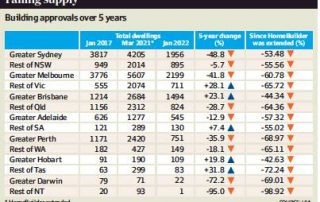
However, the pipeline of new homes in the regions had already fallen sharply since the HomeBuilder grant, which offered a $25,000 subsidy for first home buyers to build their home, was extended in March last year.

Housing Industry Australia data found that total dwelling approvals fell by 55.6 per cent in regional NSW; fell 65.7 per cent in regional Victoria and dropped 64.4 per cent in regional Queensland.

HIA executive director for industry policy Geordan Murray said: ‘‘What we saw throughout COVID was a very sharp change in housing preferences during the pandemic and a surge in demand for housing in regional areas.

‘‘The supply of housing takes a long time to respond to variations in demand.

‘‘While the regional housing markets are responding, they’ve never been in a position where they have had to respond to such a dramatic change in demand.’’

Kent Lardner, director of data analytics and consultancy company Suburbtrends, said the exodus from the city had placed immense pressure on the regions.

‘‘When you count total building approvals in the last 15 months for houses, this represents less than 1.5 per cent of total housing stock in most of these eligible markets,’’ Mr Lardner said.

‘‘Demand already exceeds supply here, which is keeping strong upwards pressure on prices. Any policy that amplifies demand will only push prices up further, given the current market conditions. I can’t see how this policy helps affordability.’’

Henderson Advocacy buyer’s agent Jack Henderson said the small number of available grants would have little impact in boosting supply in the regions.

‘‘There’s only 10,000 new housing expected to be built each year across the regions, that amount of supply will not be enough to satisfy the existing demand,’’ he said.

‘‘We have a huge deficit of regional housing, so I don’t think it will put a huge dent in the overall supply shortfall that we’re in right now.’’

The extra demand for new construction would also fuel further increases in building costs, said Marty Sadlier, director of MCG Quantity Surveyors.

‘‘It will drive higher building costs because of the current tight labour market and material shortage,’’ he said.

‘‘It’s very difficult to build in the regions at the moment, with many tradies having supply issues and heightened demand due to the floods in the east coast.

‘‘Materials will be funnelled to the most impacted areas; therefore the regions will see extended material lead times and severely increased material costs.’’

Deposit scheme ‘will make buying harder’2022-04-01T12:52:14+11:00