Property

House rents jump 20pc despite a rise in vacancies

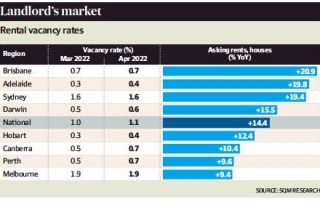
The squeeze on rental accommodation around the country eased slightly in April, with vacancy rates rising 0.1 percentage points to 1.1 per cent in the first increase since the start of the year.

But the improvement in vacancy rates has not made renting any easier for tenants, with asking rents climbing higher as demand continues to outpace supply, data from SQM Research shows.

Louis Christopher, managing director of SQM Research, said more property owners were responding to the tight rental market and leasing their properties again after taking them off the market during COVID-19.

Vacancy rates held steady at 1.6 per cent and 1.9 per cent in Sydney and Melbourne respectively, but they are still at their lowest levels in years. Brisbane’s vacancy rate of 0.7 per cent was the lowest on record.

Rental markets in Perth, Canberra, Adelaide, Hobart and Darwin posted up to 0.2 percentage point increases in vacancy rates during the month, but most are still at their tightest levels in decades.

Some of the tightest regional rental markets also eased slightly. Vacancy rates in the Blue Mountains, Hunter region and the Central Coast in NSW rose by 0.20 percentage points to 0.7 per cent, 0.8 per cent and 0.7 per cent respectively.

The Gold Coast also recorded a 0.2 percentage point rise in vacancy rate to 0.5 per cent. On the Sunshine Coast it was up by 0.1 percentage points to 0.6 per cent, and climbed by 0.5 percentage points to 2.1 per cent in Byron Bay.

‘‘While the small increase in vacancy rates means rental conditions have not deteriorated further, it is still very much a landlord’s market,’’ Mr Christopher said.

‘‘There are still far more would-be renters than landlords at this stage that’s why we’re still seeing rents continuing to rise strongly around the country.

‘‘Landlords are very confident at the moment in terms of lifting rents, and they’re getting that rise.’’

In the past 30 days, landlords nationwide have lifted their asking rents by another 1.4 per cent, after increasing by 2.4 per cent in the previous month.

Asking rents for Sydney houses jumped by 19.4 per cent over the year to May 12, and Melbourne climbed by 9.4 per cent. High rental demand for Brisbane houses triggered a 20.9 per cent rise in asking rent, 9.6 per cent increase in Perth, 19.8 per cent in Adelaide, 10.4 per cent in Canberra, 15.5 per cent in Darwin and 12.4 per cent in Hobart.

‘‘We’re not seeing any slowdown in the rise in rents, particularly across Sydney, Melbourne and Brisbane,’’ Mr Christopher said.

‘‘These three cities are recording some of the fastest increases in rents because of the imbalance between rental demand and supply. So, I think rents are going to continue to rise for the foreseeable future.’’

In Sydney’s eastern suburbs, asking rents jumped by 19.3 per cent over the year. They climbed by 11.5 per cent in the inner west, by 6.4 per cent on the northern beaches and by 13.3 per cent in the CBD.

In Melbourne’s inner east, asking rents rose by 9.4 per cent and were up by 11.3 per cent on the Mornington Peninsula.

Asking rents on the Gold Coast rose by 28.2 per cent and by 16.5 per cent in inner Brisbane.
House rents jump 20pc despite a rise in vacancies2022-05-20T15:49:42+10:00

Rising rents drive home buying

Rapidly rising rents could push some aspiring homeowners to pull the trigger on buying a home, despite higher mortgage rates and inflated house prices, experts say.

Many home buyers had been priced out of the housing market as the widespread boom triggered a 27.8 per cent rise in median dwelling values nationwide since the pandemic. But renting has also become unaffordable, and in many cases even more so than buying.

In more than one in four markets across the capital cities, paying a mortgage on an average home is cheaper compared with paying rent, analysis by CoreLogic shows.

A total of 274 suburbs are more favourable for buyers than renters, including 201 unit markets and 73 house markets.

Across 20 unit markets and one house market in Sydney, buying is cheaper than renting; in Melbourne, 20 apartment markets favour buyers more than renters.

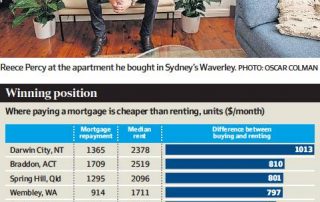
In western Sydney, buyers of median-priced units in Auburn are better off by $318 each month compared with renting, and they are ahead by $266 in Rosehill and by $254 in Mays Hill. It is cheaper to pay a mortgage than rent in Sydney’s inner suburbs Roseberry and Mascot, where buyers can save $203 and $190 on average each month, respectively.

The monthly mortgage repayments for units in Melbourne’s inner-city suburbs Carlton and Docklands are cheaper than renting by $533 and $422, respectively. In Perth, buyers in Wembley and West Leederville are better off by $797 and $785, respectively.

Darwin is the most favourable market for buyers – the monthly mortgage repayments on a median-priced unit are cheaper by $1013 compared with renting.

The calculation took into account the current median values and median weekly rental valuation, assuming the latest average mortgage rate from the RBA for new owner-occupier variable loans of 2.49 per cent with a 20 per cent deposit over 30 years. No other fees or transaction costs were considered.

‘‘It depends on the individual’s situation, but broadly speaking, it’s probably more challenging to rent, with rapidly rising rents in many parts of the country, increased competition for rents with holiday-makers and overseas arrivals,’’ said Eliza Owen, CoreLogic’s head of research.

‘‘And although interest rates are rising, they are still pretty low, and in some markets prices are starting to fall.

‘‘This could be a bit of a ‘sweet spot’ for first home buyers who have been saving up their deposit.

Sydney-based first-home buyer Reece Percy was among those who jumped the gun in the past few months.

‘‘I was tired of renting and paying the landlord’s mortgage, so I decided to buy a one-bedroom apartment in the eastern suburbs,’’ he said.

‘‘I looked over the long-term and realised I would be better off buying because I would be building my own asset base.

‘‘I much rather spend my money paying for an asset that will grow in value over time. I plan to hold it over the long term because I believe time in the market beats timing the market.’’

Jack Henderson, Sydney-based buyer’s agent with Henderson Advocacy, said the rising rents were a big factor motivating aspiring homeowners such as Mr Percy to take the plunge.

‘‘Housing costs are going up whether you’re renting or looking to buy, but for those who have saved the deposit, soaring rents could potentially push them to take the plunge and buy their home,’’ he said. ‘‘I think with rents continuing to rise, people may feel more comfortable spending that money on their own property than paying other people’s mortgage.’’

Rents nationwide have jumped by 2.7 per cent in the three months ended April – faster than the 1.9 per cent gain for house prices, data from CoreLogic shows. Over the year, the median dwelling rent climbed 9 per cent.

‘‘Rent rises probably do have a bit further to go,’’ Ms Owen said. ‘‘Upward pressure on rental values could persist amid higher wages growth, the return of overseas arrivals to Australia, and the lag at which rental supply responds to increases in demand.’’

Although surging rents might eat into savings and make it harder to get over the deposit hurdle, the cooling property prices triggered by rising interest rates make it a much easier time to buy, said Nerida Conisbee, Ray White chief economist.

Rising rents drive home buying2022-05-17T09:06:03+10:00

Sellers rattled as rate rise sparks house sales dive

Auction clearance rates fell sharply across most capital cities as the first interest rate rise in more than 11 years unnerved buyers who are worried about the impact of higher mortgage costs on their household budgets.

The slowing market also spooked vendors who have started to pull out in droves, data from CoreLogic shows.

A week after the RBA raised the official cash rate, Sydney’s preliminary auction clearance rate dropped by 3.6 percentage points to 58.7 per cent, the weakest result in two years.

In Melbourne, early results showed the clearance rate tumbled by 3.8 percentage points to 64.6 per cent, the lowest preliminary result since December.

Average preliminary results across all capital cities dropped 2.5 percentage points to 64.7 per cent, the lowest level this year.

‘‘The interest rate decision has put further pressure on the housing market, which was already slowing prior to the rate rise,’’ said Tim Lawless, CoreLogic’s research director.

‘‘Rising interest rates and high inflation are eroding household balance sheets, which is causing buyers to pull back.

‘‘The correlation between clearance rates and the pace of value growth is really strong, so the falling auction clearance rates portend declines in prices, particularly in Sydney and Melbourne.’’

SQM Research managing director Louis Christopher, said the rise in the cash rate and the prospect of further interest rate increases had turned sentiment towards the housing market negative.

‘‘Fewer buyers would enter the market as it becomes more difficult to qualify and service a big mortgage,’’ he said.

‘‘The overall hurdle rate to test home loan applicants will go up and disqualify an increasing number of would-be home buyers and investors, and this in large part is what is going to drag the market down for the rest of 2022 and perhaps beyond.’’

SQM Research is expecting Sydney house prices to decline by 7 per cent this year, Melbourne by 8 per cent and nationwide by 4 per cent.

As Sydney’s clearance rates continue to weaken, more vendors are withdrawing from the auction market, according to CoreLogic. The proportion of homes withdrawn this week has surged to 25 per cent, the highest level since April 2020, around the start of the pandemic.

‘‘We’re seeing more auctions being pulled from the market and not being rescheduled,’’ said Mr Lawless.

‘‘Since the middle of February, more vendors are shunning the auction market. People who have been looking to sell their home by auction are simply pulling out of the market as conditions start to deteriorate.’’

Sydney-based auctioneer Clarence White said it was becoming harder to get buyers to bid at auctions.

‘‘I’ve really noticed that when there are only a small number of bidders, like what we’re seeing now, people back away very quickly and they hesitate to bid,’’ he said. ‘‘Buyers’ confidence is very low at the moment.’’

Jack Henderson of Henderson Advocacy said vendors were also becoming nervous about selling.

‘‘There are a lot of anxious sellers in the marketplace and some are probably making irrational decisions around the price that they’ll take for a property,’’ he said.

‘‘For buyers, this opens up a great opportunity because this is the peak of the uncertainty for both vendors and other buyers, which means you can take advantage of people’s emotions as a buyer.’’

In contrast to the weaker auction results in Sydney and Melbourne, Adelaide posted an 81.2 per cent preliminary clearance rate, the highest across all capitals. Canberra cleared 75 per cent, while 62.7 per cent sold at auctions in Brisbane.

Among the sales in Brisbane was a five-bedroom house in Ashmore on the Gold Coast that sold for $3.65 million at auction.

Sellers rattled as rate rise sparks house sales dive2022-05-13T13:55:34+10:00

WHY INTEREST RATES WILL KEEP RISING

Stormy waters Everyone, from the Reserve Bank to economic commentators, has reached a consensus that Australia is in for a sustained period of increasing rates, writes John Kehoe.

The global inflation wave has washed on to Australia’s shores, right in the middle of the federal election.

The price pressures and looming interest rate rises have exposed that the Coalition and Labor do not have a serious economic plan to deal with inflation. Rather, the government is pouring another $5.6 billion of ‘‘cost of living’’ cash hand outs and tax refunds on to the inflation bonfire.

The election pork will add to inflation pressures that have been underestimated by both the Reserve Bank of Australia and Treasury. The RBA boldly declared at the start of the pandemic that inflation would not be sustainably high enough to lift the 0.1 per cent cash rate until at least 2024 and last December said the market should not expect rate rises in 2022.

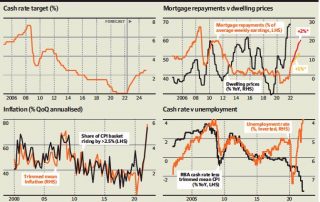
But times have changed. Inflation hit 5.1 per cent in the March quarter, the highest annual rate since the 10 per cent goods and services tax was introduced in 2000-01. Wholesale electricity prices have doubled over the past year and will soon begin flowing through to retail power prices, due to the soaring cost of coal and gas triggered by the war in Ukraine.

The government rightly points out much of the price pressures are due to international forces out of its control, including war driving up the global oil price and supply chain disruptions from the pandemic, particularly in the manufacturing hub of China.

Nevertheless, home-grown price pressures are also building due to strong demand from cashed up consumers and the economy running near full capacity, as evidenced by a firming in inflation of non-tradable items and services. Food, housing, transport and education prices are rising.

The RBA will soon begin raising interest rates, either next week or in early June, and keep raising the cash rate in the months ahead. It is a welcome development that the cash rate will finally be lifted from an emergency low of near-zero. The economy, with a low 4 per cent unemployment rate, has rebounded from the pandemic due to $314 billion of federal government stimulus.

To be sure, controlling inflation is predominantly the remit of the independent central bank. But despite economic management rhetoric from the government and cost of living complaints from Labor, neither side of politics is offering a comprehensive economic policy plan to contend with inflation and productivity.

Dan Andrews, a former Treasury, RBA and OECD official, says, ‘‘if the inflation tide has turned, then the imperative is to boost supply via productivity improvements’’.

‘‘The chickens are coming home to roost,’’ says Andrews who is now program director at the e61 Institute. ‘‘The supply side productivity agenda has been neglected for some time. Reforms matter now more than ever given that inflation typically arises from strong demand pushing up against supply constraints in the economy.’’

To lift chronically weak productivity growth of the past decade, economists nominate reforms to the tax system, boosting competition against incumbent firms to allow the growth of more innovative firms, improving energy and climate policy to lift investment, enhancing workplace relations and labour mobility, and better regulation to reduce red tape barriers. But these areas are largely off the table among a political class that believes voters are not up for a difficult national conversation.

There is also no plan from the Coalition or Labor to rein in structural budget deficits which will further fuel demand pressures in the economy if inflation persists more than previously thought. Barrenjoey chief economist Jo Masters says: ‘‘There is no real talk of any serious reform and everyone is small target on the economy.’’ She adds: ‘‘The inflation cycle makes it imperative to lift real wages through productivity-enhancing reforms.’’ And: ‘‘Economists are exhausted talking about it.’’

Labor’s economic plan this week pledged more spending on childcare, aged care, clean energy and to support pay rises for aged care workers, while unveiling a modest $5 billion in savings over four years on ‘‘waste and rorts’’. Shadow treasurer Jim Chalmers argues cheaper childcare will reduce family costs and inject more productive female workers into the workforce.

The Coalition is largely running on the economic performance during the pandemic, with little new policies. The 22.1c a litre petrol excise cut for six months, while politically understandable when prices were above $2 a litre, will only artificially and temporarily reduce inflation.

More than half of businesses have experienced cost increases over the past three months and a majority of firms passed price increases on to their customers, an Australian Bureau of Statistics survey reported this week. Coles chief executive Steve Cain says he is receiving price rise requests from suppliers. Moreover, the two-year closure of the international border and broader pandemic concerns have reduced the flow of labour around the world. Unions and workers are starting to demand larger pay rises, to catch up to inflation. Outlook Economics director Peter Downes says the low 4 per cent unemployment rate is starting to generate wage pressures, a factor the RBA would be picking up in its business liaison.

RBA governor Philip Lowe in early April signalled he would like to see both inflation and wages rising before lifting the 0.1 per cent cash rate. The next wage price index print is due on May 18 and average earnings data in the national accounts on June 1.

If Lowe holds true to his public statements about the bank’s ‘‘reaction function’’ being wages, then a pre-election rate rise is not on, and the RBA would wait until June. Treasurer Josh Frydenberg publicly reminded the RBA of this framework this week – a move Chalmers said undermined the independence of the central bank.

But the big 5.1 per cent jump in annual inflation and 3.7 per cent rise in underlying inflation will force the RBA to consider moving the first rate increase forward to next week. A gentle 0.15 of a percentage point rise to 0.25 per cent is a live option.

Outlook’s Downes says: ‘‘There is no point waiting any longer.’’ He adds: ‘‘Knowing what we know now, they should have started raising rates at the start of the year. The longer the RBA waits the higher they will have to raise rates later.’’

He says Australia can and should avoid repeating the ultra-high 8.5 per cent inflation rate of the United States ‘‘without having to raise rates too much’’.

Money market traders have priced in a 2.5 per cent cash rate by the end of the year, implying rate rises every month for the rest of the year.

Commonwealth Bank of Australia economist Gareth Aird argues high household debt levels will limit RBA increases to about 1 per cent by December.

The Morrison government would obviously prefer the RBA wait until after the election to raise rates, while Labor would welcome a pre-election rate rise to drive home its cost of living pitch to voters.

But sensing the RBA might move next week, the government has warned that the economic uncertainties caused by inflation and rate rises mean now is not the time to risk handing the economy to an inexperienced Labor government.

Morrison also makes the point that it’s very different to when the RBA raised rates in the 2007 election campaign – a move that upset then prime minister John Howard and treasurer Peter Costello. Back then rates were already at 6.5 per cent and Howard had pledged to keep them low. .

Andrews recalls the RBA’s interest rate hiking cycle in 1994, when the RBA raised the cash rate from 4.75 per cent to 7.5 per cent in six months. Then, Australia was on the cusp of a productivity boom thanks to the internet revolution and economic reforms of the Hawke-Keating governments in the 1980s and 90s. Andrews says productivity was one of the factors why the RBA didn’t keep hiking rates beyond 1994.

‘‘That expanded the speed limit of the economy and inflation was brought under control,’’ he says. ‘‘We’re in a very different place right now because we haven’t done substantive structural reform.’’

WHY INTEREST RATES WILL KEEP RISING2022-05-03T09:42:36+10:00

Low demand to eat into house prices

Lower demand for housing as a result of higher interest rates and tighter lending is more likely to trigger faster and deeper price falls than any widespread mortgage defaults caused by the rising cost of credit, experts say.

‘‘An increase in the official cash rate would reduce demand for new mortgages and therefore property prices,’’ Eliza Owen, CoreLogic’s head of research, said.

‘‘Higher mortgage rates might put some people off purchasing while prices are still quite high, so prices are more likely to come down off the back of successive increases in the cash rate.’’

Some economists are forecasting interest rates to rise by 1 percentage point by the end of the year and by another percentage point next year, with the first increase tipped to come as early as Tuesday.

A calculation by comparison site Rate City shows that a 1 percentage point rise in the cash rate would slash borrowing capacity for someone earning $100,000 a year by $75,600 and a couple earning a combined salary of $150,000 by $111,100. A 2 percentage point lift would limit a single borrower by $139,700 and would cut a couple’s mortgage amount by $205,400.

‘‘Anyone borrowing at capacity will see their budget shrink, which could be enough to cool things down, particularly in property hotspots such as Sydney and Melbourne,’’ Sally Tindall, RateCity research director, said.

‘‘Rising interest rates will significantly decrease how much the bank will let people borrow. This will have a flow-on effect on property prices, as many prospective buyers will no longer be able to bid as high.’’

SQM Research managing director Louis Christopher said rising mortgage rates and higher assessment rates could knock potential buyers from the market.

‘‘Buyers tend to stay away from the housing market when rates are rising, but more people are going to be rejected by the banks because they haven’t met the higher servicing test,’’ he said. ‘‘Fewer buyers will definitely qualify for a loan if interest rates rise by 2 per cent.’’

Rough estimates by AMP Capital suggest that a 1.5 percentage point to 2 percentage point rise in mortgage rates would reduce home buyer borrowing power and the ability to pay for a house by 10 to 15 per cent. ‘‘Demand for housing is going to be affected immensely, simply because people won’t be able to borrow as much as they did in the past,’’ Shane Oliver, AMP Capital chief economist, said.

‘‘This will have a greater negative impact on prices than defaults by existing mortgage holders because many households are already ahead of their repayments and still pay lower interest rates than new borrowers.’’

Maree Kilroy, senior economist with BIS Oxford Economist, said the buildup in household savings and strong economy would reduce the risk of homeowners defaulting on their loans.

‘‘The risk of homeowners defaulting, which would cause prices to fall more than expected, will likely be mitigated by a strong jobs market,’’ she said.

‘‘We expect the unemployment rate forecast to hold below 4 per cent and almost two-thirds of owner-occupiers have increased their mortgage payment buffers since the onset of the pandemic.’’

Low demand to eat into house prices2022-05-03T09:39:38+10:00

Rate rises threaten property funds’ stellar results

Tipping point The double-digit growth in unlisted real estate funds thanks to cheap money could be coming to an end, particularly for newer releases, writes Duncan Hughes.

Unlisted property funds have blitzed other asset classes to generate returns of more than 20 per cent over one and five years by using record low interest rates to invest in retail, commercial and industrial properties.

But some analysts are concerned that accelerating performance with high levels of gearing could create problems for recently launched funds, with tight lending conditions if interest rates begin to rapidly rise.

Unlisted property funds generated returns of almost 22 per cent in the year ended December 31 (the most recent analysis) compared to about 20 per cent for real estate investment trusts (REITs) investing in local property listed on the Australian Stock Exchange and about 18 per cent for shares.

‘‘The period of turbo-charged growth fuelled by cheap money will end as interest rates rise,’’ warns Dugald Higgins, head of responsible investment and real assets at Zenith Investment Partners.

Kevin Prosser, research manager of direct assets at Lonsec, an investment and ratings group, says overall gearing is ‘‘reasonable’’ at 40 per cent to 45 per cent of assets under management.

A high gearing ratio means a trust has a larger proportion of debt compared to equity. A low gearing ratio means the trust has a small proportion of debt versus equity.

Prosser says managers are aware of the potential impact and many have hedged against the risk for up to three years, fixed rates with their lenders or are reviewing potentially vulnerable variable costs.

Potential problems are likely to come from recently launched funds involved in construction projects that might not have hedged their borrowing and are facing rising costs, or disruptions, because of shortages in the building sector, say analysts.

There are estimated to be about 600 unlisted property funds with assets totalling about $20 billion, says Zenith’s Dan Cave, a senior investment analyst.

At least 30 funds are estimated to have been launched in the past 18 months with assets totalling about $3 billion. These include about 12 office funds, five retail and four industrial funds with the remainder a mixture of sectors.

Listed property trusts and unlisted funds are similar to the extent that investors contribute capital for a share of the assets either in shares (for listed) or units (unlisted).

Investors receive income (called distributions) and, if asset values increase, a capital gain on their original investment from either the rising share price (for listed) or the sale of the asset (for unlisted).

Listed funds typically yield 3-6 per cent and unlisted about 6-8 per cent. The premium is because there is little or no liquidity.

Property Funds Association analysis shows that unlisted funds rebounded from the pandemic, helped by low rates, economic growth and a recovery in corporate earnings.

Performance was underpinned by buoyant rental income that was boosted by recovering rental incomes for assets that had been affected by the COVID-19 lockdown.

Surging property prices for industrial and logistical property, particularly warehouses, more than doubled total returns to about 30 per cent.

Prime industrial rents are expected to increase about 11 per cent this year (more than double the growth in 2021) and to keep rising at double-digit rates over the next three years as the e-commerce boom drives up demand for warehouse space, analysis by CBRE and JLL shows.

Total returns for offices nearly doubled to more than 9 per cent as employees returned to work as lockdowns eased.

Retail, which slumped by more than 10 per cent in the pandemic, bounced back to post 6 per cent growth.

Strong price growth means capitalisation rates (a key measure for investors calculated by dividing net operating income by property value) are at historic lows for most markets.

Investment adviser Alex Jamieson, founder of AJ Financial Planning, says investors need to consider the impact of rising interest rates, particularly for aggressively geared funds involved in building projects under pressure from sharply rising costs.

Interest rate increases are likely to be rolled out over the next year or two and for many funds the impact could be offset by earnings recovery as the economy strengthens, according to analysts.

For example, higher wages might be inflationary but could boost demand for retail assets as retail spending among low and middle income earners increases.

But Zenith’s Higgins says: ‘‘There are many funds we feel that are high-risk propositions when considering that we are probably coming out of a high-growth environment and entering a period where the easy gains from rising markets will be harder to come by.’’

Higgins believes many smaller operators are underestimating the challenges and costs involved in achieving the higher benchmarks for sustainability required by tenants and potential future buyers.

‘‘We are essentially at a point where any company or fund that cannot demonstrate deep environmental, social and governance credentials, which naturally spans a wide range of sustainability and social issues, will simply be ‘uninvestable’ to institutional investors,’’ he says.

‘‘We know from experience that many businesses with less in the way of resources to devote to these disciplines are increasingly at greater risk of being stranded by capital markets that are demanding greater transparency on how these issues are addressed.

‘‘These views are likely to increasingly flow down to retail investors as scrutiny on these

Rate rises threaten property funds’ stellar results2022-04-29T13:28:50+10:00

Premium suburbs lead price growth

House prices in some suburbs on Sydney’s northern beaches and the Gold Coast have doubled every three to four years in the past decade, fuelled by low levels of stock and a growing number of affluent buyers, data from Suburbtrends shows.

The more expensive housing markets with the median price above $2 million also outperformed, gaining 13.3 per cent each year on average in the past 10 years. This is more than twice the capital growth of 4.8 per cent posted by the affordable end of the market with a median price under $500,000.

‘‘The premium end of the market performed strongly in the past decade, driven by scarcity, being located near the beach or the harbour,’’ said Kent Lardner, director of Suburbtrends.

‘‘Housing inventory levels in these suburbs remained very low, especially in recent years. The increasing levels of wealth and low interest rates have also created near perfect conditions.’’

The number of ultra-rich Australians with net worth of $US30 million ($40 million) or more surged by 124 per cent over the past five years, and they allocated nearly a third of their wealth to their homes or second dwellings last year, according to estate agency Knight Frank.

House prices in suburbs within the Manly area such as Balgowlah, Balgowlah Heights, Clontarf, Fairlight, Manly and Seaforth surged by 21 per cent each year on average during the past decade – essentially doubling every three years and five months.

House values in the Broadbeach area on the Gold Coast have also doubled within four years, after surging 19 per cent each year on average in the past decade.

House prices in Broadbeach Waters, Burleigh Heads, Burleigh Waters, Mermaid Beach, Miami and Broadbeach jumped by 42 per cent to $1.6 million in the past year.

‘‘Many of the commutable coastal locations boomed in the past 10 years, and in the case of those near Sydney, we did see the ripple effect shifting demand from the eastern suburbs, spreading over to the north shore and up to the Central Coast,’’ Mr Lardner said.

‘‘It is normal to see price gaps start to close between markets when this happens, but the premium markets kept on growing at phenomenal rates as well.’’

A separate analysis by CoreLogic found the top-performing market segments were generally skewed towards houses over units.

‘‘The stronger long-term performance for houses is a trend we have seen historically and is likely a reflection of the underlying land value being driven higher by scarcity factors,’’ said Tim Lawless, CoreLogic’s research director.

‘‘House values will probably continue to appreciate faster than unit values due to the scarcity of supply and what is likely to be persistently strong demand for lower density housing options.’’

Hobart outperformed other cities, with dwelling values surging 101.8 per cent across the greater capital city region over the 10 years to March. Sydney was the only city to record a higher 10-year growth rate, with housing values increasing by 109.5 per cent, according to CoreLogic.

Perth and Darwin were the weakest housing markets over the past decade, as values moved through a long-running downturn, Mr Lawless said.

But Mr Lardner said worsening affordability and higher interest rates could slash capital growth by more than half in the next 10 years as buyers grapple with bigger household debt and lower borrowing capacity.

‘‘Australia’s property market bull run may end this year as the two decades of falling interest rates are about to end,’’ he said.

Shane Oliver, AMP Capital chief economist, said falling demand due to lower immigration could also weigh on house price growth in the coming decade.

While immigration was starting to pick up, he said, ‘‘it may not get back to the highs we saw pre-pandemic, so the underlying level of demand for housing may not be as strong as it has been’’.

Premium suburbs lead price growth2022-04-26T12:08:11+10:00

Investors return as rents soar up to 20pc

Rebound Vacancies below 1 per cent and strong demand is driving renewed interest, writes Duncan Hughes.

Residential rents rising as fast as property prices are attracting investors seeking higher yields, a hedge against inflation and generous depreciation and tax breaks. House rents in some of Australia’s capital cities have risen between 15 and 20 per cent during the past 12 months as supply fails to keep pace with a sharp rise in demand, particularly in higher-density, regional capitals.

‘‘This will attract more investors into the market,’’ says Louis Christopher, chief executive of SQM Research, which monitors property markets.

Investor borrowing, which was running out of steam in February after increasing around 116 per cent in the 12 months to last May 31, is expected to rebound even more strongly as competition grows, says buyers’ advocate Cate Bakos.

Andrew Wilson, chief economist for My Housing Market, a property consultancy, says stock surpluses are being rapidly absorbed around inner-city Melbourne, Sydney, and Brisbane.

‘‘Investor interest is accelerating because of capital growth, rising yields and high demand,’’ says Wilson.

According to SQM analysis, national residential property vacancies are about 1 per cent, the lowest in 17 years and half the amount for the same time last year.

Vacancy rates in Sydney and Melbourne are 1.6 per cent and 1.9 per cent respectively, while in Brisbane, Adelaide, Canberra, Darwin, and Hobart they have fallen below 1 per cent, its analysis shows.

Rents for apartments in Sydney’s central business district have jumped 5.5 per cent in the past 30 days. In Melbourne, rents are up more than 7 per cent in the same period.

In some areas surrounding regional and state capitals, there are no rental properties available. Rosalie Day, managing director of Bell Real Estate, which covers three postcodes around Gembrook, some 65 kilometres south-west of Melbourne, says: ‘‘There are no rentals. If we put anything up for rent, it goes straight away.’’

Day blames restrictive local council regulations, high state government taxes and rising property prices, which have encouraged many landlords to sell.

Many landlords also decided to sell because of issues caused by a freeze on rental increases and tenant evictions during the COVID-19 lockdown.

SQM’s Christopher adds: ‘‘What is happening is unprecedented. A shortage of properties is causing market rents to explode’’. He expects rental prices this year to increase faster than house prices.

In 2021 national house prices rose about 22 per cent, the biggest increase since 1989, says Shane Oliver, chief economist for AMP Capital. This stemmed from record low mortgage rates, home buyer incentives, the pandemic driving a switch to housing, a lack of supply, and fear of missing out.

Demand for rental homes is this year expected to increase because of the strengthening economy, easing of COVID-19 restrictions, and the return of high levels of migration and students, says analysis by the National Housing Finance and Investment Corporation, a government think tank that monitors housing demand, supply, and affordability.

Adding to the pressure in NSW and Queensland is homelessness caused by flooding.

Buyers’ agent Bakos says it’s unusual for investors to enjoy both rising income and capital gains. She adds: ‘‘Many investors turn to bricks and mortar if nervous about the stock market or global outlook.“

Confidence is also boosted by the absence of any federal election policies that might lead to a cutback on generous negative gearing concessions or depreciation allowances.

Property is also an effective hedge against inflation, according to Cushman & Wakefield, a global commercial real estate company. Its analysis shows every 1 per cent increase in inflation is associated with a 1.1 per cent increase in total property returns (capital growth and income).

Investors account for about one-third of mortgages, an increase of about seven percentage points over recent months but below the decade average level of 35 per cent, says CoreLogic, which monitors property markets.

Lenders are easing tough borrowing terms for investors, say mortgage brokers.

‘‘They are lowering interest rates and improving terms, such as allowing more rental income to be included in the loan eligibility assessment,’’ adds Phoebe Blamey, director of Clover Financial Solutions, a mortgage broker.

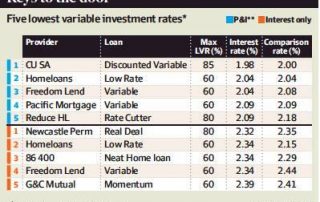
The accompanying tables from Canstar, which monitors rates, shows the cheapest deals for investors seeking principal-and-interest or interest-only loans.

These rates are typically about 130 basis points lower than average loans on offer.

‘‘This highlights the importance of shopping around for the best deal,’’ says Belinda Williamson, Canstar group manager.

Average investor loan sizes increased to more than $556,000 from about $477,000 in the 12 months ended February 28, says Tim Lawless, CoreLogic’s research director.

‘‘Investor lending growth is biggest in areas where housing prices are generally lower than Sydney and Melbourne,’’ Lawless says. These include south-east Queensland, inner-city Brisbane and Adelaide. AFR

Investors return as rents soar up to 20pc2022-04-26T12:07:15+10:00

Tax Office property win puts foreign investors on notice

Foreign investors who fail to report their investments in Australian assets have been put on notice by the Australian Taxation Office and face significant cash fines after a landmark legal win in which the judge said his intention was to ‘‘wipe out’’ the profits of a serial property buyer.

Between July 2016 and April 2018, Vijay Balasubramaniyan spent more than $1.4 million on three residential properties and a block of residential land in Melbourne’s west.

Justice Barry Beach agreed with the ATO that Mr Balasubramaniyan, who had a temporary visa, breached foreign investor rules six times – four times for the purchases, which occurred without permission, and also for owning two established properties.

Justice Beach, following the first prosecution of such a case, ordered penalties of $250,000, broken down into four $30,000 penalties and two $65,000 penalties. The amount was well above the $162,839 that Mr Balasubramaniyan argued was his net gain.

‘‘The judgment provides a strong base from which we will progress our penalty litigation work as part of the ATO’s overall compliance approach,’’ ATO assistant commissioner Keir Cornish told The Australian Financial Review.

The judgment sets a precedent for how the law treats foreign investors in Australia who do not alert authorities to their acquisition. It is the first such ruling since the Foreign Investment Review Board Act was rewritten in 2015 to introduce civil penalties.

Previously, penalties for international residents acquiring Australian assets without alerting authorities were largely a slap on the wrist. They were forced to divest but could keep any profits gained.

In the three years to June 30, 2020, there were more than 1100 penalty notices for contraventions of the FIRB Act in residential property alone.

‘‘This serves as a clear deterrent to other foreign investors who believe they can operate outside of the law,’’ Mr Cornish said.

‘‘The ATO promotes voluntary compliance of the rules by foreign persons, but where foreign investors resist compliance action, stronger enforcement action is taken.’’

In his judgment, Justice Beach said Mr Balasubramaniyan had made gross capital gains of $710,300.

‘‘This is a significant fact for penalty purposes. General deterrence will only be achieved by a penalty that puts a price on any contravention sufficient to deter others who might be tempted to contravene the Act,’’ he said.

The ATO argued the net gain was $425,000. Justice Beach accepted some of the ATO’s calculations, but cut the number further.

‘‘I do not propose to linger on the arithmetic, save to say that I am satisfied that a figure of around $250,000 represents no less than the respondent’s net gain,’’ Justice Beach said in his judgment.

‘‘I propose to wipe this out by the total penalty that I will impose . . . Indeed, the sum of $250,000 is considerably more than the respondent’s own calculation of the net gain.’’

Lachlan Molesworth, a barrister and specialist in taxation and foreign investment, who represented Mr Balasubramaniyan, said he expected it to become routine for the Commonwealth to seek penalties for people who breach the act.

‘‘There is no doubt this will very much embolden the regulator, and I think it will send a clear message that if you hold assets in Australia without relevant federal clearances, those assets are very much at risk,’’ Mr Molesworth said.

‘‘The Commonwealth were probably waiting for a clear-cut case. The next frontier may well be into other assets classes, commercial investments where there have not been contraventions, and there will be a new level of confidence, we know what considerations will apply.’’

Tax Office property win puts foreign investors on notice2022-04-26T11:49:35+10:00

The rental crisis is just beginning

‘‘There’s a perception that rents are high now,’’ one of the country’s most highly regarded bankers tells me. ‘‘But rents are going to go through the roof once investors start to recognise that there won’t be significant capital gains from now on.’’

This is unequivocally bad news for renters. They had been hoping that the sharp run-up in housing rents – which are on track to climb by at least 10 per cent nationally this year – might start to abate as the boom in house prices finally shows signs of tapering off.

Instead, it appears that we are at the beginning of a period of significant rental stress, as surging demand and a lack of rental stock have sent vacancy rates plummeting to a 16-year low.

Even worse, vacancy rates are expected to tighten further with the reopening of the international border and the resumption in migration and the return of foreign students.

But, the banker explains, there are financial factors at play which will also put upward pressure on rents.

‘‘If you own an apartment, by the time you’ve paid strata levies, repairs and taxes, the returns are pretty meagre,’’ he says.

Until now, investors have put up with that because rising property prices have meant they have enjoyed strong capital gains. So, overall, it’s still worked out to be quite a good investment.’’

But, he warns, this dynamic will change as rising interest rates cause home prices to stabilise – or even decline.

(In its latest Financial Stability Review, the Reserve Bank warned house prices could fall by about 15 per cent over a two-year period if interest rates were to rise by 2 percentage points.)

‘‘If there’s no prospect of significant capital gains, investors will have to try to increase their returns through higher rents’’, he explains.

‘‘And you can see that already. Rents are already going up.’’

What’s more, although lending to property investors nudged up by 3.9 per cent in the 12 months to February 2022, he points out that many property investors have been offloading their apartments.

‘‘This is partly because investors have been taking advantage of high prices to sell, and partly a response to the eviction restrictions that were imposed during the pandemic, which made some investors decided that owning rental property wasn’t such a great deal any more,’’ he says.

‘‘And for others, it’s a desire to reduce their gearing because they’re apprehensive about rising interest rates.’’

Of course, rents are also soaring offshore.

In the United States, for instance, average monthly rents jumped more than 14 per cent in the year to December. In many major cities, including Austin, Texas and Miami, rents increased by more than 30 per cent.

As in Australia, the surge in US rents reflects a number of factors, including a shortage of housing inventory.

At the same time, many people who moved back with family in the early days of the pandemic are now flooding back into the rental market, boosting demand, and making it easier for landlords to increase rents.

In addition, after central banks slashed interest rates close to zero to soften the impact of the pandemic, many people decided to take advantage of ultra-low home loan rates to buy houses. As house prices surged, many people have been pushed out of the buyer market and into the rental market.

Landlords, meanwhile, are looking to claw back the drop in income they sustained during the pandemic when they offered discounted rents to entice new tenants, or when existing tenants missed rental payments.

Of course, people on lower incomes – such as hospitality and retail workers – are those hardest hit by soaring rents, which are rising much faster than their wages.

As the Reserve Bank noted in its April Financial Stability Review, ‘‘historically, renters have been more likely to experience financial stress than indebted owner-occupiers’’.

The RBA added that ‘‘although renters are unlikely to pose direct risks to the stability of the financial system (as they have less debt), financial stress for renters could translate to repayment difficulties for indebted landlords or pose indirect risks by constraining household consumption and so economic activity’’.

Of course, the surge in rents is already sparking calls for increased controls that would limit annual rental increases.

Rent controls have existed in New York since 1943, when the US government legislated a rent freeze in the city to fight wartime housing inflation.

Just under half of rental units in New York City are subject to rent stabilisation rules, which set the maximum rent increases, based on real estate costs and the cost of living.

But more US cities are now introducing rent controls.

Last October, local officials in Santa Ana, California, went further than the state’s rent controls which limit annual rent increases to 5 per cent plus local inflation. They decided to restrict rent increases in the City to 3 per cent for apartments built before 1995.

And in November, Minneapolis voters gave the green light to introducing the country’s most stringent rent control policies, which sets a 3 per cent cap on annual rent increases. What’s more, the controls also apply to newly constructed buildings.

Meanwhile, lawmakers in Miami and Tampa – where rents have climbed more than 30 per cent over the past year – have discussed declaring housing emergencies to introduce rent controls.

Landlords and the real estate industry are pushing back against rent controls. They argue that they discourage new apartment construction, which further chokes off the supply of rental accommodation.

And while such controls benefit people who have rental accommodation and don’t want to move, they act as a major disincentive for people to convert their properties into rental accommodation.

This makes it extremely difficult for new renters to find accommodation.

The other disadvantage is that rental controls discourage landlords from spending money on the upkeep of their apartments, which disadvantages renters.

Of course, it’s highly unlikely that Australian politicians would even contemplate riling mum and dad property investors by introducing rental controls, but rising rents will undoubtedly fuel social discontent, and increase the pressure on lower-paid workers to secure larger wage rises

The rental crisis is just beginning2022-04-26T11:47:13+10:00