Property

Record number of borrowers at risk of mortgage stress, report says

Borrowers in Western Australia are 20 per cent more likely to fall behind on their mortgages, according to S&P Global Ratings, which found home loan arrears rose in the December quarter and are likely to worsen.

While overall major bank arrears remain low – averaging 0.91 per cent of loans across the economy – the Reserve Bank’s 13 interest rate increases and its 4.35 per cent cash rate are starting to bite. Roy Morgan, in a separate report yesterday, found a record high 1.6 million people, or 31 per cent of borrowers, are at risk of mortgage stress.

‘‘The last leg of this tightening cycle could prove to be the most challenging, as savings are depleted, unemployment rises, and higher interest rates continue,’’ S&P Global Ratings said.

‘‘Financial prudence might no longer be enough for some households, leading to further increases in arrears in the months ahead.’’

At its interim results this month, Commonwealth Bank said it was supporting more than 7000 home loan customers in formal ‘‘hardship’’, including providing options to suspend mortgage repayments or to move to interest-only repayments.

That came as CEO Matt Comyn indicated that the first official rate cuts might not materialise until next year.

Borrowers who are not making repayments appear to be staying in their homes for longer than in past economic cycles, as banks seek to minimise the scrutiny that comes with calling in their loans, says Field Research director Stewart Oldfield.

In the biggest markets of NSW and Victoria, mortgage arrears are stable. In NSW, the proportion of borrowers more than 30 days late on repayments was 0.96 per cent in December from 0.94 per cent in July 2023 and 1.01 per cent in November.

But in WA, more borrowers are behind: 1.19 per cent are more than a month overdue, although this had improved from 1.50 per cent in July last year. The best performing state is Tasmania, at 0.48 per cent.

CBA this month said official rate rises were being unevenly felt, as savings were depleted faster for younger borrowers. Savings of customers aged between 25 and 34 were down 2.4 per cent year-on-year and for the 35 to 44 band, savings were 2.1 per cent lower. They rose for over 65s by 6.5 per cent.

Roy Morgan said the number of mortgage holders considered ‘‘at risk’’ of mortgage stress had surged to a record on the back of the Melbourne Cup Day rate rise in November. The 1.6 million at risk – defined as borrowers who allocate between 25 per cent and 45 per cent of their after-tax income to repayments – has increased by 802,000 since May 2022, when the RBA began tightening.

If the central bank raises rates by a further 0.25 percentage points next month, this will push a further 16,000 borrowers into the risky category, the group estimates.

The number of mortgage holders considered ‘‘extremely’’ at risk – allocating more than 45 per cent of their income – is now almost 1 million, or 19.8 per cent of borrowers. The average over the past decade is 14.3 per cent.

NABank last week said its quarterly cash earnings had dived by 16.9 per cent amid an economic slowdown, reflected in rising mortgage arrears and a $193 million impairment charge.
Record number of borrowers at risk of mortgage stress, report says2024-02-29T16:40:12+11:00

Suburbs where house prices fell $200k in three months

House prices in some of the country’s most desirable suburbs have slumped by as much as $207,000 in just three months, dragged down by the ongoing weakness in the upper end of the housing market, data from CoreLogic shows.

By contrast, house values in some of the middle-priced suburbs and those with low stock levels jumped by up to $315,000 over the same period.

CoreLogic research director Tim Lawless said the upper end of the housing markets in Sydney and Melbourne continued to weaken, while the middle to lower end stayed relatively resilient.

Over the past three months to January, the top 25 per cent of Sydney’s housing market by value has dropped by 0.2 per cent, extending its 0.1 per cent fall in the previous three months.

In comparison, the middle segment of the market posted a gain of 0.6 per cent, while the lower quartile rose by 0.2 per cent.

Similarly, in Melbourne, the upper end led the decline, with values falling by 0.5 per cent, while the lower end dipped by 0.4 per cent.

Mr Lawless said the more affordable end of the housing market could see faster growth once interest rates started falling.

‘‘Lower interest rates will have a broad-based benefit as it lifts borrowing capacity for everybody, so in that sense, it floats the entire housing market rather than just one individual area,’’ he said.

‘‘But I think we could see a more pronounced impact in some of those markets where households are more sensitive to interest rates, such as the middle to lower end of the marketplace.

‘‘We could see a real pickup in first home buyers taking advantage of the lower rates alongside a lot of the concessions or incentives that exist in the marketplace as well. I think a lot of people will also be trying to take advantage of the Sydney and Melbourne markets where prices have dropped below their recent record highs.’’

Sydney’s northern suburbs and upper north posted some of the largest declines in house values in the past three months.

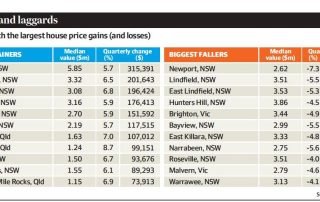
Houses in Newport on the northern beaches tumbled by 7.3 per cent in value, slashing $207,474 from the median to $2.62 million. Narrabeen, Bayview and Bilgola Plateau also lost more than 5.3 per cent, or around $154,000. Lindfield, East Lindfield and East Killara on the upper north shore also recorded sharp quarterly declines in house values, falling by 5.5 per cent, 5.3 per cent and 4.8 per cent respectively. Their medians are now lower by around $176,000 on average.

In Melbourne, house prices across Brighton, Caulfield North, Malvern and Caulfield fell by at least 4 per cent, shedding up to $178,000 in median house value.

House prices in Brisbane’s inner-city suburbs Teneriffe, Alderley and Wooloowin fell by 1.8 per cent on average or up to a $61,900 drop in their median values.

By contrast, house values in some middle-priced and tightly held suburbs bucked the slowdown and posted healthy gains in the past three months.

In Sydney, Haberfield in the inner west clocked the largest increase of 6.8 per cent or a nearly $200,000 lift in the median to $3.08 million. Neutral Bay and Mosman on the lower north shore also notched up sharp quarterly increases of 6.5 per cent and 5.7 per cent respectively, adding $201,643 and $315,391, to their median house price respectively.

Sydney-based real estate agent Thomas McGlynn of BresicWhitney said buyers had become price conscious in the past three months.

‘‘We saw a real flight to value, that’s why we’re seeing good growth in some pockets of the inner west, where houses are still priced lower than their premium counterparts,’’ he said.

‘‘Some expensive suburbs such as Mosman simply have no stock, so buyers have to compete fiercely when a property comes on the market, pushing prices even higher.’’

In the regions, the towns where house prices plummeted the most in the past year have bounced back strongly in the past three months, according to CoreLogic. Richmond-Tweed towns Lismore Heights, North Lismore and Lismore logged at least 8 per cent house price gains.

House prices in Mortlake in regional Victoria and Leyburn in regional Queensland increased by 6.2 per cent and 8.1 per cent respectively.

‘‘The lift in house prices in those regions could be a sign that more buyers are taking advantage of the fact some of these areas have become a bit more affordable after their recent price declines,’’ Mr Lawless said.

Suburbs where house prices fell $200k in three months2024-02-05T15:33:24+11:00

This is why Asian students choose our universities

International students The sector has rebounded to pre-2020 levels, with flexibility of course content key to attracting visitors, writes Michael Smith in Tokyo.

Janine Wan was still in high school when she decided to move from Singapore to finish her education in Australia.

Wan, who is now 25, jokes about getting into trouble for asking too many questions; she wanted a higher education system that was less rigid where she could challenge her teachers.

‘‘I was always getting into trouble at school in Singapore because I am the type of person who likes asking a billion questions. The Singapore system can be quite structured in that way, so it wasn’t best suited for me,’’ she says.

‘‘It was really refreshing moving to Australia and being able to ask those questions and feeling supported in that way.’’

The boom in international students has been a success story for the Australian university sector, making up 27 per cent of total revenue.

Despite the disruption from COVID-19, the numbers have now bounced back. International student numbers are now greater than they were in 2019, with 655,000 student visa holders as of July – 200,000 more than at the beginning of 2023.

The mix of students has also shifted. Chinese students, who accounted for one in every four new enrolments in 2019, have fallen by 37 per cent. Indian student enrolments, particularly in the vocational education sector, are up by the same amount.

Wan, who completed a law degree at Canberra’s Australian National University in 2019 and now works as a corporate lawyer for King & Wood Mallesons (KWM) in Singapore, had also heard Australian universities were more flexible than in other countries, and courses could be tailored to the individual.

This was important for Wan who had several potential career paths at the time and wanted to be able to pursue all her options. Before studying law, she initially wanted to be a biological anthropologist.

Wan moved to Melbourne to finish high school as a boarding student with the aim of eventually ending up at an Australian university. She completed years 10, 11 and 12 at Presbyterian Ladies’ College in Melbourne.

‘‘There were definitely challenges moving at that age, but I enjoyed it. I have always been independent,’’ she says.

Wan chose Australia over the United Kingdom not only because of its proximity to Singapore but also the flexibility of the education system, which allows high school students to take a university class. Wan completed two history courses at Melbourne University while still in school.

‘‘The reason why I considered moving to Australia for the education system was because I heard it was a lot more flexible and a lot more tailored to the individual with a focus on critical analysis.’’

After finishing year 12, Wan chose ANU because of its anthropology program and because she could do a law degree while studying other subjects as well. ANU ranks third overall in The Australian Financial Review’s Best Universities Ranking. ‘‘There was a lot of flexibility to explore your broader interests which is quite unique,’’ she says.

‘‘The prestige of ANU was definitely attractive. The approach is more intimate and the learning experience, I felt like I could get a lot of face time with the professors and really dig into what you were studying.’’

Wan made friends with students from all over the world at ANU and says the diversity was a major positive. ‘‘I have been lucky to be in very multicultural environments both in my Melbourne school and in Canberra. You get exposed to a lot of different experiences and opinions.’’

In the end, Wan chose law over anthropology and completed a four-year law degree at the end of 2019. She recalls the bushfires sweeping through Australia that summer and her sadness at leaving behind a close-knit group of friends in Canberra.

Asked if there were any negatives about her experience, she says the only issue was that international students looking to work in Australia after graduating could find it hard to secure a job.

‘‘The reality is it can be quite hard in certain industries looking for work in Australia as an international student. Some places don’t consider international students. That is something a lot of people struggle with,’’ she says.

Wan did not have any trouble finding work. She decided to move back to Singapore, partly for family but also for the huge opportunities working in Asia. She found a job with a big local law firm in Singapore and moved back in April 2020 just as COVID-19 hit.

She says some of her seniors at the firm told her Australian universities were considered inferior to those in the United Kingdom, but she saw no evidence of that when she was interviewing for jobs. Two years ago, she joined KWM where she is now an associate on the firm’s mergers and acquisitions team.

KWM already employed Australian graduates so she didn’t have a problem. ‘‘Singapore and Australia have put a lot of work into partnerships and university connections, I didn’t feel at all I was disadvantaged.’’

Employers in Asia say they like graduates from Australian universities despite some tough competition from institutions in the United States, the UK and Canada.

‘‘All four, including Australia, are still in the top bucket,’’ says Robert Quinlivan, who sits on the board of the Australian Chamber of Commerce in Hong Kong, and knows many of the city’s employers. ‘‘But there are some questions around the US because of safety/ guns etc. Canada has some visa benefits which are attractive for people post-grad.

‘‘Australia has the benefit of being close and [students from there] tend to be able to get jobs in Hong Kong.

‘‘I have three children at Australian universities at the moment, so my sense is that the overall proposition is pretty good.’’

While Australian universities compete with popular Hong Kong universities such as the University of Hong Kong and the Hong Kong University of Science and Technology, wealthier parents in mainland China prefer to send their children overseas.

A breakdown in China-Australia diplomatic relations in 2019 triggered a wave of negative stories about safety in Australia in the Chinese media, putting some parents off. However, Australia is back in favour with the Chinese government and media, although a slowing economy means parents have less money to send their children overseas.

This year’s unexpected spike in international student numbers has prompted backbench criticism of policies that make it easier for ‘‘lower quality’’ foreign university students to stay in the country and to work.

A report from the Grattan Institute in October, Graduates in Limbo: international student visa pathways after graduation, warned Australia offered international students more generous rights to stay and work after they graduated than other countries. It argued this gave them ‘‘false hope’’ to graduates who would never gain permanent residency, and threatened Australia’s reputation as a destination for tertiary study.

It said temporary graduate visa-holders in Australia would almost double to about 370,000 by 2030.

For Hong Kong-born Natalie Chan, the main attraction of studying in Australia was the multicultural atmosphere.

‘‘I liked the multiculturalism which creates a broader way of thinking, the friendly vibe of the university and the staff who were super supportive of foreign students, although this didn’t really make up for the pricey tuition fee,’’ says Chan, 30, who studied a master of communications at Melbourne’s RMIT university from 2018.

She liked an environment which she says allowed students to be creative and act like themselves compared to Hong Kong which was more constrained.

Now back in Hong Kong, Chan says the advantages of studying in Australia or other English-speaking countries is that employers like overseas graduates and their language skills.

She says RMIT has a good reputation in creative industries and offered opportunities to network with the local industry which helps students find jobs after graduating. AFR

This is why Asian students choose our universities2023-11-22T12:55:48+11:00

Population growth to drive housing demand

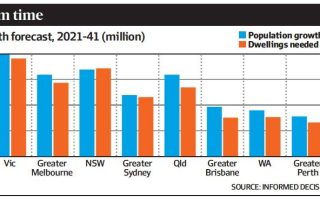
Housing demand is set to soar across the country’s four most-populous states over the next two decades fuelled by a predicted 7.4 million national spike in population, analysis by PEXA-owned Informed Decisions shows.

Victoria is poised to rack up the largest increase in population with 2 million people to be added by 2041.

NSW is set to rise by 1.7 million, Queensland by 1.6 million and WA by 904,000, spurred by strong migration.

Tim Lawless, CoreLogic research director, said housing markets in those states would benefit from the strong population growth, which could support price growth.

‘‘Population growth is a proxy for either rental or purchasing demand because all these people are going to need a roof over their head,’’ he said.

‘‘So it will provide a fundamental driver enhancing prices unless you see an appropriate supply response.’’

Australia’s population is expected to increase by 2 million people to 27.7 million by 2026.

It will increase to 31.3 million by 2036 and jump to 35 million by 2046, or about 420,000 people per annum.

Ivan Motley, founder of .id, a wholly owned subsidiary of PEXA, the ASX-listed e-conveyancing platform, said population growth was a key driver for housing supply.

‘‘People go where there is somewhere to live,’’ he said.

‘‘Clearly there’s a shortage of housing and the lack of affordability, so we need to increase supply to address that.

‘‘At the moment we’re not building enough dwellings to maintain stable vacancy rates and average household sizes.’’

Melbourne is forecast to add 1.6 million people during the same period, outpacing Sydney’s predicted population growth of 1.2 million.

Brisbane’s population is set to increase by 974,000 while Perth is expected to gain 979,000.

To meet the housing demand for those increases in population, an estimated 723,000 homes would be needed across Melbourne.

Sydney would need an additional 582000.

Across Brisbane, an extra 381,000 homes are required while Perth would need 334,000.

Melbourne’s west, south-east and the inner city are forecast to post the strongest population growth, with nearly a million people set to be added in the next two decades.

The combined population growth, which accounts for 46 per cent of Victoria’s overall population growth, will require 422,000 additional dwellings.

Within these regions, population growth is concentrated in certain suburbs such as Truganina, Mickleham and Cranbourne South.

Arjun Paliwal, head of research at InvestorKit, said Melbourne was ripe for solid house price growth in the medium-to-long term.

This was boosted by increased demand from strong population growth and its lacklustre performance in the past few years.

‘‘I think investors should position themselves in areas like Melbourne because having a lower period of price growth in a city that usually has a history of strong growth can actually be a good sign,’’ he said.

‘‘Prices have not grown much over the last few years, so they will start to look more attractive.

‘‘We’re also seeing rental growth really pick up, and it’s clear that the rental supply isn’t there, so cash flow will be more palatable.’’

In Sydney, suburbs in the southwest, Blacktown, Parramatta and the inner city are predicted to rack up the strongest population growth over the next 20 years.

An additional 572,000 people are poised to move into those areas which would require an additional 267,000 dwellings.

Meanwhile, the report predicts new housing supply could be built in River-stone, Penrith, Leppington, Campbell-town, Gilead, Parramatta and Sydney city during the same period.

Population growth to drive housing demand2023-10-26T16:47:58+11:00

House price rally not seen as sustainable

The recovery in property prices, led by surging population growth and a severe housing shortage, could prove short-lived if unemployment rises and the Reserve Bank keeps the cash rate high, economists warn.

House prices are up 6.3 per cent this year, according to data from property consultancy CoreLogic, rebounding after the fastest rate-rising cycle in three decades had initially cooled demand.

‘‘I am worried that the recovery in property prices is a false rally,’’ said Warren Hogan, economic adviser at Judo Bank. ‘‘The Australian housing market is yet to be stress-tested by a genuine slowdown in economic activity and softness in the labour market.’’

The Australian economy cooled to an annual pace of 2.1 per cent from 2.4 per cent in the June quarter.

Mr Hogan predicted that house prices would fall in 2024-25, but said the decline would be cushioned by population growth and the shortage of new dwellings. Building pipelines were near the lowest on record and almost one in three large home builders was struggling with rising wages and material costs, leading to a surge in insolvencies.

Exacerbating the housing shortage is a post-pandemic rebound in immigration. In May, the government’s budget forecast 1.24 million arrivals over the next four years.

Even so, Bob Cunneen, chief economist at MLC, doubts that this year’s rebound in property prices will last, and says the strong demand and constrained housing supply have overwhelmed the impact of higher interest rates and poor housing affordability this year.

The Reserve Bank has raised the cash rate 12 times since last year to 4.1 per cent and has indicated that it could increase this again to bring inflation back to its 2 per cent to 3 per cent target, from 5.9 per cent currently. Housing affordability is at record lows and Australian households are among the most indebted worldwide.

‘‘A more moderate pace of immigration next year and the lingering impact of higher mortgage rates should again weigh against house prices,’’ Mr Cunneen said. Migration is forecast to return to normal patterns from 2024-25.

Half of the 42 economists polled by The Australian Financial Review in a quarterly survey expect at least one more rate rise and financial markets agree, implying a one-in-two chance of another increase.

Stephen Anthony at Macroeconomics Advisory is also sceptical about the robustness of house prices.

‘‘It is more a reflection on the long and variable lags of monetary policy,’’ he said, noting that the government’s large increase in temporary visa holders had swelled the pool of demand for rental accommodation and soaked up the inventory of unsold housing stock.

Sean Langcake, head of macroeconomic forecasting at Oxford Economics Australia, also expects property prices to dip as more stock comes onto the market. ‘‘But we expect this to be a very modest downswing relative to recent cycles,’’ he said.

Jarden’s chief economist, Carlos Cacho, estimated that households had been hit by a 30 per cent reduction in borrowing capacity amid ‘‘the worst affordability on record’’.

‘‘The two key risks for the housing market are higher rates for longer and a material increase in supply,’’ he said. Many borrowers were optimistic that the RBA would start cutting rates sooner rather than later, he added.

Goldman Sachs expects the housing market to ‘‘materially soften’’ – reflecting additional tightening by the RBA. The bank’s chief economist in Australia, Andrew Boak, forecasts one more rate increase in November in response to sticky inflation.

AMP chief economist Shane Oliver also expects property prices to slip as a pick-up in unemployment leads to distressed sales. ‘‘A further rate hike and delay in rate cuts next year would add to this risk,’’ he said.

Some economists, including RBC Capital Markets’ Su-Lin Ong, are not as bearish but caution that the best of the property market rally has passed.

‘‘We do not expect the near 5 per cent gain of the last six months to be repeated in the next six months,’’ she said, highlighting a subdued housing outlook.

David Bassanese of Betashares echoed the view. ‘‘At best, prices seem likely to only level out rather than fall back all that much,’’ he said.

He noted that this year’s rally partly reflected the fear of missing out whereby investors ‘‘buy the dip’’ on expectations that the RBA is nearing the end of its tightening cycle.

David Robertson at Bendigo predicted that house prices were likely to be ‘‘much more modest’’ compared with the past decade, as core inflation would probably remain high.

House price rally not seen as sustainable2023-10-13T08:27:03+11:00

Number of recent buyers in loss-making sales triples

The proportion of pandemic-era home buyers bailing out within two years and selling for a loss more than tripled to 9.7 per cent in the June quarter from a year earlier, as mortgage stress worsened, CoreLogic’s latest Pain and Gain report shows.

With dwelling values still 4.6 per cent lower than they were before interest rates started rising, homeowners reselling within two years incurred a $30,000 loss on average, according to the data provider’s report.

More than 8000 homes resold in the June quarter were held for only two years or less, up from 7400 in the previous quarter.

‘‘We’re seeing more pain among people selling within two years, particularly if they’re selling in a market that has not fully recovered from the recent downturn,’’ said Eliza Owen, CoreLogic head of research.

‘‘The transaction costs around property are so high that you’d really have to be quite motivated to sell within a short timeframe and to sell for a loss.’’

The sales came at an uncertain time for Australia’s highly regional housing markets, as expectations of a pause in interest rate increases had pushed prices back up since March – reducing some of the losses suffered by forced sellers, Ms Owen said.

‘‘I think the rebound in values came at a very fortunate time for a lot of people that were transitioning from low fixed rates to a high variable rate in the event that they needed to sell,’’ she said.

Even so, the mounting economic pressures were leaving many people with no choice, Ms Owen said.

‘‘In the context of rapidly rising interest rates together with high cost-of-living pressures, the challenge of servicing a mortgage may be one such motivation,’’ she said.

Higher prices have already boosted profitability in home resales for the first time in a year. The portion of profit-making sales increased to 92.8 per cent in the June quarter, up from 92.4 per cent in the previous three months.

This could continue, Ms Owen said.

‘‘Property prices are continuing to rise, albeit at a softer rate than what we were seeing through April and May across the major capital city markets, so we could potentially see higher profitability when we do the September-quarter analysis.’’

Owner-occupiers comprised the bulk of the loss-making sales of homes held for up to two years at 72.1 per cent compared to 27.9 per cent by investors.

Houses made up 66 per cent of the short-term, loss-making resales, and 63.3 per cent were in the capital cities.

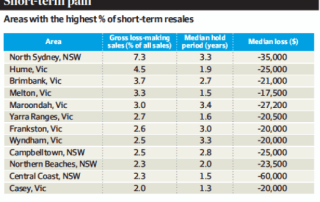
Northern Beaches, Campbelltown and Central Coast in Greater Sydney were among the areas posting a high portion of short-term loss-making sales. Vendors sustained up to a $60,000 loss on average.

Homeowners reselling within two years in Melbourne’s, Hume, Melton, Yarra Ranges and Casey incurred up to a $25,000 loss on average.

‘‘Two years is a significant time period because we are two years on from the height of pandemic-related lockdowns, low interest rates, and have just passed the peak of transitions from low fixed rates to high variable rates,’’ Ms Owen said.

Short-term resales also spiked in regional areas where the portion of homes resold within two years climbed to 11.1 per cent, a sharp increase from the 7.2 per cent decade average.

‘‘I think this speaks to the slight reversal in the popularity of regional Australia,’’ Ms Owen said.

Despite the increase in homes being sold within two years, most owners still hold their property for longer, according to a separate report by Domain.

Tenure, the number of years a property is owned before being resold, has gradually lengthened in many cities as people move less frequently, Domain’s new Tenure Report found.

House tenure extended to nine years, up from seven years in 2013, while units increased to eight years.

‘‘This highlights the ongoing challenges of housing affordability and transactional costs – factors that discourage people from relocating to homes better suited to their needs – and subsequently reduce the efficient use of the housing stock and housing mobility,’’ said Nicola Powell, Domain’s head of research and economics.

‘‘So I expect tenure will continue to lengthen until we start to see better policies in terms of taxation rules.’’

Number of recent buyers in loss-making sales triples2023-09-22T09:25:08+10:00

Rate pain won’t hit households until 2024

Australian households are yet to feel the full impact from the Reserve Bank’s tightening cycle on mortgage repayments, with economists tipping the first half of 2024 to be the most challenging for consumers.

Several economists in TheAustralian Financial Review’s quarterly survey said the September quarter was too early to assess the full impact of a cash rate at 4.1 per cent and the rollover of mortgages from fixed rate to variable rates.

Commonwealth Bank chief economist Stephen Halmarick said the final three months of 2023 and the first quarter of 2024 would be when households on variable rates would be likely to feel the maximum impact from the fastest monetary tightening in a generation.

The central bank this week kept the cash rate on hold at 4.1 per cent for July but flagged that further increases would be needed in the coming months to get inflation back to the RBA’s 2 per cent to 3 per cent target. It has added four percentage points of rate increases since May 2022. ‘‘There is a large volume of fixed rate mortgages expiring in the second half of 2023 and there is a similar three-month lag between when a fixed rate mortgage expires and the new variable rate mortgage interest rate is paid,’’ Mr Halmarick said.

Despite CBA’s forecasts showing the cash rate to peak at 4.35 per cent in August, he expects tighter financial conditions for households in the December and March quarters.

KPMG chief economist Brendan Rynne agrees, saying. ‘‘A greater proportion of households who have been relatively shielded from cash rate increases to date will have rolled off their fixed rate contracts by the end of the first quarter of 2024 . The September quarter is when this starts to gather pace, but it peaks during the first half of 2024.’’

Barrenjoey economist Jo Masters said households were already in the toughest period, citing the second and the fourth quarter of 2023. Inflation remains high and there are expectations that mortgage repayments are set to increase.

For December 2023, she expects trimmed inflation to slow to 4.3 per cent, the same as the survey’s median forecaster.

Ms Masters said there was ‘‘no doubt’’ that the household sector was being squeezed, but she said that ‘‘the pain is not evenly spread across the sector’’.

‘‘Highly leveraged households are being confronted by high interest costs, while those with no debt and high savings – typically older Australians – are benefiting from higher interest income and rental income,’’ she said.

Judo Bank economic adviser Warren Hogan said for those looking to the labour market to measure the health of the economy, the ‘‘real fright’’ would be when job losses started in the fourth quarter of 2024.

He predicted Australia’s unemployment to rise to 3.9 per cent in the December quarter, before going to 4.5 per cent in the June quarter of 2024.

‘‘The extent of the job losses will determine how much of a fright the broader household sector gets,’’ Mr Hogan said. ‘‘If people are worried enough by the extent of the slowdown in economic activity and the loss of jobs that comes with it, then we should expect to see a risk in precautionary saving.’’

MLC Asset Management senior economist Bob Cunneen said households would feel the pain over at least three quarters into halfway through 2024 amid ‘‘the crushing impact of high interest rates and surging rents and electricity prices’’.

‘‘Households face little choice but to cut spending given these cost pressures while the weaker labour market and renewed weakness in housing prices will caution even those who have some savings buffers,’’ he said.

QIC chief economist Matthew Peter said the worst phase for households was already behind them. He acknowledged that many households would convert to variable rates in the September quarter but he said ‘‘real disposable incomes will be supported by increasing wages, a slowing in the rate of inflation and support from government subsidies’’.

He expects trimmed inflation to slow to 4.4 per cent in the December quarter before further dropping to 3.3 per cent in June 2024.

Rate pain won’t hit households until 20242023-07-10T16:17:24+10:00

Katoomba leads worst suburbs for arrears

Mortgage arrears are climbing as borrowers run down their savings and collide with a tighter refinancing market that has escalated financial stress, S&P Global says.

The credit ratings agency observed arrears in residential mortgage backed securities rose notably for prime and less stable non-conforming securities, which it attributed to ‘‘rising interest rates and cost-of-living pressures’ weight on debt serviceability’’.

‘‘The cumulative effect of multiple interest rate rises is taking effect and borrowers’ savings buffers are eroding as the cost of living rises,’’ S&P said.

While refinancing had so far ‘‘tempered arrears’’, this market has tightened as the Reserve Bank lifts interest rates and banks put an end to aggressive cashback incentives, moderating competition. This, according to S&P, will mean ‘‘tougher’’ conditions and lead to more arrears later this year.

‘‘As interest rates continue to rise, refinancing conditions are becoming tougher for many borrowers, particularly those who are more highly leveraged. This is likely to add to arrears pressure because refinancing is a common way for borrowers to self-manage their way out of financial stress.’’

The worst hot spots for arrears in NSW are the Blue Mountains suburb Katoomba (5.6 per cent of loans in arrears), Sydney suburbs Bonnyrigg (4.9 per cent), Dolls Point (4.9 per cent) and Allawah (4 per cent), and the Southern Highlands suburb of Alpine (4.5 per cent).

Forrestfield in Western Australia (4.9 per cent), Avoca Dell in South Australia (4.1 per cent) and Barkly in Queensland (4 per cent) underperformed. In Victoria, Broadmeadows (4.1 per cent) and West Melbourne (4.2 per cent) stood out for arrears.

Prime RMBS arrears rose from 0.76 per cent in December to 0.95 per cent in March to ‘‘nudge up against long-term averages’’. Non-conforming arrears lifted from 3.2 per cent to 3.7 per cent, but were ‘‘unlikely to reach financial crisis peaks’’, the ratings agency said.

Lead analyst Erin Kitson told The Australian Financial Review the uptick was ‘‘reasonable’’, but said predicting how much further bad loans would rise was impossible given the dispute around the RBA’s intentions.

The RBA has lifted the cash rate in 11 of the past 12 meetings to 3.85 per cent, tightening monetary policy to fight runaway inflation which raced to 7 per cent in the March quarter.

Ms Kitson said the severity of arrears would ‘‘depend on the duration of the interest rate rises’’. ‘‘As long as interest rates go up, arrears will go up as well because people have to find more money to pay their mortgage,’’ she said.

Historically low unemployment of 3.7 per cent had put a floor under arrears, she said.

Despite this, S&P declared the overall economic and industry risks to the banking sector to be relatively low, in a separate report released on Monday. ‘‘The risk of a sharp price fall in property prices has eased,’’ S&P said.

‘‘Credit losses over the next two years should remain low, and close to pre-pandemic levels even as rate hikes erode debt serviceability for highly leveraged borrowers,’’ it said.

‘‘Nevertheless, banks in Australia remain exposed to elevated risk of a jump in credit losses due to high household debt, rising interest rates and uncertain economic conditions.’’

Katoomba leads worst suburbs for arrears2023-06-07T16:14:42+10:00

Fire sales unlikely despite greater risk of defaults

The rising risk of mortgage defaults across the country’s biggest housing markets is unlikely to trigger large-scale distressed sales as low unemployment, increasing demand for property and scarce supply will stabilise those same markets, a new PEXA report says.

The risks are increasing as owners in nearly half of all suburbs in NSW, or 181 postcodes, are likely to be at high risk of missing a mortgage payment by May – which the report by e-conveyancing platform PEXA said was the case for households paying up to 60 per cent of their income on mortgage payments.

This was a sharp increase from the three months ended December 2022, when only 118 postcodes were deemed at high mortgage risk.

In Victoria, owners in 74 postcodes – more than one in five suburbs – were at high risk of default, up from 44 in December and in Queensland, property owners across 19 postcodes were predicted to be at high mortgage risk, nearly double the December figure.

But even these scenarios – based on the assumption of a 0.5 of a percentage point increase in the benchmark lending rate by May – would not lead to widespread distress, PEXA head of research Mike Gill said.

‘‘I don’t think this will lead to massive fire sales because we’ve still got very low unemployment in Australia,’’ Mr Gill said.

‘‘For fire sales to occur, you have to see high unemployment where borrowers lose their jobs and they’re forced to make these selling decisions. We’re not seeing that.’’

Stresses on household budgets would hit owners differently, he said.

‘‘It’s more likely that this will be more nuanced, where some borrowers will really struggle to make their repayments and may be forced to sell.’’

AMP Capital chief economist Shane Oliver said there was still a risk that some home owners could be forced to sell as the full impact of the rate rises filtered through.

‘‘The full impact of the interest rate has yet to show up, as the economy slows, unemployment will rise, which could push some homeowners into distress,’’ he said.

Property owners in the more affluent postcodes are expected to face the highest mortgage risk, and PEXA predicts that these areas will account for 40 per cent of all high-risk postcodes across NSW and Victoria.

In Sydney, Northbridge (2063), Dural (2158) and Avalon Beach (2107) are the most at risk as the share of mortgage repayments is set to climb to 71.8 per cent, 71.4 per cent and 69.4 per cent of their family incomes, respectively.

The same trend is predicted across Melbourne, with Balwyn (3103), Balwyn North (3104) and Canterbury (3126) facing the biggest mortgage risk as the portion of repayments is predicted to rise to 74.2 per cent, 71.4 per cent and 70.2 per cent, respectively.

Fire sales unlikely despite greater risk of defaults2023-04-24T16:55:40+10:00

RBA change is coming, like it or not

More people, more input, more cooks in the kitchen. That’s ultimately the price the Reserve Bank of Australia will pay for a couple of years of bad or miscalculated calls, made in response to the pandemic.

Ironically, the review was conceived in the pre-COVID days when the RBA was criticised because inflation was running below its 2 to 3 per cent target range. All the attention is on what has happened since.

When money was flooding into the financial system and the economy, it is now clear the RBA board was too slow to apply the handbrake. The result is the highest level of inflation since the 1990s and an unprecedented 10 straight rate rises that were never going to be popular with ordinary Australians or politicians. No one seems to care that the unemployment rate is around its lowest level in nearly 50 years.

Right or wrong RBA governor Philip Lowe wears the blame. He will be all over the newspapers and nightly television news bulletins, even though markets (equities, bonds, currency) barely blinked. Mr Market saw the review coming, and now says the changes are some way off.

From the market’s perspective, next month’s budget is more material. Treasurer Jim Chalmers needs to set up the books for the next few years, which means finding more money. The economy is finely poised: it would be tempting to throw money around to ease cost of living pressures, although money’s tight and the inflation doesn’t need stoking.

In the meantime, old-head RBA watchers said it was a significant day. The fact that the central bank, which has such a great impact on Australians’ daily life, was subject to such scrutiny made it a historic day.

Lowe and the RBA will be hauled over the coals for what happened a few years ago, even though it was just as much the government stoking the fire that continues to burn today. The critics argue he should be accountable for the combination of low rates, forward guidance, yield curve control, quantitative easing and the term funding facility, which combined to whipsaw the economy and may yet cause a recession.

Of course, Lowe’s monetary policy is just one tool.

Once the commotion passes, we should all still be worried about the rising cost of rent and energy and how both can be addressed. The review doesn’t change that.

The review prompted plenty of thinking about the RBA, its corporate governance, board composition and decision-making. It recognised that in more normal times, the RBA had done well to keep inflation around the midpoint of its 2 to 3 per cent range for the past 30 years.

However, it is the past few years, a wartime for central bankers when no one escaped with a goldilocks path out the other side, that will now shape the direction of Australia’s monetary policy system.

What’s the answer to it all? Get more people involved in the decision-making. A specialist monetary policy board, fewer board meetings and more outsiders sitting around the table.

Reading between the lines, there seemed to be concern about how insular the RBA either is, or has become. Lowe is a perfect example; he’s got a great temperament for the governor’s job, is clearly smart and well regarded by colleagues and peers globally, but he is an RBA lifer and ingrained in current-day practice.

The creation of a new nine-person Monetary Policy Board, widely tipped by pundits, is about getting more rigorous thinking into rates decisions.

The nine people would include the RBA governor, deputy governor, Treasury secretary and six outsiders. The review recommends that ‘‘external members should be able to make a significant contribution to monetary policy setting through expertise in areas such as open economy macroeconomics, the financial system, labour markets, or the supply side of the economy, and in the context of decision-making under uncertainty’’.

So, this specific rate-setting board should mean more challenge and debate to the house view, which appears to have become more entrenched. At the same time the review calls for RBA’s operatives to spend more time with board members, making it a bit of an each-way bet but a good use of what is a big and expensive research team. (The need to spare a day a week or so in the RBA’s offices surely tilts the external board positions towards academics.)

The undertones were that the board wasn’t functioning properly, either because it didn’t have the right people or the right information. Lowe defended his board at a press conference yesterday, saying discussion around the boardroom table was robust and not dominated by himself.

It’s all well and good to have more people in the room on rates decision day, but it does not mean the board will function more efficiently or come to better decisions.

But big boards do not necessarily mean better outcomes. Corporate Australia is littered with poor boards and ‘‘jobs for the directors club’’ type attitudes that ruin what can be otherwise good businesses.

Often the bigger the board, the more constipated the decision-making process. The other scourge is chairmen roping in old mates and colleagues from other boards.

Ultimately, whether a separate and bigger Monetary Policy Board works will depend on who is on it. It was a logical and welcomed decision to create the separate board, and clear rate-setters of the governance-type matters that tend to dominate board meetings.

The review recommended a transparent appointment process, starting with advertised expressions of interest. External members would be appointed for five years, and up to another year depending on the circumstances.

There would also be fewer board meetings; eight not 11. And the governor would have to front the press following each meeting to explain the board’s decision, with more emphasis on the expected path of inflation and the labour market. That shouldn’t prove too onerous. External board members would also be required to make one public address each year.

The idea of more communication is conceptually good, although post-meeting press conferences can be a double-edged sword. We’ve seen Federal Reserve chairman Jay Powell mix his messages in a live setting, which can leave the market with more questions than answers.

Fewer meetings mean more time between rates decisions and arguably more punting and reading the crystal ball for fixed income investors. There could be more focus on monthly/quarterly economic data, to fill the information void between meetings.

Market economists liked that there could be more briefings, as it should (in theory) help them with their forecasts. They also probably like that there would be an unattributed published vote after each policy decision.

Other parts of the review said RBA should work more closely with the government/ Treasury, although it remains to be seen how. The review said fiscal and monetary policy should be set separately, however the RBA and Treasury needed to ‘‘have a good understanding of the intentions of the other and informs better policy choices’’. The two institutions are already close, but the review said their co-operation should include increased information sharing on risks, scenarios and policy constraints, and some joint scenario analysis.

Lowe was gracious at his press conference, although it was clear he did not love all the recommendations. For example, he bristled at any notion rates decisions were his alone and thinks it’s important to be careful with the number of public messages out of the RBA to ensure consistency and stability.

Lowe said he would leave his reappointment to the RBA top job in the Treasurer’s hands. He said he would be happy to go around for another term if asked. If not, he said he would find another way to contribute to society.

The fact that the RBA was subject to a 294-page review and there were 51 recommendations suggests change is on the cards.

Next week’s CPI reading could be material to the situation. Economists are tipping a number just shy of 7 per cent.

For all the focus on Lowe, in the near term the real attention should be on Chalmers and the budget. That’s the real showstopper for the economy.

a.macdonald@afr.com 

RBA change is coming, like it or not2023-04-24T16:53:10+10:00