Property

Mortgage and rental stress worsen in May

AFR Article: Wednesday 9 June 2021. Page 40.

The proportion of households struggling with their mortgage has climbed by more than 3 percentage points in NSW and Canberra during May, as sky-high home prices stretched some families to their financial limits.

More than two in five (41.3 per cent) NSW households are now in mortgage distress – a rise from 38.2 per cent in April, while 42 per cent of Canberrans also struggled – up from 38.3 per cent, analysis by Digital Finance Analytics shows.

Mortgage stress across many states has been rising since JobKeeper ended in March. In Tasmania, 56.8 per cent of households were in mortgage stress, and more than two in five in Western Australia. The rest recorded a slight drop in the proportion of distressed households.

Households are deemed in distress if they earn less than they spend. The rolling survey of more than 52,000 households was conducted at the end of May.

‘‘The end of JobKeeper is beginning to bite and the lockdowns are not helping,’’ said DFA director Martin North.

‘‘Many households in stress have less hours worked than they want, and no income growth. Bigger mortgages by first time buyers and equity drawdowns are lifting repayments as lending standards ease and more interest-only loans are being made.’’

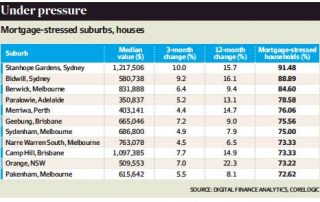
Stanhope Gardens in Sydney’s northwest posted the highest proportion of households experiencing mortgage stress, with 91.5 per cent of families spending more than they earn.

Mortgages have ballooned in the suburb after the median house price surged by 10 per cent in the three months ending May 31 to $1.2 million. In the past 12 months, house prices climbed by 15.7 per cent, CoreLogic data shows.

Households in the western Sydney suburb of Bidwill were also stretched, with 88.9 per cent earning less than they spend. Families were forced to take on bigger debts to buy a home after the median house price had risen by 9.2 per cent to $580,738 in just three months and by 16.1 per cent in a year.

Rental stress also surged across all states except the Northern Territory, where it improved marginally. In May, the proportion of households in rental stress jumped by 4.59 percentage points in Canberra, 3.46 percentage points in NSW and Victoria, and by 3.29 percentage points in Queensland.

‘‘There was a significant rise in rental stress, as the fallout from the removal of renter protections hit, and the JobKeeper and JobSeeker support ended,’’ Mr North said.

The number of households in rental stress nationwide rose from 1.78 million in April to 1.95 million in May.

‘‘The end of government support is hitting renters hard . . . more tenants are being asked to move or accept rent rises,’’ Mr North said.

‘‘Some still owe rents from the past year, which were not forgiven, just postponed in many cases.

‘‘Investors are trying to lift rents to alleviate negative returns, adding to the pressure, and some investors are now listing their investment properties, hoping to sell into the current market rises.’’

Mr North said mortgage and rental stress could worsen in the months ahead. ‘‘Until incomes rise, the conditions are set for more pressure on household finances.’’

Mortgage and rental stress worsen in May2021-07-02T10:37:20+10:00

Negative gearing tumbles on lower interest rates

The proportion of landlords negatively gearing rental properties has fallen below 60 per cent for the first time on record, reflecting a decline in interest rates.

Of the 2.2 million taxpayers owning at least one rental property, 1.3 million declared a net rental loss in 2018-19, according to new annual data published by the Australian Taxation Office.

Overall, net rental income was negative $3 billion.

Total gross rental income of $47.8 billion received by landlords was less than deductions for their cost of interest, capital works and other rental deductions incurred.

Despite the decline in negative gearing there are still many landlords owning multiple properties who are claiming a tax deduction for earning less rental income than the cost of running investment properties.

The number of landlords negative gearing at least six properties was 11,226 in 2018-19.

Some 10,935 landlords negative geared five properties, 26,719 owners had four properties claiming a net rental loss, 74,955 property investors had three properties negative geared and 250,035 had two properties claiming a loss.

Almost 1 million people – 931,132 – had one property negatively geared.

Landlords who claim a net rental loss are in effect betting on making money from a property investment via house price increases.

There were 19,113 fewer negatively geared landlords than in 2017-18, the first fall in five years, analysis by The Australian Financial Review shows.

As a share of landlords, 58.6 per cent claimed a net rental loss – the first time since records dating back to 2003-04 show a sub-60 per cent result.

The decline in negative gearing coincided with the Reserve Bank of Australia cutting the overnight cash rate to 1.25 per cent by June 2019 – then a record low.

The share of landlords claiming net rental losses peaked at 69.6 per cent in 2007-08, when the RBA raised the cash rate to 7.25 per cent during the mining investment boom and when market mortgage rates were about 10 per cent.

The share of landlords negative gearing property is likely to continue falling in the low interest rate era, because low mortgage rates make it harder to claim a net rental loss and make it more likely rental income will exceed the expenses of owning an investment property.

Landlords reported gross rental income of $47.8 billion in 2018-19.

More than offsetting this were deductions of $24 billion for rental interest, $4.1 billion for rental interest and $22.8 billion for other rental deductions.

Negative gearing tumbles on lower interest rates2021-07-02T10:32:30+10:00

Rental risk as Victoria investors sell

Australian Financial Review Thursday 3 June 2021

Victoria’s recent stamp duty hikes, higher land taxes and newly legislated minimum standards in market rental housing are prompting landlords to sell out and put the supply of rental stock at risk, agents warn.

Last month’s state budget property tax increases, along with new laws around renting that came into effect at the end of March, had prompted some landlords to give up, said Michael Love, the head of Melbourne’s northern suburbs-based Michael Love & Co agency.

‘‘They’re turning around and saying ‘Is real estate the vehicle I want to be investing in for a return?’,’’ said Mr Love, whose company manages 6000 rental properties.

‘‘They’re investing to get a return where they’re taxed heavily, there are additional costs and holding costs which have never been there.’’

Anthony Webb, the head of eastern suburbs-based real estate agency PhilipWebb, agreed.

‘‘It’s the vibe of the legislation is just making the pendulum swing that much towards the tenants,’’ said Mr Webb, whose business also has a rent roll of about 6000 homes.

‘‘It’s this combination of things making landlords go – it’s too hard and we’re going to sell.’’

It’s likely some landlords will sell out in the face of higher costs. A regulatory impact statement accompanying the new legislation said it was likely that as a result of introduction of minimum standards, 9 per cent of rental providers would increase rent, 4 per cent would sell the property and 4 per cent would not acquire future rental properties.

But low interest rates, and a buoyant housing market, are also prompting many residential property investors to come back into a market they had previously departed.

Housing values surged to record highs across all capitals except Perth and Darwin, with more growth expected in coming months as strong demand from buyers outpaces the falling volume of listings, CoreLogic figures this week showed.

Dwelling prices across the combined capitals surged 2.3 per cent in May – the second fastest growth rate since the 1980s.

The latest official home loan numbers last month showed investor lending, rose in March at its fastest pace in almost two decades.

New data showing home loan commitments to investor buyers jumped 12.7 per cent from February, the fastest increase since July 2003, to a seasonally adjusted monthly total of $7.8 billion.

They were ‘‘enormous’’ numbers and challenged the picture of a market solely driven by owner-occupiers.

But real estate agents said that landlords selling out would lead to a net loss of rental stock that would hurt tenants.

Rental risk as Victoria investors sell2021-06-09T13:32:42+10:00

House prices surge as listings slip

Australian Financial Review Wednesday 2 June 2021

Housing values have surged to record highs across all capitals except Perth and Darwin, with more growth expected in coming months as strong demand from buyers chases a dwindling number of listings.

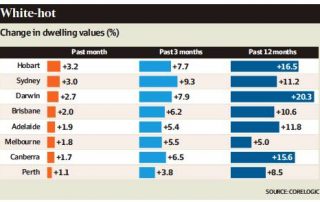
Dwelling prices across the combined capitals surged 2.3 per cent in May – the second-fastest growth rate since the 1980s, according to CoreLogic analysis.

Underpinning the growth, total listings around the country fell by 6.3 per cent over the month, separate figures from SQM Research show.

All capital cities posted strong increases, led by Hobart with a 3.2 per cent lift in prices. Next was Sydney at 3 per cent. Capital city prices are now on average 7.8 per cent above the previous record set in September 2017.

The growth momentum will eventually slow, however, as affordability worsens or if the banking regulator steps in with macro-prudential curbs, analysts say.

Dwelling prices over the year jumped by 10.6 per cent nationally – the strongest growth in almost 11 years.

In regional areas, home prices rose by 2 per cent in May and were up by 15.2 per cent on the year – the largest growth rate in nearly 17 years.

House prices posted 2.6 per cent monthly growth, while apartment prices rose by 1.4 per cent. House prices over the past 12 months rose by 11.4 per cent, while apartment prices grew by 3.5 per cent.

The housing boom is expected to continue until there is a policy response, likely to be macro-prudential tightening, rather than Reserve Bank rate rises or government policy or tax changes, investment bank UBS said.

‘‘Our view remains that macro-prudential policy tightening will likely be implemented around October – when the Council of Financial Regulators is due to meet, and the RBA release their semi-annual Financial Stability Review,’’ UBS economist George Tharenou wrote.

‘‘The trigger flagged by APRA (Australian Prudential Regulation Authority) was a substantial increase in housing credit growth to above income growth – which is a condition we expect to be met by then, given our view housing credit lifts above 6 per cent year-on-year year ahead.’’

AMP Capital chief economist Shane Oliver said the worsening affordability was becoming an increasing constraint once again.

‘‘Poor affordability will start to bite as the year progresses and the massive pick up in housing construction will dampen price increases, particularly with the borders remaining closed,’’ he said.

While still trailing house price growth by a wide margin, unit values have strengthened across capitals as investors start to return to the sector.

CoreLogic research director Tim Lawless said unit prices were likely to increase further as house prices rise to unaffordable levels.

‘‘I think we’ll see demand diverting to a more affordable sector of the marketplace like apartments, particularly in Sydney where the pricing gap between houses and apartments is around 50 per cent,’’ he said.

Even in the Melbourne CBD, where high-rise apartments have borne the brunt of the downturn, price rises are starting to be seen, Mr Lawless said.

‘‘We’re only seeing subtle growth in apartment values at the moment, but every single subregion of inner Melbourne has risen in value over the past three months,’’ he said.

Sales turnover has also risen with unit sales now tracking 15 per cent above the average.

‘‘I think part of that will be driven by investors who are starting to come back and become more active in the market, but also through demand being diverted into the sector purely through the lower price points that they are offered,’’ Mr Lawless said.

In the near term, prices are set to rise strongly as new listings fall by 2.4 per cent over May to 79,673 properties on the market nationally, figures from SQM Research show.

Total listings around the country have dropped by 6.3 per cent over the month and were down by 19.2 per cent from a year ago.

‘‘The reality is that the 79,000 new listings are simply not enough to satisfy buyer demand right now,’’ SQM Research managing director Louis Christopher said.

‘‘Buyers are so desperate that they are now raiding the oldest stock that has been on the market for months due to some defects or priced too high.’’

House prices surge as listings slip2021-06-09T13:27:10+10:00