Financial Planning Industry – Global Trends

Financial Planning Message – December 2022

As 2022 draws to a close we are reminded of the recent period of intense volatility in capital markets and the reality that a global recession is likely next year.


Markets are pricing in a lower probability of a recession in Australia.


This in turn will depress corporate earnings and valuations across all asset classes and significantly increase default rates among high-risk borrowers.


The correction to valuations is likely to be more severe during this economic cycle due to valuations starting from elevated levels compared to previous corrections.


We are also yet to experience a high number of fixed loans move from fixed interest rates of sub 2% to levels of 5%+ prevailing rates, something in the order of $500bn are due to mature in mid to late 2023.


This will no doubt impact the already depressed property market in Australia.


All the major banks and APRA are keeping a close eye on this development as we progress into 2023.


As inflationary pressures persist ( highest in 40 years ), geopolitical tensions and tight labour supply, the  central banks are forced to aggressively press on with higher interest rates and keep for much longer.


The RBA has so far moved the cash rate from .1% in March 2022 to now 3.1%, markets are now pricing in another two .25% increases in early 2023 before a potential pause to evaluate the impact on inflation.


The Federal Reserve was pricing in a rate increase of just 1% in December 2021, it is remarkable that their view now is that it is likely to peak at approximately 5.25%.


Consequently, 2023 is poised to exert added stress to highly leveraged borrowers, specifically those that have acquired property / equities in 2021 / 2022, are now in nil or negative equity positions.


It is worth noting that during this business cycle, we have had an explosion of companies that have become addicted to cheap debt, on the other hand, these same companies are not generating sufficient cashflow to support increased interest payments.


Clearly, there will be consolidation particularly in property related businesses in 2023.


There are no doubt significant headwinds for Australian households and the economy in general as we enter 2023.


Accordingly, extreme caution and sound strategies need to be implemented for the year ahead, including but not limited to :-

  • Be clear on what and who matters given the many conflicting sources of information and ‘investment opportunities’ across the media.
  • Understand your portfolio and position appropriately taking into account your forward plans and risk / return / management costs.
  • Review cashflows and eliminate unnecessary lifestyle costs in light of higher interest rates in 2023.
  • Let’s not forget managing your tax position, this is always relevant be it during your working life, in retirement ( with respect to investments) or as part of your estate plan.
  • Focus on what can be controlled / influenced as opposed to factors over which we have no control or influence.
  • Make incremental ‘dollar cost savings’ as opposed to taking a significant position when investing.
  • Diversification and history are our best friends, reflect and actively rebalance asset allocations.
  • Consider Dividend Reinvestment Plan ( DRP) in light of the attractive valuations.
  • Confirm borrowing / refinancing options well before due dates and explore potential savings across relevant lenders – competition appears to be intensifying across the major lenders.
  • Insurance is always important, however potentially critical during extreme business cycles as are likely to unfold in 2023. It is not desirable to execute forced sales at depressed values.


In closing, we would like to take this opportunity and thank you for placing trust in AMCO since inception 26 years ago and making our Integrated Wealth Management practice what it is today.


We are aware of the challenges you are facing during these uncertain times and are there to advise and navigate all matters with professional care and promptness.


It is vital that fundamental mistakes are prevented during these critical periods, hence the need for sound advice.


From the team at AMCO, we wish you and your loved ones good health, peace of mind and prosperity in the year ahead.


Merry Christmas.


Danny D. Mazevski 

Chartered Tax & Financial Adviser

FIPA   CTA  FTMA  MBA (Un.NSW/SYD)  Dip.FS   JP

Financial Planning Message – December 20222022-12-22T08:01:23+11:00

China is stumbling into its own destabilising mortgage disaster

The Chinese authorities’ drift on managing bad debts feels eerily like the impending subprime crisis in 2008.

It is spreading like wildfire. Home buyers in China are refusing to pay the mortgage on properties they have bought but that their financially strapped developers can’t finish. Some say that they will resume payments only when construction restarts.

The protest involved more than 100 delayed projects as of July 13, up from 58 projects the previous day.

The frustrated buyers accuse the developers of misusing sales proceeds and the banks of failing to safeguard their loans.

China has never seen anything like this. As in the United States – until the 2007 subprime crisis – the possibility of troubles in the mortgage market was vanishingly small.

But this mortgage strike isn’t entirely unpredictable. Home buyers have every reason to be angry. Most of the projects were begun by developers who have defaulted.

China Evergrande Group led the pack, accounting for an estimated 35 per cent of the total projects that faced mortgage revolts, data compiled by capital management company CLSA of Hong Kong shows.

One such project in eastern Jiangsu province was launched before the COVID-19 pandemic. Construction has been suspended since August, while property values in its neighbourhood have come down by about 10 per cent. In other words, not only did the affected households see their wealth dip, they can’t move in and enjoy their new apartments either.

Over the years, with consent of local governments, the likes of Evergrande and Country Garden Holdings fed the residential housing boom through a pre-sales model: apartments are bought long before they are completed. Now the builders don’t have money to finish these projects.

Granted, developers’ debt woes were met with protests in the past – from suppliers, employees, all the way to hapless retail investors who had bought their wealth management offerings. But this new development is something entirely different.

It opens a Pandora’s box and poses a direct threat to the stability of Chinese banks. The Ministry of Housing and Urban-Rural Development held talks with financial regulators and major banks last week to discuss the mortgage boycotts.

Unless President Xi Jinping’s government stops this stampede, a collapse of the banking system on the scale of Lehman Brothers in the US in 2008 is very much on the cards. China is unprepared for such a big chunk of its bank loans to go sour.

According to Autonomous Research, banks have about 62 trillion yuan ($9.1 trillion) of exposure to the property sector. More than half is in the form of mortgage loans. At China Construction Bank, one of the world’s largest banks, mortgages account for more than 20 per cent of total assets.

Until last week, China’s middle class were excellent customers, dutifully paying their monthly bills. The government’s social credit system – a national credit rating and borrowing blacklist – has worked well; bad credit can even hamper one’s ability to travel on high-speed rail. But what if some are just fed up and willing to walk away from their obligations?

We’re not talking about one or two delinquent developers. In the past year, 28 of the top 100 developers have defaulted or asked their debt holders for extensions, data compiled by CLSA shows.

Collectively, they account for about 20 per cent of China’s total property sales. Money is even tighter now. In the first half of the year, property sales plummeted 72 per cent from a year ago, further eroding their cash flow.

A CLSA monthly survey on the status of Evergrande projects gives us a glimpse of how many unfinished sites there are across China. As of June, more than half of Evergrande’s projects were under construction halts.

CLSA estimates that about 840 billion yuan in mortgages is tied to abandoned sites across China.

It is worth asking how we even managed to get to this point, especially for a government that is obsessed with stability.

All we have seen is policy inertia. Developers have been in distress for more than a year now, but there has been no progress in restructuring their finances. Local officials have been unwilling to make difficult decisions, write off bad debt and reach resolutions.

Unable to shed financial burdens, builders cannot focus on operations. They become zombies, and their construction sites turn into ghost towns.

In 2008, I worked at Lehman Brothers in New York and witnessed first hand how the subprime mortgage crisis dragged down the venerable bank – and threatened the entire industry. This environment is starting to feel eerily similar.

BLOOMBERG OPINION

Shuli Ren is a Bloomberg Opinion columnist covering Asian markets.

China is stumbling into its own destabilising mortgage disaster2022-07-22T16:08:11+10:00

Small business pays the cost of rising wages

Average pay rates among small businesses have grown by more than 4 per cent this year off the back of the tightest labour market in decades, according to new research.

Data on more than 130,000 small to medium businesses using technology software firm Employment Hero shows the average hourly rate of 1.75 million employees increased 1.4 per cent between May and June, and 4.3 per cent since January.

The company’s inaugural SME index suggests labour shortages in low-paid jobs such as hospitality have started to bite.

Employment Hero chief executive Ben Thompson said changes in average rates could be influenced by lack of staff as much as wage growth.

‘‘We’ve seen a lot of change in industry engagement – people moving from hospitality and retail into knowledge work – and if that means we’ve seen some senior roles with high salaries terminated through resignation and moving from one sector to another, then that could definitely affect the average rate of pay,’’ Mr Thompson said.

‘‘For example, in healthcare if you saw a lot of highly experienced mature-age nursing staff resigning due to COVID burnout that could lead to a decrease in the average wage.’’

The report found retail, hospitality and tourism experienced an increase in average hourly rates of 4.7 per cent from May to June.

However, healthcare suffered a decrease in its average rate of 4.2 per cent. Agriculture, mining and energy experienced the biggest fall, 11.6 per cent.

Overall, the Employment Hero report found medium-sized firms, which also experienced the biggest increase in staff, were driving the most recent surge in average hourly rates.

Small businesses (fewer than 20 employees) and large businesses (more than 200) had their average hourly wage growth marginally decline.

Asked how they would deal with this year’s minimum wage increase of up to 5.2 per cent, about 24 per cent of 500 respondents said they would ‘‘have to review prices’’ and 16 per cent said they would need to work more hours.

About 11 per cent said they would have to let staff go and 10 per cent planned to outsource work locally. About 7 per cent said they would seek to identify cost savings outside of pricing and staffing changes.

The report follows an analysis by JP Morgan economist Jack Stinson last week that suggested wage growth was still tepid because vacancies were concentrated in industries such as hospitality that also had the lowest margins.

‘‘Such firms are less willing to bid wages up to levels above marginal product,’’ Mr Stinson’s analysis said.

‘‘The consistently high level of unfilled vacancies should then be read as a partial signal that firms cannot fill positions at any cost, explaining some of the disconnect between very low unemployment and middling wage growth.’’

Whitehaven Coal chief executive Paul Flynn told The Australian Financial Review his ASX-listed company had been relying on paying retention bonuses ‘‘on a quarterly basis, just to make sure people stay put because the market is very, very tight’’. ‘‘All the miners are running hard and then the government is competing for the same labour with all the infrastructure building they have got going around the country … so the government is contributing to a lot of the inflationary pressure by their own actions here so that is challenging for us,’’ he said.

Small business pays the cost of rising wages2022-07-22T14:58:31+10:00

What It Means For Your Money

There are numerous opportunities for astute investors and consumers to take advantage of. Aleks Vickovich and our expert writers break it down.

As expected, the Morrison government’s pre-election budget had plenty of sweeteners. The 2022-23 budget documents revealed total expenditure of $628.5 billion, of which social security and welfare ($221.7 billion) made up the lion’s share, alongside funding for health ($105.8 billion), education ($44.8 billion), defence ($38.3 billion) and transport and communications ($18.9 billion).

Included was a one-off, $8.6 billion package of short-term handouts described by The Australian Financial Review as a ‘‘shameless voter bribe’’.

Whether the cash splash is effective remains to be seen, with voters to go to the polls in May. But the budget’s short- and long-term measures contain a range of opportunities that astute investors and consumers may seek to take advantage of.

Here’s what you need to know.

Women

Australian women remain on track to earn $2 million less than their male counterparts due to what economists and critics deem a lacklustre, pre-election federal budget.

While it included $9 million in funding to support emerging female entrepreneurs and $58 million in funding for endometriosis, experts warn the measures do not go far enough to promote women’s earnings capacity and – in the case of the paid parental leave changes – may even backfire.

The government’s paid parental leave scheme will now be 20 weeks shared at the couple’s discretion at the minimum wage. Previously, primary carers – who tended to be mothers – were eligible for 18 weeks, while partners were eligible for two weeks. The income test will be changed to a household limit of $350,000 each year rather than the individual test.

‘‘It’s done under the guise of flexibility and allowing more leave sharing between partners,’’ says Grattan Institute CEO Danielle Wood. ‘‘That’s great in the small percentage of households that want to do that, but my theory is it will actually lead to more gendered norms around who cares [for children] in the early years.’’

That policy, coupled with no movement on childcare, confirms Grattan modelling that finds the average mother will earn $2 million less over her lifetime compared to the average father, says Wood.

‘‘[The budget] was a missed opportunity to address some of the disincentives to women’s workforce participation, particularly the higher cost of childcare,’’ she adds.

Industry groups also characterised the budget as lacking for women.

Tax Institute analysis of childcare costs and subsidies found the secondary earner, who is often the mother, faces a steep disincentive to return to full-time paid work.

‘‘If they’re back to a full-time schedule, the secondary earner is only gaining $6 extra for the tenth day of work in a fortnight. By the time they’ve commuted to work and bought a morning coffee, they’re paying to go to work that day,’’ says Tax Institute tax policy and advocacy general manager Scott Treatt.

‘‘The secondary earner in a family can be taxed at an effective rate, including net childcare costs, of more than double the top personal marginal tax rate. This makes returning to work financially impossible for many parents who might otherwise like to.’’

LUCY DEAN

Retirees

In a measure foreshadowed by the Financial Review in March, the government committed to extending its changes to the superannuation minimum drawdown requirement for another year. ‘‘The government has extended the 50 per cent reduction of the superannuation minimum drawdown requirement for account-based pensions and similar products for a further year to June 30, 2023,’’ the budget documents said.

‘‘The minimum drawdown requirements determine the minimum amount of a pension that a retiree has to draw from their superannuation in order to qualify for tax concessions.’’

Drawdown rates range from 4 per cent to 14 per cent, depending on age. The extension of the halved rate would drop the rate from 7 per cent to 3.5 per cent for someone aged between 80 and 84.

While the budget billed this measure as ‘‘supporting retirees’’, experts say it would really only benefit retirees who have already accumulated substantial wealth outside super.

Peter Burgess, deputy chief executive of the SMSF Association, says the extension allows individuals who have access to outside funds to withdraw less than they would ordinarily have to under the normal policy conditions.

‘‘This means they can retain more in their super pension account – which is tax-free – for longer,’’ he says.

The tax benefits of keeping more money in a super environment are clear, says Lisa Papachristoforos, a partner at accounting firm Hughes O’Dea Corredig.

Wealth held in a super fund in pension mode incurs no tax on income and capital gains, she points out – as opposed to income held in an individual’s name, which is taxed at marginal rates.

But tax advantages are not the only potential benefit. The extension of the minimum drawdown also provides ‘‘continued flexibility’’ on how much retirees need to withdraw to fund standard of living, Papachristoforos adds.

Aside from tax efficiencies, leaving more money in super means more can be invested, generating further returns.

Plus, while the policy may be aimed at retirees, all super fund members may profit from the extension regardless of their age or distance from retirement.

‘‘Super funds are potentially faced with an additional year of lower minimum pension withdrawals paid to their members, allowing them to utilise that forgone withdrawal at a pooled level for investment purposes,’’ Papachristoforos says.

‘‘As such, extending the minimum drawdown rule could positively affect all superannuants, not just those drawing an income stream from their account, and the investment managers of super money will have more funds to invest.’’

Certified financial planner Josh Dalton, of Dalton Financial Planners, agrees there are potential tax minimisation benefits from the extended minimum drawdown policy, as well as the prospect of opening up more money to be invested in markets.

But he warns the measure is not suitable for all retirees. ‘‘Retirees need to estimate their annual expenditure and get a good grasp on how much income they can live on comfortably,’’ he suggests.

‘‘They can then decide to reduce their pension payments in line with their budget estimate and conserve more of their account-based pension capital if it suits.’’

ALEKS VICKOVICH

Home buyers

Borrowers planning to apply for the expanded Home Guarantee Scheme should start preparing their applications soon because competition is expected to be fierce, say lenders.

First home-loan applications surged when previous allocations were announced to allow first home buyers and single parents to get into the property market with a deposit of between 2 per cent and 5 per cent without needing to pay for expensive lenders mortgage insurance.

Applicants need to choose a loan from a lender on the scheme’s list that offers the rates, terms and conditions best suited to their needs. It has to be a principal and interest loan. Investors are not eligible.

Prospective borrowers should gain pre-approval for their loan from the lender, which will involve providing identification, age, proof of income, a prior property ownership test, proof of deposit and intention to be an owner-occupier.

Applicants also need to ensure their loan application is within the price caps set for each city. For example, it is capped at $800,000 for Sydney’s central business district and $500,000 for Ballarat in regional Victoria.

The First Home Guarantee, which supports eligible first home buyers to build or purchase a new or existing home with a 5 per cent deposit, has been increased from 10,000 offers to 35,000 a year from July 1. It is capped at $125,000 annual income for individuals and $200,000 for a couple.

There are also 5000 places for the Family Home Guarantee, which enables eligible single parents with dependents to enter or re-enter the housing market with a deposit from 2 per cent.

Mortgage broker Elodie Blamey says single mothers and fathers can earn up to $125,000 – excluding childcare support – to be eligible. ‘‘Unlike the Home Guarantee Scheme, it is not being used nearly enough,’’ she says. Many single parents might not be aware of the scheme and its conditions, or consider themselves eligible.

Merinda Brooks, a single parent with a three-year-old son, says: ‘‘It has absolutely changed my life.’’

The speech pathologist says it would have been challenging to save a 10 per cent deposit. ‘‘I was working really hard but unsure about how I could have otherwise got a deposit together,’’ she adds.

There are also another 10,000 places a year under the Regional Home Guarantee scheme for anyone who has not owned a property for five years, on the condition they purchase a newly built home or build.

Lenders are awaiting additional details from the government before advising potential borrowers.

DUNCAN HUGHES

Patients

Government changes to the Pharmaceutical Benefits Scheme safety net thresholds, making medicines more affordable, is good news for many self-funded retirees, according to a leading super specialist.

Lower safety net thresholds for the PBS mean potential savings for retirees, and may create an opportunity for others who have ‘‘grandfathered’’ account-based super pensions.

From July 1, the PBS safety net thresholds will be reduced from $326.40 to $244.80 for concession patients, and from $1542.10 to $1457.10 for general patients, which means fewer scripts before the safety net is reached.

Patients will also reach the safety net sooner with 12 fewer scripts for concession patients and two fewer scripts for general patients.

‘‘This is good news for self-funded retirees who do not hold a Commonwealth Seniors Health Card,’’ says Colin Lewis, head of strategic advice for Fitzpatricks Private Wealth.

‘‘There may also be the opportunity for advisers to consider clients who have an underperforming ‘grandfathered’ account-based pension but feel trapped for fear of losing the card if they move.’’

Many CSHC holders have account-based pensions that are ‘‘grandfathered’’ after the income test rule change on January 1, 2015. Account-based pensions started after that date are deemed under the card’s income test, whereas nothing counted with existing pensions. For this reason, many are reluctant to switch pensions or super funds for fear of losing their CSHC.

‘‘It is a matter of doing the numbers.’’ says Lewis. ‘‘Deemed income from a new pension may not push a cardholder over the CSHC income threshold but, where it does, the cost of losing the card is now reduced with a lower safety net, and the potential return from a new pension may well exceed this cost.’’

The same concern may contribute to some self-funded retirees maintaining self-managed super funds rather than switching to a possibly better-performing and cheaper retail or industry fund.

DUNCAN HUGHES

Small business owners

Improving workforce skills, incentives for employing apprentices and increasing investment in technology and digitisation are among the opportunities. Small and medium businesses with a turnover of up to $50 million are getting an additional 20 per cent deduction for the cost of external training provided to employees.

That means a business will be able to deduct $120 for every $100 spent on a course.

As an example, a business needs to train 10 employees in administrative skills to manage jobs. The company enrols them at a cost of $430 per employee. In addition to the $4300 deduction, the company can claim an additional $860 deduction, being 20 per cent of the expense.

There is also $2.8 billion over five years to increase apprenticeships, including $5000 payments to apprentices over the first two years of their apprenticeships, and $15,000 to qualifying employers paid as 10 per cent for first- and second-year apprentices and 5 per cent for third-year workers.

For example, a business employing an apprentice for $40,000 a year will receive $1250 every six months for two years to help with the cost of training. The company can apply for payments of $4000 in the first and second years, and $2000 in the third year.

The calculations were provided by financial adviser Cameron Harrison.

Businesses are also eligible for another 20 per cent deduction for expenses on digital upgrades, such as cyber security systems or subscriptions to cloud-based services, up to $100,000. Installation has to be completed by June 30, 2023 to be eligible.

‘‘This is a no-brainer,’’ says Greg Travers, a director of William Buck. ‘‘Businesses know they need to digitise, and now the government is giving them an incentive to do it. The benefit is not huge . . . but it helps.’’

Digitisation means more pre-filling, data-matching and data-sharing for the Australian Taxation Office.

‘‘The measures are designed to reduce compliance costs for businesses, but also make it easier for the ATO and other revenue authorities to data-match and share information,’’ Travers says. These measures include using real-time data to calculate PAYG tax instalments.

Sam Pratt, chief executive of Render Networks, which develops broadband connectivity, says while it was a good budget for infrastructure, there needs to be more support for the digital economy to keep it competitive with the US and Europe.

Changes to the taxation of employee share schemes will help smaller companies, particularly technology start-ups, attract and retain skilled workers. Limits on the value of shares an employer can issue to employees has been increased from $5000 to $30,000, which puts it in line with international standards.

DUNCAN HUGHES

Aged care residents

With medication management long regarded as the bane of residential aged care, funding to link care facilities with community pharmacists and onsite pharmacists should bring some comfort to residents and nurses.

The delivery of wrong and/or excessive medication has long been an issue waiting to be addressed.

However, at the heart of this and other positive reforms flagged for the aged care sector in the federal budget lies a major problem – recruiting and retaining qualified staff.

Notably absent from the spendathon was any mention of the wage increase for existing or future aged care workers that is so desperately needed to deliver the existing services, let alone promised ones.

Pharmacists are as desperate for the implementation of a workforce plan as the aged care sector, putting a huge question mark over the success of a potentially good idea before it is even rolled out.

The ongoing release of 80,000 home care packages in 2021-2023 – taking the total to about 275,600 people by June next year – is welcome confirmation of intentions to assist older Australians to remain living independently at home.

But the delivery of the packages and other at-home support is also dependent on attracting a suitably skilled workforce to meet the demand.

It is the same for the 8500 new respite services also announced previously as part of an $18.8 billion, five-year reform program following the Royal Commission into Aged Care Quality and Safety.

On that front, the $48.5 million for 15,000 additional aged care training places for new and existing personal care workers, to a total of 48,800 places, is a positive move.

More money for more training is always welcome, says Sean Rooney, chief executive of Leading Age Services Australia and representative of the Australian Aged Care Collaboration. But he says the budget failed to address the key fundamental deficiencies identified in the royal commission – wages and the viability of aged care homes.

Sticking with the commitment to reform the residential aged funding model through the introduction of the Australian National Aged Care Classification Transition Fund, the budget included an additional $34.60 per bed per day.

The proposed residential aged care funding model, scheduled to begin on October 1, is designed to align residential aged care funding to the care needs of each resident.

The starting price is $216.80 a day per resident for standard care – with more for dementia-related care – compared to about $180 a day per resident under the old funding model.

Council on the Ageing chief executive Ian Yates will be looking to see that the additional money is spent on increasing the number of care minutes with residents as intended by the royal commission, which recommended care homes have a target of 200 minutes per resident per day.

Exactly how that will be measured is yet to be worked out. But Yates wants the government to commit to publishing how many minutes of care each residential facility is being funded to deliver, compared to the number of minutes actually delivered, as part of its new star rating system.

With an election on the way, there is still hope for further announcements that will directly benefit older Australians and those who deliver the care they deserve.

Unlike the government, the opposition has centred its budget promises on fixing the aged care workforce with a $2.5 billion pledge for measures, including a wage rise.

BINA BROWN

Young Australians

Successive budgets chasing the ‘‘grey vote’’ have allowed structural flaws in Australia’s economy to form, with younger generations and economists now calling for bold conversations to help strike out the unwieldy debt bill.

The budget features a projected $78 billion deficit for 2022-23. The deficit is expected to linger for the next 10 years, with gross debt peaking in 2025.

While a deficit isn’t necessarily a problem if the debt brings sustained productivity or lifestyle improvements, Australia’s ability to wind back high levels of spending will be the key issue for younger generations, says the Grattan Institute’s Wood. ‘‘We shouldn’t be so fixated on the deficit per se, especially coming out of COVID-19; it partly reflects that we did need to spend a lot to respond, and that it was appropriate to do so,’’ she says.

‘‘But we should think about the structural budget deficit over time, and that does look a bit concerning.’’

Wood says Australia’s spending appears to be fixed at a higher level after COVID-19, with more money flowing through to defence, aged care and the National Disability Insurance Scheme.

‘‘We haven’t really talked about how we’re going to pay for that over time,’’ she says. ‘‘The risk is if we don’t do anything about that and debt continues to creep up as a share of the economy – that’s the concern that young people, quite rightly, might have.

‘‘It’s that longer-term picture and the lack of clarity around how we’re going to square those numbers.’’

The co-founder of intergenerational fairness advocacy group Think Forward, Sonia Arakkal, agrees government debt is a complex issue, but is concerned that the budget puts older generations’ needs before younger generations’ current and future needs.

‘‘Young people have a sophisticated understanding of the economy – we’re a very highly educated generation . . . we want policymakers to take into account our interests,’’ she says.

‘‘So, if they are accruing debt in our name, it should be debt that is invested in climate change or infrastructure – not pork-barrelling in particular marginal seats or particular states.’’

Faced with baked-in higher spending, an ageing population and a need to decarbonise, Arakkal – who is leading calls for a parliamentary inquiry into intergenerational fairness – is calling for Australia’s political class to engage in more difficult conversations about equality.

‘‘We have a system that is overly reliant on income taxes and doesn’t treat asset taxes in the same way, and we shouldn’t be punishing people for working. We should be looking at taxes that are inefficient, like capital gains tax, or how we tax superannuation,’’ she says.

‘‘We need to be having those conversations to set the younger generation up for success.“

There are two options for tackling the deficit, says Wood.

The first is to find ways to make the economy grow faster, as a faster-growing economy will essentially ‘‘fritter away’’ the debt burden.

‘‘Looking at policies which actually promote productivity and growth is important, so that could be tax reform, reforming cities, and how we do planning and zoning regulation?’’ she says.

Supporting more women to return to the paid workforce after having children is also a key way to uncap economic potential, Wood says, expressing disappointment at the budget’s muted changes in that area.

‘‘Over time, I think taxes will have to rise, even if we do tick some boxes on the growth front,’’ she says.

‘‘It’s inevitable that as government has increased as a share of the economy, that there will have to be an increase in taxes to pay for that. That has to be done carefully. What we shouldn’t do is just rely on income tax to do all the heavy lifting, which is what we’ve done historically.’’

LUCY DEAN

Households

Those earning up to $126,000 will be eligible for an additional one-off $420 that will be paid when their 2022 tax return is lodged. There’s also a one-off cost of living payment of $250 to eligible income support recipients and certain concession cardholders. Fuel excise (a federal tax imposed on each litre of petrol) will be halved, intended to reduce the cost of fuel by 22¢ a litre. In addition, costs of taking a COVID-19 test to attend work are tax deductible from July 1.SI

DUNCAN HUGHES

What It Means For Your Money2023-04-21T14:15:56+10:00

How hard do we hit Russia?

The West has yet to use its full arsenal of measures against the Russian economy. What is the most effective thing it could do now?

The elephant in the room in the discussions about Ukraine is just how hard the US and Europe really want to hurt Russia.

The United States could bring Russia to its knees economically within days, via full exclusion of all Russian banks from the SWIFT system and by blocking all clearing in US dollars. It has chosen not to do so.

The SWIFT system sits at the very top of Western property right transfers.

Russia and much of eastern Europe were not a part of the Roman Empire that laid the basis of the Western legal system.

Compiled by Emperor Justinian (the Corpus Juris Civilis) and further developed in the Napoleonic code, civil rights, contract law, and land and property registries were well established. The Charlemagne and Hapsburg empires brought Germany, the Czechs and Poland into the fold.

Russia has never had anything like this legal structure. Communism (with no belief in private property) followed the tsars, leaving the country nothing to fall back on when the Soviet Union collapsed. The KGB fraternity was best placed and organised to steal the state companies in the vacuum created, and to adopt the tried-and-true law of ‘‘do as I say, or else’’.

Ukraine is courageously trying to move away from Russia’s idea of property rights, towards the Western model.

Russia and China both ignore the rule of law and international agreements as they see fit, the latest example being Russian atrocities that ignore the Geneva Conventions (that Moscow signed and ratified). For hundreds of years the tsars did what we observe in Ukraine today.

China too eyes Taiwan and other territories with no basis in law.

None of this is new, yet Europe, and Germany in particular, appear to have been willingly oblivious: living in a sort of ‘‘pacifist bubble’’, enjoying consumerism and growth dependent on the whims of Russia with respect to energy.

Having miscalculated on the military front, Russia has now asked China for help to overcome its property rights problems with the West.

The Russian military miscalculation is that the lessons of history have not been understood by Vladimir Putin. He should have read more Tolstoy: ‘‘Nobody spoke a word of hatred for the Russians. The emotion felt by every Chechen was stronger than hatred. It was … a feeling of such disgust, revulsion and bewilderment at the senseless cruelty of these creatures that the urge to destroy them was as natural as that of self-preservation.’’

This is what Putin’s army of 150,000 soldiers is up against today, in a country of 45 million people that is 1260 kilometres across and does not want to be subjugated.

Russia must also be surprised at how co-ordinated the response of the West has been, and could still be again.

In responding to Russia’s plight, China now faces major dilemmas. It could help Russia to evade sanctions by buying less oil and gas from the Middle East and more from Russia. China can also supply Russian consumers. This could help Russia avoid capitulation.

However, overt help for Russia may draw China into the property rights firing line.

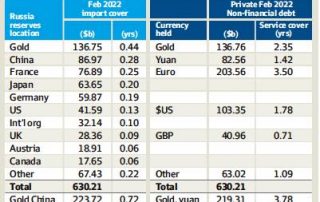
The table sets out Russia’s foreign exchange reserves situation to February this year. Russian Finance Minister Anton Siluanov told state television that about $US300 billion ($405 billion) of the $US630 billion reserves is ‘‘usable’’. This would provide about one year of import cover. Gold is very usable (and easy to deliver to China if needed), and likewise for assets located in China. Together they are worth $US224 billion, which implies about $US76 billion is coming from elsewhere ($US80 billion if the currencies column on the right-hand side of the table is used).

This is interesting because this ‘‘extra’’ could only be assets in countries that are supposedly covered by the sanctions – I am thinking of the leeway being given to European transactions for Russian energy, and of course deposits in Switzerland (estimates suggest $US200 billion of Russian money is there, enjoying property rights not available at home).

For debt servicing the situation is somewhat better, as it applies only to Russia’s foreign debt of $US480 billion or so (internal debt is of no consequence for the issues considered here). The debt service ratio is around 12.1 per cent. Russia would need to come up with only $US58 billion a year (so usable reserves would cover about five years of servicing).

Talk of defaults is therefore somewhat puzzling. It’s either because (a) the US won’t let Russia pay funds due to Western entities, such as money owed to a US bank (possible, but unlikely); or (b) with its usual respect for contract law, Russia is singling out US dollar holders. Frivolous offers to pay in roubles underline its lack of form in contract law.

China would not like to see the US test its full arsenal of measures on Russia, which could one day be used against Beijing. It is therefore likely to opt for face-saving compromises rather than escalate the situation.

The US, by focusing SWIFT restrictions on only some of Russia’s banks, is also looking to avoid escalation. But this is a very weak restriction. By allowing some banks to continue to operate, all Russian banks can get by. This is the very nature of regulatory arbitrage that we saw in the run-up to the financial crisis.

Unless all Russian banks are treated the same way all over the world, they will get by for any obligations they care to meet. Europe will continue to pay for its gas, while Russia will use this to pay for imports, any debt service it chooses to honour, and possibly weapons. Indeed, with rising energy prices and European payments for its supply, Russian reserves could just as easily go up rather than down. They would not be a constraint at all.

The US appears to give weight to concerns about stumbling unintentionally into a nuclear conflict with Russia – like the stumbles that led to the outbreak of World War I in 1914.

One issue here is whether Putin is really crazy, or whether he likes to pretend he is so that his threats carry more weight. I am sceptical on the former, because the Russians do love their children too, and the oligarchs love their global wealth.

For the US, the main issue therefore is the European alliance. European nations may be willing to pay more for their energy, but they don’t want their supply to be cut off. Understandable. So, this takes me back to the benefits of the Roman Empire and the Napoleonic code.

A middle course that cuts off money to Russia temporarily and keeps energy supply moving would be for the gas payments to be fully sequestered (before going into the SWIFT transfer system) until the crisis is resolved. The reserves constraint would become more binding without having to collapse the financial system.

While Russia does not follow the rigours of Roman contract law, it should be happy with that compromise arrangement, because we do follow those rules.

Adrian Blundell-Wignall writes on the world economy and is a former director of the OECD.

How hard do we hit Russia?2022-03-25T13:44:57+11:00

IMF warns of rocketing house prices

AFR Article 25 September 2021 page 3

The International Monetary Fund has called on Australia to address the rising financial stability risks posed by surging house prices, which are expected to increase by up to 20 per cent this year.

The IMF also warned there would be a ‘‘reckoning’’ for so-called zombie companies once pandemic supports were withdrawn, which could result in a spike in corporate insolvencies, particularly in small and medium firms.

Australia’s consistent lack of large-scale systemic tax reform also needed attention, according to the global financial institution, which said a failure to act on productivity-enhancing reforms would come with a long-term cost.

‘‘We think the tax reform would help economic efficiency and strengthen Australia’s position fiscally over the medium term … but also in terms of economic efficiency by realising gains from having a better system of direct taxation,’’ IMF’s Australian division chief, Harald Finger, said.

Echoing recommendations from the OECD last week, the IMF called for Australia to reduce the income tax burden on households and business – which is higher than the OECD average – by increasing GST revenue and offsetting the regressive effects on low- and middle-income households.

‘‘Not pursuing the reform basically means losing out on the gains that one can have from better incentivising investment,’’ Mr Finger said.

Treasurer Josh Frydenberg last week ruled out any change to the GST.

The recommendations came at the conclusion of the IMF’s biannual (and this time online) assessment of Australia’s economy, which forecast growth of 3.5 per cent by the end of the year and 4.1 per cent next year.

Of note was the IMF’s projection that inflation would grow to 2 per cent by the end of next year and stay within the Reserve Bank of Australia’s target band of 2 per cent to 3 per cent. This would suggest interest rates could begin to lift by the end of next year, ahead of the RBA’s current 2024 forecast.

The release of the IMF report came as Prime Minister Scott Morrison and his ambassador to the United States, Arthur Sinodinos, met with IMF managing director Kristalina Georgieva in Washington on Friday (AEST).

The meeting focused on the international economic outlook and the world’s recovery from the COVID-19 crisis, particularly the challenges for Australia’s neighbours in the Pacific and its largest trading partner, China.

On Australia’s booming housing market, Mr Finger said the IMF’s concerns were growing affordability issues and the potential for rising financial vulnerabilities. ‘‘We think that requires a comprehensive policy response,’’ he said. ‘‘Macro-prudential policy should be tightened to address gradually rising financial stability risks.’’

Possible options include increasing interest-serviceability buffers (the stress test on household for their ability to pay loans with higher interest rates), as well as caps on debt-to-income ratios or loan-to-value ratios.

The chief executives of the Commonwealth and ANZ banks this week said they were concerned about rising house prices, and CBA boss Matt Comyn said the bank, which is Australia’s biggest residential mortgage lender, has already increased its rate benchmark from 5.1 per cent to 5.25 per cent.

Mr Comyn suggested this was a more nuanced approach to dealing with financial instability issues than caps on loan ratios, which had the potential to disadvantage certain groups, such as first home buyers.

Reserve Bank of Australia assistant governor Michelle Bullock this week said the RBA was monitoring the situation closely, given the risk to financial stability caused by high household debt-to-income ratios.

Australia’s top grouping of watchdogs, the Council of Financial Regulators, held its quarterly meeting on Friday and discussed potential measures to cool the property market.

While no immediate crackdown is planned, regulators are nudging banks to ensure prudent lending.

IMF warns of rocketing house prices2021-10-12T09:58:35+11:00

AUSTRALIA’S GREAT DEBT GAMBLE

AFR Review 3-4 July 2021. Page13

Intergenerational report Policymakers are betting on low rates and solid growth, writes Ronald Mizen.

Tony Abbott and Joe Hockey’s infamous 2014 budget became so toxic it ultimately destroyed its makers; the task facing Prime Minister Scott Morrison and Treasurer Josh Frydenberg is orders of magnitude bigger.

Abbott and Hockey won an election on a platform of fixing Labor’s ‘‘debt and deficit disaster’’, but in the end, the job of selling fiscal repair was overwhelming for the former prime minister and his treasurer.

Not even the highly politicised release of the 2015 Intergenerational Report, which outlined an economic renaissance over the four decades hence if people embraced the duo’s policies, helped.

The fall from grace was swift. Throw forward a little more than half a decade, and Morrison and Frydenberg face a more complex set of challenges.

In financial year 2015, net debt was about 14 per cent of economic output, and the deficit was expected to be $30 billion, or about 1.8 per cent of GDP (which included an additional $8 billion spent by the Coalition).

Today, net debt is forecast to peak at 40.9 per cent of GDP and the deficit is expected to hover between 2.4 per cent and 5 per cent of GDP for some years.

Labor points to the global financial crisis and its more than $70 billion in economic stimulus between 2008 and 2009 as the root cause of the budget deterioration during its time in government.

The Coalition opposed much of this spending, which, as then opposition leader Malcolm Turnbull later said in his biography, made Abbott’s and Hockey’s eventual debt and deficit campaign possible.

In stark contrast, few criticise the almost $300 billion spent in direct economic support to help the nation through, and out of the COVID-19 pandemic – not only was it appropriate, it was low.

‘‘As a share of the economy, net debt is around half of that in the UK and US and less than a third of that in Japan,’’ Frydenberg said on budget night. But that just makes the eventual repair pitch all the more difficult.

Savings of an order last seen in the 2014 budget – or about $40 billion to$50 billion a year – will eventually have to be made to tame the ballooning bottom line, says Deloitte Access Economics partner Chris Richardson. ‘‘That’s a challenge. To be clear, budget repair shouldn’t start soon. And it can – and should – be slow. But it won’t be fun,’’ he says.

On current settings, Australians are in for 40 years of debt and deficit, this week’s release of the 2021 Intergenerational Report shows. The budget comes within a whisker of balance in 2036-37, reaching 0.7 per cent of GDP before falling away again to 2.3 per cent in 2060-61, a consequence of increased spending and the artificial tax-to-GDP cap of 23.9 per cent.

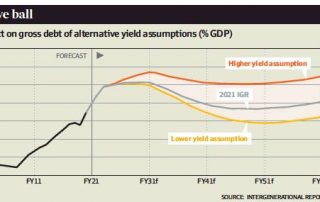
Net debt is expected to hit 34.4 per cent of GDP by financial year 2061, while gross debt – a better determiner of serviceability – reaches 40.8 per cent. And that outcome is on the rosy side – the risk is mostly downside. Dig a little deeper into the document and a very different picture emerges.

Frydenberg argues that, while gross debt has increased significantly since the onset of the pandemic, the cost of servicing that debt is lower in 2021-22 than it was in 2018-19, as a result of historically low interest rates. ‘‘Low yields, together with strong economic growth, means the government can reduce the debt-to-GDP ratio without running a surplus,’’ the 2021-22 budget papers say.

That scenario, of course, assumes low yields and strong economic growth. Sensitivity analysis in the Intergenerational Report shows that if 10-year bond yields converge from their current lows over five years to the long-run rate of 5 per cent, the debt and deficit profile deteriorates dramatically. The deficit increases by 0.6 of a percentage point to about 3 per cent of GDP by 2060-61, which adds about 14 percentage points to gross debt and lifts the outlook to just shy of 55 per cent of GDP.

Indicators generally suggest neither inflation nor bond yields will rise too far in that space of time, says Tony Morriss, Bank of America’s head of Australian economics and rates strategy. ‘‘The two major factors we would need to see would be a sustained rise in global and local inflation and a change in the global structure of interest rates and bond yields, most notably a move away from zero or negative interest rates in Europe and Japan that helped anchor yields since the GFC.’’ he says.

Then there’s the question of ‘‘strong economic growth’’. Productivity accounted for more than 80 per cent of national income growth in the past 30 years, and Frydenberg labelled it ‘‘the most vital ingredient in lifting our long-term living standards and wages’’.

Falling just 0.3 of a percentage point short of the forecast 1.5 per cent average growth rate forecast in the IGR will have significant consequences. Gross national income will be $32,000 per person lower, pushing down government tax receipts and lifting net debt as a portion of the economy to more than 57 per cent by 2060, and gross debt to just shy of 64 per cent.

The overall size of the economy would be $500 billion smaller at about $4.95 trillion (or $127,600 per person) compared with the baseline scenario of $5.46 trillion (or $140,900 per person). Yet actual productivity gains since the 2015 IGR have been barely one-third of the 1.5 per cent rate assumed.

Frydenberg says the ‘‘big bang’’ reforms of the 1980s and 1990s cannot be repeated and future reform will be incremental; but economists are sceptical about whether this will be enough to reverse the trend.

‘‘Even the sensitivity analysis suggestion of 1.2 per cent is incredibly optimistic. If we were able to achieve 1.2 per cent that would be a miracle,’’ says Blueprint Institute chief executive Steven Hamilton.

Big reform, as recent history has shown, is a difficult proposition, especially when the debate has become one where there can be no losers. ‘‘Reforms cost too many votes for governments to even try to champion them,’’ says Richardson.

The Business Council of Australia (BCA) this week pulled up the stumps on waiting for politicians to lead and drive a reform agenda, instead outlining a plan to take its message to the people and build a groundswell of support for reform.

Gross national income per person could be $10,000 better off over the decade if measures are introduced to boost productivity and stop it from ‘‘acting as a handbrake on the economy’’, says BCA chief executive Jennifer Westacott.

That wouldn’t make up for the $11,000 per-person lost over the last decade as a result of what the Productivity Commission calls the worst for productivity growth in more than half a century.

Then there’s the long-term impact on the nation’s population because of the closed international border during the pandemic, and the benefits of making up for this lost ground over the next 40 years.

Australia’s population was forecast to reach almost 40 million by financial year 2055, in the 2015 IGR, but because of COVID-19 and a much-lower-than-forecast fertility rate, it is now likely to reach about 38.8 million five years later.

This comes with a significant cost. But boosting annual net overseas migration from 235,000 a year to 327,000 by 2060-61 would lift real GDP growth from 2.3 per cent to 2.6 per cent by the end of the forecast period, and add $260 billion to the economy.

Closing borders has been politically popular, even while tens of thousands of Australians remain stranded overseas. Some people draw a connection between Australia’s success in lowering the jobless rate and the nation’s tightly sealed international border.

So, while the Intergenerational Report shows the need to not only return migration to previous levels but also boost it to make up for lost ground, the politics of such a proposition could be difficult after the Fortress Australia mindset.

Eventually tough, but necessary, decisions will need to be made on reform, on budget repair and on opening the border.

‘‘What will it take for either side of politics to do something bold?’’ asks Blueprint’s Hamilton. [If] an IGR which shows budget carnage over the next 40-years isn’t enough – what will be enough?’’ P

AUSTRALIA’S GREAT DEBT GAMBLE2021-07-29T10:07:11+10:00

Future Fund warns of rising inflation

A potential significant increase in inflation is a risk for financial markets and rising interest rates would make it difficult to generate investment returns, the head of the country’s $179 billion sovereign wealth fund has warned.

Future Fund chief executive Raphael Arndt said if inflation began to rise and governments and central banks failed to unwind their extraordinary stimulus, inflation could run too hot.

To prepare for ‘‘fundamentally changed’’ market conditions, Dr Arndt said the fund would hire more than 150 extra staff to deal with the challenges of COVID-19 and following an extended period of ultra-low interest rates. This included plans to employ another 70 investment staff, almost double the current level of about 80 investment managers.

Since the Future Fund’s inception under the Howard government in 2006, high returns have been made easier by falling global interest rates inflating asset values.

But with trillions of dollars of extraordinary stimulus from central banks and governments flowing through economies and the financial system, Dr Arndt warned the days of easy returns might be coming to an end.

‘‘Policy settings continue to support markets for the time being, but this is priced into assets and unwinding these measures will be a complicated exercise,’’ he told a Senate hearing in Canberra yesterday. ‘‘Equally, a failure to reduce the stimulus at the appropriate time could fuel a significant increase in inflation, a risk markets are already starting to focus on. The ability to generate strong returns into the future is more complex and challenging than ever before given the low level of interest rates around the world.’’

The Future Fund’s planned 79 per cent increase in headcount has been approved by the government, which lifted the cap on the fund’s average staffing level to 350.

As well as investment managers, the remaining increase in staff will be in operational roles, including technology, human resources, risk, governance and administration.

The Future Fund was set up by former treasurer Peter Costello to pay for the unfunded pension liabilities of public servants and to strengthen the government’s long-term financial position. Mr Costello now chairs the fund.

Dr Arndt said lower staff levels, now about 196, had served the fund well over the past 15 years when markets were generally stable and asset prices appreciating in the low-interest rate era.

‘‘I’m certainly comfortable that we had enough staff to be successful up until last year – in other words, when markets fundamentally changed because of the COVID pandemic.

‘‘And actually we’ve performed reasonably well through that period.

‘‘But coming out of that experience our job is to maximise long-term performance and look forward a long time on a strategic basis, and our view is that the world is fundamentally changing and financial markets are changing with them. To continue to be successful and to continue to be able to meet what is an increasing challenging investment mandate with interest rates at zero around the world, we needed more staff.’’

Dr Arndt was responding to questions from Labor finance spokeswoman Katy Gallagher, who said the Coalition government was generally reluctant to increase staff levels in public service agencies.

Headline inflation in Australia rose 0.6 per cent in the March quarter to be up just 1.1 per cent a year – a key factor in the Reserve Bank projecting it is unlikely to raise interest rates until at least 2024.

Future Fund warns of rising inflation2021-06-09T13:08:05+10:00