

Banking & Lending

Banks’ future prospects worry investors

Banks, it seems, are finding it increasingly difficult to live up to lofty investor expectations.

After dazzling investors with their ability to largely withstand the economic upheaval caused by the pandemic, and after benefiting from writing back billions in provisions they squirrelled away to cover soured loans, banks are struggling to convince investors that they’ll be able to continue to grow their earnings.

And that’s left investors anxious that the banks’ share prices are vulnerable to even the slightest disappointment, given that so much optimism – both about the economic outlook and on bank earnings – is already priced in.

For instance, the share price of the country’s largest lender, the Commonwealth Bank, has climbed from a low of 57.66 last march, to close at $98.78 in trading yesterday – a rise of 71.3 per cent.

But investors are reining back some of their previous enthusiasm which pushed the Commonwealth Bank’s share price as high as $103.69 last month.

Part of the investor malaise reflects a growing unease over the outlook for the home loan market.

After all the strong rebound in earnings of the big four banks largely reflects the astonishing surge in demand for home loans. As a rough rule of thumb, every 1 per cent increase in mortgage lending boosts the banking sector’s earnings by 1 per cent.

But there are growing doubts as to whether activity in the property market can continue at such a frenzied clip.

Especially since there are signs that the prudential regulator could be looking at ways to take some heat out of the market, either by raising the interest rate buffer on new loans, or by imposing limits on loan to valuation ratios, or how much debt people can take on relative to their income.

Meanwhile, the latest lockdown of greater Sydney will weigh on bank earnings, because a number of home loan and business customers will decide to defer their loan repayments.

What’s more, the Sydney lockdown will also make the big banks much more cautious both with respect to releasing some of the provisions they set aside during the pandemic to cover the expected surge in bad debts, and to calculating their dividend payments.

More importantly, however, the lockdown will likely undermine consumer and business confidence.

The Westpac-Melbourne Institute Index of Consumer Sentiment shows that consumer confidence has already been shaken, with a 13.6 per cent drop in Sydney, and a 10.2 per cent decline in NSW.

As Westpac chief economist Bill Evans pointed out, it’s likely that when the survey was taken, many respondents were anticipating a shorter lockdown period.

‘‘Ominously, that suggests confidence in Sydney and NSW could fall significantly further, if lockdown measures are unsuccessful or slow to act in containing the outbreak,’’ he noted.

And although there has been a slight pickup in business investment, partly in response to tax incentives contained in the budget, bank lending to companies dropped 2 per cent in the year to May 2021.

Bankers point out that the closure of international borders means that there are whole sectors of the economy – such as tourism, aviation and education – where businesses are trying to whittle down their debts.

More broadly, the Sydney lockdown is causing investors to worry that the country’s vaunted economic rebound may not be as robust as it appeared.

And this makes it more likely that the Reserve Bank will be correct in its forecast that official interest rates will remain close to zero until 2024.

For the country’s banks, this means that the squeeze on their interest rate margins – what they pay on deposits and what they earn on loans – will persist for years.

Indeed, it’s likely to worsen. The banks benefited from around $200 billion in ultra-cheap three-year loans from the Reserve Bank, but this program has now ended.

Similarly, they were able to protect their interest rate margins by nudging down the rates they pay on term deposits, but this repricing is now largely completed.

At the same time, banks are increasingly competing on price, particularly in the coveted home loan market. As a result, local bankers are bracing for further erosion in their net interest margins.

But big four locals at least have some consolation. Investors were equally underwhelmed by the blockbuster second quarter results that both Goldman Sachs and JPMorgan unveiled this week.

The two giant Wall Street banks both benefited from a surge in merger and acquisition activity, which has been fuelled by ultra-low borrowing costs.

Corporate chiefs, private equity firms and blank-cheque companies have spent hundreds of billions on corporate takeovers.

Meanwhile, investors have been lining up to buy the hundreds of billions of shares issued by corporates making their share market debut.

Fees in Goldman’s investment banking were up 36 per cent compared with the same period a year earlier, to $US3.6 billion ($4.8 billion). And at JP Morgan, investment banking fees rose 25 per cent to an all-time high of $US3.6 billion.

This buoyant investment banking activity helped Goldman report quarterly profit of $US5.5 billion, on revenue of $US15.4 billion.

Meanwhile, JP Morgan posted profit of $US11.9 billion, on revenue of $US30.4 billion.

Still, although the results of both banking giants exceeded expectations, investors were underwhelmed.

Goldman’s share price – which has climbed 80 per cent in the past year – finished 1.2 per cent lower. And JPMorgan, whose share price has climbed close to 60 per cent in the past year, finished 1.5 per cent lower.

Although they celebrated the sharp rebound in traditional investment banking activity, investors were somewhat disheartened by the steep slide in trading revenue.

What’s more, there are worries that the new coronavirus variants could still weigh on the global economic recovery. Investors are conscious that the US bond market continues to point to more muted pickup in activity.

And this was reinforced by the anaemic loan growth. JPMorgan, the largest US bank, reported that loans outstanding were flat relative to a year earlier at around $US1 trillion.

There are also concerns that moves by the Biden administration to stamp out anti-competitive practices could weigh on investment banking earnings. Proposed mergers and acquisitions could come under far greater regulatory scrutiny if there is pressure to more vigorously enforce antitrust laws.

Increasingly, investors are questioning whether the spectacular recovery in bank share prices since the dark days of the pandemic can continue.

The author owns shares in the major banks.
Banks’ future prospects worry investors2021-07-29T10:28:01+10:00

Get ready for negative rates: APRA to banks

AFR Article 13 July 2021. Page 16

The prudential regulator wants banks to be prepared for zero and negative interest rates, and has called on them to take all ‘‘reasonable steps’’ to ensure their technology systems can deal with extreme monetary policy settings.

The Australian Prudential Regulation Authority said yesterday that it had written to the banks seven months ago, asking them if they would have any problems in implementing negative interest rates.

The Reserve Bank has said many times that a negative cash rate would be highly unlikely in Australia. Such a setting could support economic activity, by keeping downward pressure on borrowing rates and exchange rates. But negative rates could also make it harder for banks to lend and encourage saving over spending.

The banks’ responses showed they were typically well-placed to deal with negative market interest rates on products managed by their treasury operations, APRA said.

But some banks pointed to the operational challenges if negative rates were applied to lending and deposit products (which means they would have to pay customers to park funds with them). Other banks flagged the costs of fixing the existing systems to deal with negative rates.

APRA said that at the very minimum, banks should ‘‘develop tactical solutions’’ – short-term fixes to create workarounds on existing systems – to implement zero and negative market interest rates and the cash rate by April 30, 2022. It wants this done for all products referencing the cash rate or a market interest rate. This includes business lending, residential mortgages, personal loans and credit cards.

The regulator said it would finalise its expectations by October 31 and wanted feedback by August 20.

Its focus on a potential negative interest rate world comes as financial markets consider that the Reserve Bank might lift official rates faster than expected, despite its governor, Philip Lowe, insisting that they will not rise before 2024.

The regulator acknowledged the RBA’s position that a negative cash rate is unlikely. Dr Lowe said in December it was ‘‘extraordinarily unlikely’’ the central bank would adopt such a position, which would involve ‘‘clear costs’’ including on the supply of credit by making it harder for banks to lend.

But APRA said it still wanted banks to be prepared, because ‘‘it is possible that other interest rates determined in the financial markets could fall to zero or below zero at any time’’.

Negative interest rates have been implemented in Europe, Japan, Sweden, Switzerland and Denmark.

The Reserve Bank of New Zealand has also asked Australian banks to be prepared for a negative policy rate: it sent a communication similar to APRA’s December letter in May last year.

APRA said there were risks if banks were not prepared for zero and negative interest rates, and these were material enough to trigger its Prudential Standard CPS 220 on risk management.

It wants banks to ensure they have controls to address operational risk in a negative rate world, and to consider the potential for conflicts of interest and the fair treatment of customers.

Banking analysts say negative interest rates would harm earnings.

In an analysis of the prospect of negative rates published last year, Macquarie said banks would ‘‘be able to navigate the negative rate environment through repricing measures’’, but ‘‘earnings headwinds will be difficult to offset in full’’. Banks with a higher proportion of deposit funding would be hit harder as they would lose their funding cost advantage, Macquarie added.

Get ready for negative rates: APRA to banks2021-07-29T10:23:29+10:00

AUSTRALIA’S GREAT DEBT GAMBLE

AFR Review 3-4 July 2021. Page13

Intergenerational report Policymakers are betting on low rates and solid growth, writes Ronald Mizen.

Tony Abbott and Joe Hockey’s infamous 2014 budget became so toxic it ultimately destroyed its makers; the task facing Prime Minister Scott Morrison and Treasurer Josh Frydenberg is orders of magnitude bigger.

Abbott and Hockey won an election on a platform of fixing Labor’s ‘‘debt and deficit disaster’’, but in the end, the job of selling fiscal repair was overwhelming for the former prime minister and his treasurer.

Not even the highly politicised release of the 2015 Intergenerational Report, which outlined an economic renaissance over the four decades hence if people embraced the duo’s policies, helped.

The fall from grace was swift. Throw forward a little more than half a decade, and Morrison and Frydenberg face a more complex set of challenges.

In financial year 2015, net debt was about 14 per cent of economic output, and the deficit was expected to be $30 billion, or about 1.8 per cent of GDP (which included an additional $8 billion spent by the Coalition).

Today, net debt is forecast to peak at 40.9 per cent of GDP and the deficit is expected to hover between 2.4 per cent and 5 per cent of GDP for some years.

Labor points to the global financial crisis and its more than $70 billion in economic stimulus between 2008 and 2009 as the root cause of the budget deterioration during its time in government.

The Coalition opposed much of this spending, which, as then opposition leader Malcolm Turnbull later said in his biography, made Abbott’s and Hockey’s eventual debt and deficit campaign possible.

In stark contrast, few criticise the almost $300 billion spent in direct economic support to help the nation through, and out of the COVID-19 pandemic – not only was it appropriate, it was low.

‘‘As a share of the economy, net debt is around half of that in the UK and US and less than a third of that in Japan,’’ Frydenberg said on budget night. But that just makes the eventual repair pitch all the more difficult.

Savings of an order last seen in the 2014 budget – or about $40 billion to$50 billion a year – will eventually have to be made to tame the ballooning bottom line, says Deloitte Access Economics partner Chris Richardson. ‘‘That’s a challenge. To be clear, budget repair shouldn’t start soon. And it can – and should – be slow. But it won’t be fun,’’ he says.

On current settings, Australians are in for 40 years of debt and deficit, this week’s release of the 2021 Intergenerational Report shows. The budget comes within a whisker of balance in 2036-37, reaching 0.7 per cent of GDP before falling away again to 2.3 per cent in 2060-61, a consequence of increased spending and the artificial tax-to-GDP cap of 23.9 per cent.

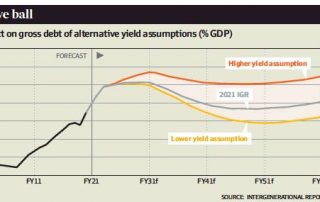
Net debt is expected to hit 34.4 per cent of GDP by financial year 2061, while gross debt – a better determiner of serviceability – reaches 40.8 per cent. And that outcome is on the rosy side – the risk is mostly downside. Dig a little deeper into the document and a very different picture emerges.

Frydenberg argues that, while gross debt has increased significantly since the onset of the pandemic, the cost of servicing that debt is lower in 2021-22 than it was in 2018-19, as a result of historically low interest rates. ‘‘Low yields, together with strong economic growth, means the government can reduce the debt-to-GDP ratio without running a surplus,’’ the 2021-22 budget papers say.

That scenario, of course, assumes low yields and strong economic growth. Sensitivity analysis in the Intergenerational Report shows that if 10-year bond yields converge from their current lows over five years to the long-run rate of 5 per cent, the debt and deficit profile deteriorates dramatically. The deficit increases by 0.6 of a percentage point to about 3 per cent of GDP by 2060-61, which adds about 14 percentage points to gross debt and lifts the outlook to just shy of 55 per cent of GDP.

Indicators generally suggest neither inflation nor bond yields will rise too far in that space of time, says Tony Morriss, Bank of America’s head of Australian economics and rates strategy. ‘‘The two major factors we would need to see would be a sustained rise in global and local inflation and a change in the global structure of interest rates and bond yields, most notably a move away from zero or negative interest rates in Europe and Japan that helped anchor yields since the GFC.’’ he says.

Then there’s the question of ‘‘strong economic growth’’. Productivity accounted for more than 80 per cent of national income growth in the past 30 years, and Frydenberg labelled it ‘‘the most vital ingredient in lifting our long-term living standards and wages’’.

Falling just 0.3 of a percentage point short of the forecast 1.5 per cent average growth rate forecast in the IGR will have significant consequences. Gross national income will be $32,000 per person lower, pushing down government tax receipts and lifting net debt as a portion of the economy to more than 57 per cent by 2060, and gross debt to just shy of 64 per cent.

The overall size of the economy would be $500 billion smaller at about $4.95 trillion (or $127,600 per person) compared with the baseline scenario of $5.46 trillion (or $140,900 per person). Yet actual productivity gains since the 2015 IGR have been barely one-third of the 1.5 per cent rate assumed.

Frydenberg says the ‘‘big bang’’ reforms of the 1980s and 1990s cannot be repeated and future reform will be incremental; but economists are sceptical about whether this will be enough to reverse the trend.

‘‘Even the sensitivity analysis suggestion of 1.2 per cent is incredibly optimistic. If we were able to achieve 1.2 per cent that would be a miracle,’’ says Blueprint Institute chief executive Steven Hamilton.

Big reform, as recent history has shown, is a difficult proposition, especially when the debate has become one where there can be no losers. ‘‘Reforms cost too many votes for governments to even try to champion them,’’ says Richardson.

The Business Council of Australia (BCA) this week pulled up the stumps on waiting for politicians to lead and drive a reform agenda, instead outlining a plan to take its message to the people and build a groundswell of support for reform.

Gross national income per person could be $10,000 better off over the decade if measures are introduced to boost productivity and stop it from ‘‘acting as a handbrake on the economy’’, says BCA chief executive Jennifer Westacott.

That wouldn’t make up for the $11,000 per-person lost over the last decade as a result of what the Productivity Commission calls the worst for productivity growth in more than half a century.

Then there’s the long-term impact on the nation’s population because of the closed international border during the pandemic, and the benefits of making up for this lost ground over the next 40 years.

Australia’s population was forecast to reach almost 40 million by financial year 2055, in the 2015 IGR, but because of COVID-19 and a much-lower-than-forecast fertility rate, it is now likely to reach about 38.8 million five years later.

This comes with a significant cost. But boosting annual net overseas migration from 235,000 a year to 327,000 by 2060-61 would lift real GDP growth from 2.3 per cent to 2.6 per cent by the end of the forecast period, and add $260 billion to the economy.

Closing borders has been politically popular, even while tens of thousands of Australians remain stranded overseas. Some people draw a connection between Australia’s success in lowering the jobless rate and the nation’s tightly sealed international border.

So, while the Intergenerational Report shows the need to not only return migration to previous levels but also boost it to make up for lost ground, the politics of such a proposition could be difficult after the Fortress Australia mindset.

Eventually tough, but necessary, decisions will need to be made on reform, on budget repair and on opening the border.

‘‘What will it take for either side of politics to do something bold?’’ asks Blueprint’s Hamilton. [If] an IGR which shows budget carnage over the next 40-years isn’t enough – what will be enough?’’ P

AUSTRALIA’S GREAT DEBT GAMBLE2021-07-29T10:07:11+10:00

Investors pay Australia to hold their money

AFR Article: Friday 11 June 2021. Page 8

The federal government has paid a negative interest rate on $1 billion borrowed from institutional investors, the first time on record the total cost of a Treasury debt sale has fallen below zero.

Institutional investors such as foreign pension funds, insurers and banks need to park their money for short periods of time in safe assets and will pay the Australian government to hold their funds for the next three months.

Yesterday investors paid between -0.010 per cent and zero to lend $1 billion to the federal government until September.

The historic financing reflects central banks’ suppression of interest rates by buying government bonds in the secondary market, and the huge amounts of cash sloshing around the world’s financial system.

It also suggests debt investors have become less worried about a potential breakout in global inflation. Bond yields spiked in February on bets of higher inflation from the Biden administration’s $US1.9 trillion ($2.5 trillion) spending stimulus.

Yesterday the government’s debt manager, the Australian Office of Financial Management (AOFM), sold a three-month Treasury note attracting a weighted average yield of -0.0034 per cent.

The negative yield on short-term government debt is partly being driven by foreign investors engaging in a currency arbitrage, market sources said.

Investment banks are buying the debt on behalf of offshore investor clients, making a loss on the yield but earning a profit on three-month forward foreign exchange contracts.

The debt raising was more than eight times oversubscribed, with total bids of $8.65 billion.

AOFM head Rob Nicholl said demand for Australian government debt was strong. ‘‘We would expect that to remain for quite some time, particularly while the banks are not issuing their own short-term bank bill paper,’’ he said.

Banks are flush with funding thanks to deposits by households and businesses that are cashed up from government stimulus payments.

Banks also have access to cheap 0.1 per cent, three-year loans from the Reserve Bank of Australia’s $210 billion term funding facility.

They are therefore discouraging institutional investors such as superannuation funds from increasing bank deposits, forcing investors to put their money into other debt instruments such as low-yielding government debt.

The Treasury note sale was the first time successful bids in a government debt auction ranged from negative territory to zero and that the total cost of the debt raising was negative.

In December the government sold $1.5 billion of debt, some of which paid a negative interest rate of -0.01 per cent to investors. But overall, the weighted average yield on the three-month Treasury note last year was slightly positive at 0.0099 per cent.

Bond rates are falling sharply as fears of an inflationary spike subside. The Australian 10-year bond rate has slid to 1.43 per cent from 1.65 per cent just a week ago, and a two-year peak of 1.85 per cent reached in late February.

‘‘Money is looking for a home as QE from central banks floods the system with cash,’’ said ALTIUS Asset Management co-founder Chris Dickman.

‘‘Counterparties are pretty happy to get zero per cent at the moment,’’ he said. ‘‘It also reflects an impression that the inflation story is cooling.’’

Earlier this week, Mr Nicholl said the government was committed to holding a large stockpile of cash to meet its funding needs in a crisis and to manage outlays such as GST transfers to the states.

The government’s cash balance at the RBA is raised through the issuance of Treasury notes. It peaked around $70 billion last September and has run down to about $30 billion at present.

The RBA is currently paying commercial banks zero to deposit excess funds with it. The policy is designed to encourage banks to seek higher returns by lending to households and businesses, or lending to the government for a positive yield on longer-term bonds.

Non-bank institutional investors, which cannot deposit cash with the RBA, are investing in other risk-free assets, such as government debt.

Investors pay Australia to hold their money2021-07-02T10:43:27+10:00