Banking & Lending

Former RBA economist slams bank’s pandemic response

The Reserve Bank damaged its credibility by miscalculating the inflationary effects of the pandemic, acting too slowly to tame rising prices and poorly communicating its intentions to the market, according to a former RBA senior economist.

Jeremy Lawson, chief economist for UK-based fund manager abrdn, which last year rebranded from Standard Life Aberdeen, where he also heads its research institute, worked at the RBA for seven years until 2008.

The RBA has echoed errors from other central banks around the world, notably the Federal Reserve, in waiting too long to act to temper swiftly rising prices, he said.

‘‘The credibility of the RBA has been damaged,’’ Mr Lawson told AFR Weekend. ‘‘Central banks really misdiagnosed just how this pandemic would influence the inflationary environment.’’

Among the RBA’s biggest mistakes has been its communications, according to Mr Lawson, who is the latest in a line of economists to criticise the bank for claiming that rates were unlikely to rise until ‘‘2024 at the earliest’’ in monetary policy statements.

‘‘They were obviously trying to underpin confidence that rates would remain low for an extended period of time, especially early in the pandemic, but it came across as a promise,’’ he said. ‘‘That communication was too strong in an uncertain environment.’’

The idea that rates would remain near zero for years may not have convinced professional investors, but everyday borrowers may have loaded up on debt that will become increasingly difficult to service as interest rates rise.

‘‘It’s one thing for markets to be thrown around by these things, but individuals, they make day-to-day decisions based on things that they might get in a headline,’’ he said. ‘‘If [rates increase] rapidly, that can have really foul consequences for people.’’

Mr Lawson’s comments come weeks after RBA Governor Philip Lowe admitted the central bank’s pandemic guidance that interest rates would not rise until at least 2024 was an ‘‘embarrassing’’ error and it ‘‘should have done better’’.

Dr Lowe said an internal RBA review of its so-called forward guidance during the pandemic would be conducted and findings made later this year.

Next week, the central bank is set to increase rates for just the second time since 2010 after last month’s 25-basispoint increase that lifted the cash rate to 0.35 per cent from its pandemic level record low of 0.1 per cent.

Economists are divided on whether the bank will raise by a further 25 basis points when it meets on Tuesday or push through a more aggressive 40-basis-point increase that would bring the rate to 0.75 per cent.

Mr Lawson said the RBA should move aggressively to tame the swift increase in consumer prices in the same vein as central banks in the US, Canada and New Zealand, which have each increased rates by 50 basis points this year. ‘‘It’s increasingly likely they’ll go in larger jumps, which is the right thing to do. Then, depending on how the economy, the housing markets, and how forward indicators evolve, maybe they can justify a pause.’’

‘‘[If they] go at 25, 25, 25, then they only get to where they need to be sometime in 2023. That’s taking too long.’’

He thinks the Australian cash rate will peak at 2.75 per cent in the current hiking cycle, a forecast roughly in line with three of the four major banks.

Commonwealth Bank remains an outlier: its economists expect a shallower tightening cycle with a terminal rate of 1.6 per cent early next year. Investors hold a more bullish outlook, however, with bond market pricing implying the cash rate will increase to 3.6 per cent over the next 12 months.

The global wave of rising interest rates across developed market economies to dampen inflation will increase the likelihood of recession in the coming years, which has become abrdn’s base case scenario.

Former RBA economist slams bank’s pandemic response2022-06-08T18:29:50+10:00

Soaring construction sector costs hit home

Property Supply chain shortages are creating headaches for builders.

Building a home became a lot pricier for one Metricon customer when the company called and asked for an extra $100,000 to build a dwelling that was approved, but not yet started.

It was a shock and gave no confidence about when their knock-down-and-rebuild project would be complete, one of the Sydney-based couple said.

‘‘Their reason was that the previous pre-site manager underestimated the cost,’’ he said. ‘‘I find this to be the most ridiculous excuse to recoup money from us.’’

An underestimate may not be so far from the truth. Figures this week showed the cost of a new house rose by a record $76,715 in April from a year earlier due to the global supply chain crisis sparked by the pandemic and worsened by the war in Ukraine and further omicron COVID-19 restrictions in China, as well as surging local demand.

Whether Metricon and other home builders will be able to recoup these higher costs, however, is unknown. Another Sydney Metricon customer who AFR Weekend spoke to on Friday – who had not been asked for extra – said his contract gave the company no pathway to renegotiate.

The company, which in March tried to renegotiate contracts with Queensland clients – a move it reversed after the state government said there was no legal basis for clients to pay more – said it would not attempt to alter ‘‘valid’’ contracts with customers.

‘‘Metricon is committed to fulfilling every valid contract in which a fixed price has been agreed,’’ said Patrick Eather, the company’s general manager for NSW.

But with supply shortages affecting the whole sector, rather than just one company, there’s no guarantee any other builder could take on a Metricon job any more cheaply than the country’s largest home builder.

A rule of thumb in a new home build is that materials account for 45-50 per cent of total costs, labour 35-40 per cent and profit margin 15-20 per cent – excluding land, taxes and other charges.

Wholesale, or producer price figures for the March quarter show the biggest material cost increases over the four quarters were in reinforcing steel, which rose 43.5 per cent, structural timber, which jumped 39.2 per cent, and plastic pipes and fittings, which gained 26.5 per cent.

The construction industry early on anticipated that the pandemic would push up costs of materials and labour, and it was right.

Shortages of materials across the board were surging by mid-2021 – a little-known polystyrene product used in housing slabs called waffle pods was particularly hard to come by – and in February, Simonds Group plunged to a first-half $5.2 million loss as a result of crimped supply of materials and labour, along with COVID-19 restricting on-site activity.

In March, the invasion of Ukraine dealt a further blow to already-stretched global supply chains, when retailer Bunnings ordered suppliers to stop buying ‘‘conflict timber’’ from Russia in the wake of declarations earlier that month by global forestry bodies about timber from that country and its ally Belarus.

Housing Industry Association numbers show that home building-related trades costs rose 2.1 per cent in the March quarter and were up 5.1 per cent from a year earlier. Bricklayers, carpenters and painters showed the most cost increases.

The big exception to rising prices across the board was a 12 per cent drop in the cost of trades for site preparations. This reflected the hangover from a year earlier, when home buyers and builders rushed in the March quarter to kick off construction of their HomeBuilder-subsidised dwellings, HIA executive director for industry policy Geordan Murray said.

‘‘There was a massive spike as everybody tried to get their slab down,’’ Mr Murray said.

The rising costs are now depressing home building. Activity in both house-building and apartment construction fell in May, industry figures published in the Ai Group-HIA performance of construction index show, as disrupted supply, cost increases and difficulty filling positions pushed out project completion times.

‘‘Some house builders reported falling demand by customers concerned about price escalation and higher interest rates,’’ the PCI report said.

One positive sign is that the pace of growth in building cost inflation may now have peaked.

‘‘The cost of materials isn’t going to increase in the next 12 months like it did in the past 12 months,’’ said HIA chief economist Tim Reardon.

That doesn’t mean costs will fall, but simply that the rate of gain will slow, he said. This creates a separate concern.

The delays pushing out new already-contracted housing work could encourage the RBA to raise rates higher that it would have otherwise done – because the sector will keep ticking over employing people and obscuring the effect of rising rates on the rest of the economy, Mr Reardon said.

‘‘They risk overshooting,’’ he said. ‘‘The lag between rate rises and a decline in housing starts is more than 12 months, whereas in 2010 it was about six months. There’s just that much work in the pipeline.’’

Soaring construction sector costs hit home2022-06-08T18:28:18+10:00

Rate rise won’t dent blue chip confidence

At almost exactly the same time the Reserve Bank was pressing the button on its first interest rate rise in 11 years yesterday, Seven Group chief executive Ryan Stokes was revealing a ‘‘stronger for longer’’ infrastructure boom was gathering pace across the nation, just as commodity prices keep the good times rolling for Seven’s WesTrac heavy equipment division.

A few hours earlier, Wesfarmers chief Rob Scott had declared his confidence that the lowest unemployment rate in decades, rising incomes and an enlarged savings pool meant Australia’s household and housing sectors – so vital to the health of his Bunnings chain – could withstand rates rise.

And Mirvac boss Susan Lloyd-Hurwitz pointed to unheard of tightness in the industrial property sector, a recovering office and retail market, and positive medium-term outlook for apartments.

So while the RBA’s unexpectedly large interest rate rise might have underscored the growing challenge of inflation, the mood from company chief executives at the Macquarie Australia Conference in Sydney was clearly optimistic.

Supply chain dislocations and labour shortages are presenting real challenges, and cost pressures keep building, but an environment of strong demand is allowing most companies to pass through these inflationary pressures and underpinning confidence.

The conference, which brings together investors and companies across 103 presentations and close to 1000 one-on-meetings, is being held in-person for the first time since 2019, and it was no surprise to feel a real buzz in the room.

Not only has the Australian funds management community come out in force, but a strong contingent of international investors has made the trek to Australia for the first time since the pandemic struck in early 2020.

As always, the outsider view is interesting. For these international investors – it is understood the big names visiting include T Rowe Price, Fidelity and GIC – the Australian market can play a range of roles in a portfolio.

For example, the ASX is exposed to China, but has less of the volatility and geopolitical risk that the market has seen in recent times. It’s experiencing a level of inflation, but much less in the United States, where anxiety about earnings and valuations is growing.

And it offers great exposure to the commodities thematic that has become so popular (perhaps even overcrowded) since Russia invaded Ukraine.

The companies presenting at the conference would have given these international investors plenty to think about.

Wesfarmers, which sits across a big chunk of the Australian economy – retail, the industrial sector via its chemicals business, small business via its Officeworks and workwear divisions, and resources and energy via its new lithium project – painted a picture of broad economic resilience, even as inflationary pressures continue to build.

CEO Scott said while rate rises ‘‘obviously puts a lot of focus back on the housing market’’, the conglomerate remained ‘‘very confident about the Australian housing market and household spending generally’’.

‘‘Low unemployment and household savings, combined with a structural benefit as people spend more time working from home, provides a strong base for future investment in and around the home,’’ he said.

Real wage growth, Scott pointed out, was good for the economy and good for Wesfarmers. And while inflation created challenges for the broader economy, it would give smart companies that can limit cost rises the chance to take market share from competitors.

Mathematics says higher interest rates puts downward pressure on asset prices, but Charter Hall managing director David Harrison downplayed the impact, arguing sensible market participation would take a long-term view on rates like they do through every cycle.

Higher borrowing costs could also create opportunities, as corporates with ‘‘lazy’’, asset-heavy balance sheets consider options such as sale and leaseback arrangements.

This thread was also picked up by Lloyd-Hurwitz, who reminded the conference that there was still a level of post-lockdown demand flowing through the economy.

‘‘There are so many decisions that corporates didn’t make over the last two years that will need to be made.’’

For Mirvac, that manifests in the office sector, where demand for quality assets (read the latest and greatest) remains high.

Stokes presented another picture of broad economic strength. With strong iron ore, coal, nickel, copper and lithium activity expected to continue, the outlook for Seven’s WesTrac division – which sells Caterpillar heavy equipment and parts – looks sound.

In infrastructure, where Seven’s Coates equipment hire business is a major player, an estimated $1.1 trillion of infrastructure spending over the next five years is expected to underpin strong demand.

Stokes says that while Infrastructure Australia expects spending to peak in 2023, ‘‘our expectation is that this wave of infrastructure investment will run stronger for longer’’ due in no small part to shortages of specialist skills.

The challenge of labour was a constant refrain across the conference. It is clear that pressures are intense in nearly every sector and calls for immigration to open up to plug gaps are likely to grow louder.

As Reserve Bank governor Philip Lowe warned markets to prepare for the cash rate to rise from yesterday’s new level of 0.35 per cent to 2.5 per cent, ASX investors were given a little taste of the sectors likely to feel the most pressure from rising rates, with technology and real estate sold off.

No surprises there. But investors will need to watch carefully over the coming months to see what impact rate rises have on what ASX companies still believe is a pretty strong economy.

Rate rise won’t dent blue chip confidence2022-05-20T15:57:26+10:00

These lenders will save you money

Refinancing Home owners looking for a better rate should not overlook smaller outfits they’ve never heard of, writes Lucy Dean.

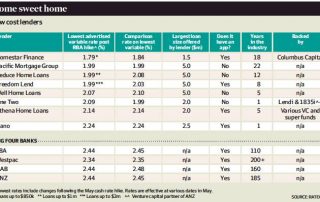
Borrowers looking for a better rate may hover over low-cost lenders such as Athena, Nano and One Two before moving on due to their unfamiliar names, but doing so may close them off to opportunities to save thousands of dollars.

While the idea of moving to a lesser-known lender may not sit well with some borrowers, home owners should remember that when it comes to risk, it is the lender who loans the money – not the other way around, says RateCity research director Sally Tindall.

‘‘Borrowers on the hunt for ultra-low rates sometimes hover over the low-cost lenders, but quickly move past them, based on their unusual names,’’ she says.

‘‘However, if people have the time, it’s worth probing just a bit deeper into their background because often their origin and history might surprise you.’’

For example, many of these cheaper lenders have been in the market for more than a decade, with Homestar Finance founded in 2004 and Reduce Home Loans in 2010. Newer lenders such as Athena, Nano and Tic:Toc have been set up by former bank executives from NAB, Westpac and Bendigo and Adelaide Bank.

‘‘These non-bank lenders have helped drive prices down across the entire home loan market, particularly since the start of COVID-19 when record numbers of borrowers switched lenders to get themselves into a better financial position,’’ Tindall says.

‘‘Even if people don’t end up switching over to a low-cost lender, they can still use these low rates in their research to get a benchmark of what’s competitive and what is not.’’

Mortgage broker and founder of Madd Home Loans, George Samios, says his firm is refinancing about $20 million a week after the Reserve Bank’s decision to raise rates.

‘‘Everyone’s looking at their loans now,’’ Samios says.

Any borrower who hasn’t heard from their lender in the past 12 months should be analysing their current deal and working out if they can get a better one, he says.

‘‘If you don’t review your loan once a year, you’re losing thousands of dollars. That is the biggest takeaway point.’’

Samios says it is worth considering a broker because they will negotiate with lenders to get the best rate. Every loan he has written in his 20-year career was negotiated to get the best deal.

Going through a broker can mean some borrowers who have the right amount of equity could get better deals at the bigger banks, which are now also trying to compete on price.

Generally speaking, any variable loan with an interest rate beginning with a 3 or 4 (per cent) means the borrower is ‘‘being severely ripped off’’, Samios adds.

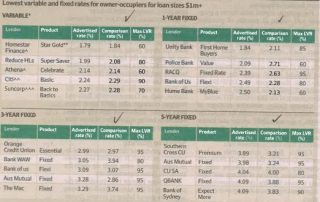
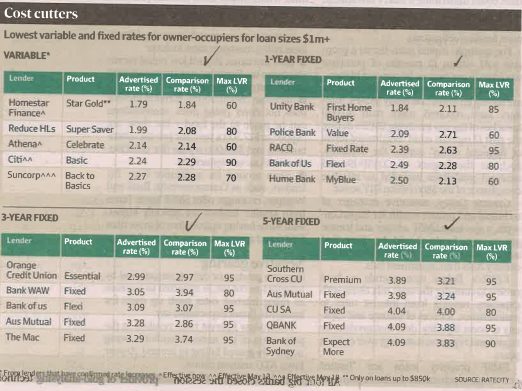
Switching a $2 million home loan from the average 3.17 per cent variable rate to one of the lowest variable rates would save home owners as much as $41,446 over two years, RateCity analysis found.

That is based on the average 2.10 per cent variable rate across three of the cheapest lenders.

A borrower with a $1 million mortgage who refinanced to a 2.02 per cent interest rate, based on the average of the three cheapest lenders for that loan size, would save $21,522 over two years.

They are huge savings, but borrowers still need to check the fine print – no matter who they are refinancing with.

‘‘What you should be really careful about is the terms of the loan,’’ says University of NSW business school professor Richard Holden.

‘‘The history of the subprime crisis in the US went well beyond subprime to people with really good credit ratings who got things like adjustable rate mortgages and didn’t pay attention to the fine print, which said, ‘It’s going to go up 25 basis points a quarter after the adjustable rate period ends’.’’

He says borrowers need to make sure they understand the differences between their current and new loan.

‘‘These smaller lenders probably aren’t going to make big inroads into the market by offering a higher interest rate, so it’s natural that they’re going to offer a lower interest rate,’’ he says. ‘‘You just want to make sure that you’re not paying for it in some other way.’’

But he adds that borrowers need to be equally aware of the risks that come with inertia and simply choosing to stay with their lender.

One difference between a larger lender and a smaller lender is often in the level of customer service provided, adds Tindall.

‘‘That’s not to say one is better than the other. Often it comes down to your needs and your personality,’’ she says.

‘‘Smaller lenders typically have fewer resources. However, you might find you like their more personalised customer service style. You won’t know unless you test it out, so do exactly that.’’

She suggests potential refinancers ring the call centre at their prospective lender and ‘‘ask some tricky questions’’, take a look at their website or use their online chat service to see how easy key information is to find.

For example, if information about fees and charges is hard to find, that can be a red flag.

‘‘Customers looking for an offset account should be aware some low-cost lenders offer ‘offset’ facilities where the money isn’t held in a separate bank account,’’ she adds.

‘‘While this may not worry some customers, people who like the idea of keeping their money separate from their home loan might prefer to use a more traditional offset account.’’

It is also a good idea to read the reviews of what real customers are saying.

‘‘Doing this research will also help you feel prepared and informed and that’s important,’’ Tindall says. ‘‘The bottom line is, it’s important to be happy with your home loan provider, otherwise you could end up feeling uneasy for years.

‘‘If you fundamentally like the idea of having your home loan with a bank that offers a suite of other products and at least a handful of bricks-and-mortar branches, there are still plenty of competitive deals at your disposal.’

These lenders will save you money2022-05-17T09:07:02+10:00

Ease the rate-rise squeeze

Home loans Whether you’re an owner-occupier or investor (even via your DIY super fund), you can use these strategies to help handle interest rate rises, writes Duncan Hughes.

A mortgage-holder with a $1 million home loan on the average variable rate could insulate themselves against the equivalent of several Reserve Bank of Australia cash rate increases by switching to the cheapest variable rate on offer.

It would take more than four rates rises equivalent to this week’s 25-basis-point increase to bridge the gap between the cheapest and average rates on offer, analysis shows.

Before this week’s increase, the average owner-occupier borrower with a 25-year variable rate home loan was paying around 2.92 per cent, or 113 basis points higher than the lowest variable rate.

With lenders passing on the rate rise later this month, the same borrower is expected to pay around 3.17 per cent, or 118 basis points higher than the lowest variable rate on offer.

The lower rate would save a borrower nearly $10,000 in the first year, or $21,500 over two years, according to analysis by RateCity, which monitors savings and borrowing rates.

Bankers warn borrowers there could be a string of interest rate rises over the next year, with RBA governor Philip Lowe saying the cash rate could rise from 0.35 per cent to 2.5 per cent.

The big banks have also updated their cash rate forecasts, with CBA expecting 1.6 per cent by next February and NAB citing 2.6 per cent by August 2024.

A cash rate of 2.6 per cent would mean an increase in monthly repayments of $1350 for a borrower with a $1 million, 25-year principal and interest mortgage.

But other bankers, such as Macquarie bank’s global head of strategy Viktor Shvets, believe deteriorating economic conditions will force central banks to consider ‘‘backpedalling’’ by reducing rates within 12 months.

Mortgage brokers are urging borrowers to ‘‘calmly consider their options’’ and not rush into more expensive alternatives, such as switching from a variable to a fixed rate. Some lenders are increasing fixed rates by more than 50 basis points.

‘‘Borrowers are clearly concerned about the future and how several rate rises will squeeze household budgets,’’ says Phoebe Blamey, director of Clover Financial Solutions, a mortgage broker.

‘‘But many are in a strong position to manage those increases because of increasing savings in offset accounts when rates were low, and a readiness to find a cheaper rate,’’ Blamey says.

Residential property borrowers have made the most of record low rates to squirrel away a record $232 billion in offset accounts (an increase of nearly 15 per cent, or $30 billion) in the past 12 months as insurance against higher rates.

Maile Carnegie, ANZ group executive Australia retail, says around 70 per cent of accounts are ahead on repayments – many of them by two years or more. Household deposits are also at record levels.

Whether you’re an owner-occupier, investor or own a property via a self-managed super fund, here’s how you can lessen the impact of rate rises.

Switch your loan

A borrower with a $1 million mortgage could recoup the costs of switching from the new average variable rate of around 3.17 per cent to the cheapest variable rate on offer within a couple of months.

Costs in switching to a 25-year principal and interest loan would include a $350 discharge fee from the former lender, around $300 in state government fees and upfront fees on the new loan of around $930.

The savings (after costs) of switching from the average to the cheapest variable rate are around $833 a month, RateCity says.

Mortgage brokers warn some nervous borrowers are so concerned about a string of rate rises they are considering paying an extra 100 basis points plus switching fees for the supposed security of a fixed mortgage rate.

‘‘Keep your eye on what is best for your finances,’’ says Christopher Foster-Ramsay, principal of mortgage broker Foster Ramsay Finance. ‘‘Don’t be distracted by guessing what rates will do,’’ he adds.

Some borrowers could be forced to review their borrowing because of changed financial circumstances, such as a job loss or having misrepresented their income, or savings, to the lender. For example, around 37 per cent of homebuyers overstate their financial position when applying for a home loan, according to investment bank UBS. Key issues borrowers need to consider: What rates are on offer and how rising rates will affect repayments and household budget. Can extra repayments be made before the next rate rise? Fees and charges and how long it will take to recoup in lower interest repayments. Breaking a fixed rate can cost thousands of dollars, plus establishment and annual fees with the new lender. Ask for a detailed breakdown before agreeing to the loan, including application, settlement and discharge fees. Some low fixed rates roll to high variable rates after the fixed term, which will also affect the comparison rate.

State government fees vary between states, but expect to pay between $300 and $500.

Check the small print conditions to make sure the loan is portable so could be switched to another property.

What are the loan features? Does it include an offset account and allow additional payments?

Is the lender flexible in case of unexpected events? For example, some lenders offer short-term repayment ‘‘holidays’’. Alternatively, does it accept reduced payments instead of full suspensions, or a combination of both?

Check the level of support, such as call centres, a branch network or internet access.

Too late to fix

Property investors have ‘‘missed the boat’’ for fixed rates and should instead shop around for cheapest variable rates, financial and mortgage advisers say.

An investor with a 20 per cent deposit will pay around 2.59 per cent for a principal-and-interest variable loan from CBA, or around 56 basis points lower than a comparable interest-only mortgage, RateCity says. (These rates have yet to be adjusted following the cash rate rise.)

By comparison, some banks charge 4.39 per cent for a three-year fixed rate or 4.89 per cent for five years.

Alex Jamieson, founder of AJ Financial Planning, says: ‘‘The best time traditionally to fix rates is in the middle of a recession, when interest rates have been cut and the recovery phase is just about to start. That’s not now. Investors considering a fixed-term mortgage have missed the boat. Variable is the way to go.’’

While fixed-rate loans offer some certainty about repayments, they often don’t allow extra payments, are costly to exit and have fewer loan features, such as offset accounts or redraw facilities.

Investors pay a premium of 33 basis points on existing home loans and a 29 basis-point premium on new loans, RBA analysis shows.

Higher rates are unlikely to deter long-term investors seeking higher yields and long-term capital gains, particularly when national property vacancies are less than 1 per cent, the lowest in 17 years, according to SQM Research, which monitors property markets.

Analysts expect rents to rise rapidly in tight rental markets, particularly after the ending of rent caps and eviction controls in the pandemic. These are likely to offset the impact of higher mortgage repayments when rates begin to rise.

Tim Lawless, research director at CoreLogic, which monitors property markets, says while higher rates will discourage some investors, there are others attracted by strong tenant demand, despite low rental demand from foreign students and the soaring cost of building materials and labour shortages.

Every capital city in Australia has vacancy rates below 2 per cent, with Melbourne’s the highest at 1.9 per cent, or less than half what it was about 12 months ago, adds SQM Research.

National gross yields posted a small gain to 3.23 per cent during March, the first since August 2020, and are outperforming capital growth of 2.4 per cent, according to CoreLogic.

As to whether investors are better off on interest-only or principal-and-interest loans, AJ Financial Planning’s Jamieson says a typical long-term investor with a $1 million portfolio is better off paying down the principal and lowering debt using a principal-and-interest loan.

SMSF strategies

Trustees of self-managed super funds (SMSF) investing in property should undertake a full review to ensure there is sufficient liquidity to deal with any financial pressure from rising rates and costs.

SMSF specialists warn increasing expenses might require trustees to increase member contributions, raise rents or sell fund assets to meet increasing liabilities, such as paying pension benefits.

Julie Dolan, head of SMSF and estate planning for KPMG Enterprise, says: ‘‘Trustees should play it safe and have a couple of years’ rental income in the fund as a buffer.’’

Dolan says the likelihood of more interest rate rises over coming months could create stress in funds facing rising expenses without readily available liquid assets, such as listed shares that can be sold, or available cash.

Demand for residential and commercial investment properties jumped during last year’s property boom by around 22 per cent to almost $66 billion, according to analysis by the Australian Taxation Office.

The value of property in SMSFs also rose by about 22 per cent to a record $140 billion, thanks to rising prices and investments, the analysis shows.

Falling property prices and rising interest rates could undermine a fund’s investment strategy and increase taxes if a liquidity squeeze forced a fire sale of a property to meet funding obligations.

For example, capital gains tax on a property sold within 12 months of purchase would be 15 per cent, or 50 per cent higher.

The economic slowdown and rising costs are having an impact on many SMSFs. Auditors have reported more than 40,000 breaches of the law involving SMSFs during the past 12 months amid ‘‘heightened levels of financial stress’’ across the economy, such as the impact of COVID-19 and renewed guidelines intended to increase compliance of the $860 billion DIY sector.

Graeme Colley, executive manager of technical and private wealth for SuperConcepts, a specialist SMSF adviser and trustee group, says funds should be diversified across a range of asset classes to avoid unnecessary risks if an investment fails.

KPMG’s Dolan recommends a fund review to consider the asset mix along with expenses, ranging from interest rates to maintenance, sources of income and capacity to boost liquidity, debt that needs to be repaid and repayment strategy over coming years.

SMSF property loans are ‘‘limited recourse’’, which means the banks can claw back only the specific asset purchased if the loan defaults.

Loan repayments must come from the fund, which means there must be sufficient liquidity or cash flow to meet loan repayments.

Strategies to ensure adequate liquidity to meet rising mortgage rates include:

Rent increases. Record low rental vacancies mean landlords have an unprecedented opportunity to raise rents.

Increase contributions. If rental income does not cover rising rates, contributions can be made to the fund – but these are capped at $27,500 a year (for pre-tax contributions) and $110,000 a year (for contributions with no tax deduction).

Shop around for a cheaper loan. Big lenders, such as Commonwealth Bank and Westpac, no longer offer SMSF loans. Rates from smaller lenders are typically higher, with some having upfront fees of more than $3000 and annual charges of about $400.

Negative gearing

Negative gearing, or debt strategies used by investors to cut tax, is expected to increase as rising interest rates push up costs for landlords, finance specialists say.

Record-low interest rates resulted in the proportion of the nation’s landlords being negatively geared falling to around 20-year lows, ATO analysis shows.

But Shane Oliver, AMP Capital chief economist, says: ‘‘It will probably rise as rates rise.

‘‘The collapse in mortgage rates relative to property rental yields made it harder to negatively gear properties as the interest cost in many cases fell below the property’s net income,’’ Oliver says. ‘‘With rates on the rise again, negative gearing will become easier to achieve.’’

Investor confidence is being partly sustained by the absence of any federal election policies that might lead to a cutback on generous negative gearing concessions or depreciation allowances.

Investors spearheaded demand for residential property loans last year, despite it being difficult to derive much benefit from negative gearing.

‘‘Investors may have been buying in anticipation that the value from negative gearing from a tax perspective will return,’’ Oliver says.

The proportion of Australia’s 2.3 million landlords who are negatively geared was around 60 per cent in 2019, about the same as the previous two years and the lowest since 2003, according to ATO data.

The data shows that in 2019 around 1.3 million landlords made rental losses, while 922,175 (or around 40 per cent) were in a neutral position or made a gain. When losses on an investment property are greater than the gains, the losses can be used to reduce tax on wages or other income.

Analysis by Jeremy Goldschmidt, chief executive of RentBetter, a DIY platform for property investors seeking to cut out professional managers, estimates that average rental properties around Australia are losing their owners more than $1000 a month, despite negative gearing concessions.

Goldschmidt says many landlords fall back on tax deductions rather than looking for more effective ways of cutting expenses and boosting returns.

‘‘Good investing requires close management of expenses. Effective landlords will be looking for ways to manage down other expenses rather than rely on tax deductions,’’ Goldschmidt says.SI

Ease the rate-rise squeeze2022-05-13T14:14:11+10:00

WHY INTEREST RATES WILL KEEP RISING

Stormy waters Everyone, from the Reserve Bank to economic commentators, has reached a consensus that Australia is in for a sustained period of increasing rates, writes John Kehoe.

The global inflation wave has washed on to Australia’s shores, right in the middle of the federal election.

The price pressures and looming interest rate rises have exposed that the Coalition and Labor do not have a serious economic plan to deal with inflation. Rather, the government is pouring another $5.6 billion of ‘‘cost of living’’ cash hand outs and tax refunds on to the inflation bonfire.

The election pork will add to inflation pressures that have been underestimated by both the Reserve Bank of Australia and Treasury. The RBA boldly declared at the start of the pandemic that inflation would not be sustainably high enough to lift the 0.1 per cent cash rate until at least 2024 and last December said the market should not expect rate rises in 2022.

But times have changed. Inflation hit 5.1 per cent in the March quarter, the highest annual rate since the 10 per cent goods and services tax was introduced in 2000-01. Wholesale electricity prices have doubled over the past year and will soon begin flowing through to retail power prices, due to the soaring cost of coal and gas triggered by the war in Ukraine.

The government rightly points out much of the price pressures are due to international forces out of its control, including war driving up the global oil price and supply chain disruptions from the pandemic, particularly in the manufacturing hub of China.

Nevertheless, home-grown price pressures are also building due to strong demand from cashed up consumers and the economy running near full capacity, as evidenced by a firming in inflation of non-tradable items and services. Food, housing, transport and education prices are rising.

The RBA will soon begin raising interest rates, either next week or in early June, and keep raising the cash rate in the months ahead. It is a welcome development that the cash rate will finally be lifted from an emergency low of near-zero. The economy, with a low 4 per cent unemployment rate, has rebounded from the pandemic due to $314 billion of federal government stimulus.

To be sure, controlling inflation is predominantly the remit of the independent central bank. But despite economic management rhetoric from the government and cost of living complaints from Labor, neither side of politics is offering a comprehensive economic policy plan to contend with inflation and productivity.

Dan Andrews, a former Treasury, RBA and OECD official, says, ‘‘if the inflation tide has turned, then the imperative is to boost supply via productivity improvements’’.

‘‘The chickens are coming home to roost,’’ says Andrews who is now program director at the e61 Institute. ‘‘The supply side productivity agenda has been neglected for some time. Reforms matter now more than ever given that inflation typically arises from strong demand pushing up against supply constraints in the economy.’’

To lift chronically weak productivity growth of the past decade, economists nominate reforms to the tax system, boosting competition against incumbent firms to allow the growth of more innovative firms, improving energy and climate policy to lift investment, enhancing workplace relations and labour mobility, and better regulation to reduce red tape barriers. But these areas are largely off the table among a political class that believes voters are not up for a difficult national conversation.

There is also no plan from the Coalition or Labor to rein in structural budget deficits which will further fuel demand pressures in the economy if inflation persists more than previously thought. Barrenjoey chief economist Jo Masters says: ‘‘There is no real talk of any serious reform and everyone is small target on the economy.’’ She adds: ‘‘The inflation cycle makes it imperative to lift real wages through productivity-enhancing reforms.’’ And: ‘‘Economists are exhausted talking about it.’’

Labor’s economic plan this week pledged more spending on childcare, aged care, clean energy and to support pay rises for aged care workers, while unveiling a modest $5 billion in savings over four years on ‘‘waste and rorts’’. Shadow treasurer Jim Chalmers argues cheaper childcare will reduce family costs and inject more productive female workers into the workforce.

The Coalition is largely running on the economic performance during the pandemic, with little new policies. The 22.1c a litre petrol excise cut for six months, while politically understandable when prices were above $2 a litre, will only artificially and temporarily reduce inflation.

More than half of businesses have experienced cost increases over the past three months and a majority of firms passed price increases on to their customers, an Australian Bureau of Statistics survey reported this week. Coles chief executive Steve Cain says he is receiving price rise requests from suppliers. Moreover, the two-year closure of the international border and broader pandemic concerns have reduced the flow of labour around the world. Unions and workers are starting to demand larger pay rises, to catch up to inflation. Outlook Economics director Peter Downes says the low 4 per cent unemployment rate is starting to generate wage pressures, a factor the RBA would be picking up in its business liaison.

RBA governor Philip Lowe in early April signalled he would like to see both inflation and wages rising before lifting the 0.1 per cent cash rate. The next wage price index print is due on May 18 and average earnings data in the national accounts on June 1.

If Lowe holds true to his public statements about the bank’s ‘‘reaction function’’ being wages, then a pre-election rate rise is not on, and the RBA would wait until June. Treasurer Josh Frydenberg publicly reminded the RBA of this framework this week – a move Chalmers said undermined the independence of the central bank.

But the big 5.1 per cent jump in annual inflation and 3.7 per cent rise in underlying inflation will force the RBA to consider moving the first rate increase forward to next week. A gentle 0.15 of a percentage point rise to 0.25 per cent is a live option.

Outlook’s Downes says: ‘‘There is no point waiting any longer.’’ He adds: ‘‘Knowing what we know now, they should have started raising rates at the start of the year. The longer the RBA waits the higher they will have to raise rates later.’’

He says Australia can and should avoid repeating the ultra-high 8.5 per cent inflation rate of the United States ‘‘without having to raise rates too much’’.

Money market traders have priced in a 2.5 per cent cash rate by the end of the year, implying rate rises every month for the rest of the year.

Commonwealth Bank of Australia economist Gareth Aird argues high household debt levels will limit RBA increases to about 1 per cent by December.

The Morrison government would obviously prefer the RBA wait until after the election to raise rates, while Labor would welcome a pre-election rate rise to drive home its cost of living pitch to voters.

But sensing the RBA might move next week, the government has warned that the economic uncertainties caused by inflation and rate rises mean now is not the time to risk handing the economy to an inexperienced Labor government.

Morrison also makes the point that it’s very different to when the RBA raised rates in the 2007 election campaign – a move that upset then prime minister John Howard and treasurer Peter Costello. Back then rates were already at 6.5 per cent and Howard had pledged to keep them low. .

Andrews recalls the RBA’s interest rate hiking cycle in 1994, when the RBA raised the cash rate from 4.75 per cent to 7.5 per cent in six months. Then, Australia was on the cusp of a productivity boom thanks to the internet revolution and economic reforms of the Hawke-Keating governments in the 1980s and 90s. Andrews says productivity was one of the factors why the RBA didn’t keep hiking rates beyond 1994.

‘‘That expanded the speed limit of the economy and inflation was brought under control,’’ he says. ‘‘We’re in a very different place right now because we haven’t done substantive structural reform.’’

WHY INTEREST RATES WILL KEEP RISING2022-05-03T09:42:36+10:00

Fears of emerging markets debt crisis

Emerging market funds are being hit with increased withdrawals as investors worry that soaring food and oil prices will fuel social and political tensions, while rising interest rates in the United States will make it harder for cash-strapped governments to meet hefty debt repayments.

For the past few decades, investment managers have touted the benefits of investing in emerging markets, claiming that their higher economic growth rates translate into bigger opportunities for local companies, and that falling trade barriers would improve their access to developed markets.

But returns have been disappointing over the past decade. Most emerging market index-linked funds have delivered average annual returns of less than 4 per cent over the 10-year period.

But investors fear that the outlook is becoming even bleaker for emerging markets, as Russia’s invasion of Ukraine is propelling food and energy costs even higher, at a time when the US central bank is pushing up interest rates, which has caused global financing conditions to tighten.

Investors are worried that emerging countries will be hit by a wave of social unrest as global food prices have climbed to their highest ever level after Russia’s invasion of Ukraine.

Soaring prices for cooking oils, cereals and meats meant that food commodities cost a third more than the same time last year, according to the UN Food and Agriculture Organisation.

Russia’s invasion of Ukraine has disrupted the supply of key commodities, including wheat, corn, barley and sunflower oil.

(Over the past five years, the two countries together have accounted for almost 30 per cent of the world’s wheat exports, 17 per cent of corn, 32 per cent of barley (a crucial source of animal feed), and 75 per cent of sunflower seed oil, an important cooking oil.)

The war has helped push cereal prices up 17 per cent over the past month, while the cost of vegetable oil has jumped 23 per cent.

The surge in food costs has a bigger impact in less affluent countries. In advanced economies, food typically accounts for less than 20 per cent of consumer spending. In developing countries, a much higher proportion of the household budget is spent on food.

Even before the war, food prices were pushing higher, following serious droughts and floods in major food producing regions, and because of shipping delays and rising freight costs caused by the coronavirus pandemic.

There are growing fears that food prices will push even higher, as the war in Ukraine makes it unlikely that more than one-third of the country’s cropland will be planted this year.

Meanwhile, many countries are bracing for smaller harvests as farmers reduce their use of fertiliser, the price of which has climbed to a record high amid a steep drop in Russian supply. Russia is the world’s largest fertiliser exporter, accounting for about 15 per cent of global supply.

At the same time, rising energy costs will exacerbate cost-of-living pressures in emerging markets given that energy typically accounts for between 5 per cent and 10 per cent of measured inflation in these countries.

The oil price surged above $US100 a barrel for the first time since 2014, and natural gas prices vaulted sharply higher following Russia’s invasion of Ukraine. At present, oil is trading just under $US100 a barrel.

Some emerging economies which are major exporters of fossil fuels – such as Saudi Arabia and Malaysia – benefit from soaring energy prices, which lift their export revenues and boost government revenues.

But emerging countries that are dependent on energy imports – such as India, Thailand and Turkey – face a blowout in their import bills and higher domestic inflation.

Investors also fret that emerging markets will be the most serious casualties from tighter US monetary policy.

Last month, the US Federal Reserve raised official interest rates for the first time since 2018, and pencilled in six more rate rises this year.

The Fed has also signalled that it plans to shrink its $US9 trillion ($12.15 trillion) balance sheet at a rapid rate, which will lead to a significant tightening in global financial conditions. And this will likely make it more difficult, and more expensive, for emerging markets to refinance their growing debts.

According to a World Bank report, Finance for an Equitable Recovery, released in February, emerging economies are taking longer to recover from the pandemic than advanced economies.

‘‘The evidence available so far suggests that the economic effects of the pandemic will be more persistent and severer for emerging economies,’’ it says.

‘‘For example, after the collapse in per capita incomes across the globe in 2020, 40 per cent of advanced economies recovered and exceeded their 2019 output level in 2021.

‘‘The comparable share of countries achieving per capita income in 2021 that surpassed their 2019 output is far lower for middle-income countries, at 27 per cent, and lower still for low-income countries, at 21 per cent, pointing to a slower recovery in poorer countries.’’

The World Bank report also notes that governments in many emerging countries introduced unprecedented emergency support measures – such as cash transfers to households and credit guarantees for businesses – to cushion the economic impact of the pandemic.

But this has had the effect of causing the debt levels of many developing countries – which were already at record highs before the pandemic – to balloon even further.

‘‘The pandemic has led to a dramatic increase in sovereign debt,’’ the report says.

‘‘The average total debt burdens among low- and middle-income countries increased by roughly 9 percentage points during the first year of the pandemic … compared with an average increase of 1.9 percentage points over the previous decade.’’

And, it says, interest payments in emerging economies have been rising even before the Fed raises interest rates.

‘‘Although interest payments in high-income economies have been trending lower in recent years and account, on average, for a little over 1 percentage point of GDP, they have been climbing steadily in low- and middle-income economies.’’

The problem is that these interest payments will increase further as the Fed pushes US interest rates higher.

What’s more, much of the borrowing is denominated in US dollars, and the greenback tends to rise in tandem with higher US interest rates.

This means that emerging markets could be hit with another shock, as their local currency depreciates against the US dollar, which will make their debt repayment even more onerous.

Fears of emerging markets debt crisis2022-04-26T12:09:55+10:00

Investors return as rents soar up to 20pc

Rebound Vacancies below 1 per cent and strong demand is driving renewed interest, writes Duncan Hughes.

Residential rents rising as fast as property prices are attracting investors seeking higher yields, a hedge against inflation and generous depreciation and tax breaks. House rents in some of Australia’s capital cities have risen between 15 and 20 per cent during the past 12 months as supply fails to keep pace with a sharp rise in demand, particularly in higher-density, regional capitals.

‘‘This will attract more investors into the market,’’ says Louis Christopher, chief executive of SQM Research, which monitors property markets.

Investor borrowing, which was running out of steam in February after increasing around 116 per cent in the 12 months to last May 31, is expected to rebound even more strongly as competition grows, says buyers’ advocate Cate Bakos.

Andrew Wilson, chief economist for My Housing Market, a property consultancy, says stock surpluses are being rapidly absorbed around inner-city Melbourne, Sydney, and Brisbane.

‘‘Investor interest is accelerating because of capital growth, rising yields and high demand,’’ says Wilson.

According to SQM analysis, national residential property vacancies are about 1 per cent, the lowest in 17 years and half the amount for the same time last year.

Vacancy rates in Sydney and Melbourne are 1.6 per cent and 1.9 per cent respectively, while in Brisbane, Adelaide, Canberra, Darwin, and Hobart they have fallen below 1 per cent, its analysis shows.

Rents for apartments in Sydney’s central business district have jumped 5.5 per cent in the past 30 days. In Melbourne, rents are up more than 7 per cent in the same period.

In some areas surrounding regional and state capitals, there are no rental properties available. Rosalie Day, managing director of Bell Real Estate, which covers three postcodes around Gembrook, some 65 kilometres south-west of Melbourne, says: ‘‘There are no rentals. If we put anything up for rent, it goes straight away.’’

Day blames restrictive local council regulations, high state government taxes and rising property prices, which have encouraged many landlords to sell.

Many landlords also decided to sell because of issues caused by a freeze on rental increases and tenant evictions during the COVID-19 lockdown.

SQM’s Christopher adds: ‘‘What is happening is unprecedented. A shortage of properties is causing market rents to explode’’. He expects rental prices this year to increase faster than house prices.

In 2021 national house prices rose about 22 per cent, the biggest increase since 1989, says Shane Oliver, chief economist for AMP Capital. This stemmed from record low mortgage rates, home buyer incentives, the pandemic driving a switch to housing, a lack of supply, and fear of missing out.

Demand for rental homes is this year expected to increase because of the strengthening economy, easing of COVID-19 restrictions, and the return of high levels of migration and students, says analysis by the National Housing Finance and Investment Corporation, a government think tank that monitors housing demand, supply, and affordability.

Adding to the pressure in NSW and Queensland is homelessness caused by flooding.

Buyers’ agent Bakos says it’s unusual for investors to enjoy both rising income and capital gains. She adds: ‘‘Many investors turn to bricks and mortar if nervous about the stock market or global outlook.“

Confidence is also boosted by the absence of any federal election policies that might lead to a cutback on generous negative gearing concessions or depreciation allowances.

Property is also an effective hedge against inflation, according to Cushman & Wakefield, a global commercial real estate company. Its analysis shows every 1 per cent increase in inflation is associated with a 1.1 per cent increase in total property returns (capital growth and income).

Investors account for about one-third of mortgages, an increase of about seven percentage points over recent months but below the decade average level of 35 per cent, says CoreLogic, which monitors property markets.

Lenders are easing tough borrowing terms for investors, say mortgage brokers.

‘‘They are lowering interest rates and improving terms, such as allowing more rental income to be included in the loan eligibility assessment,’’ adds Phoebe Blamey, director of Clover Financial Solutions, a mortgage broker.

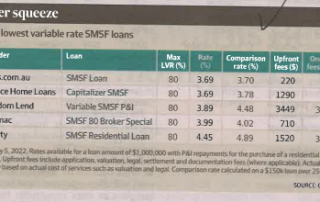
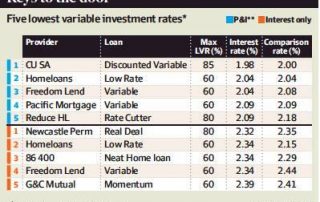
The accompanying tables from Canstar, which monitors rates, shows the cheapest deals for investors seeking principal-and-interest or interest-only loans.

These rates are typically about 130 basis points lower than average loans on offer.

‘‘This highlights the importance of shopping around for the best deal,’’ says Belinda Williamson, Canstar group manager.

Average investor loan sizes increased to more than $556,000 from about $477,000 in the 12 months ended February 28, says Tim Lawless, CoreLogic’s research director.

‘‘Investor lending growth is biggest in areas where housing prices are generally lower than Sydney and Melbourne,’’ Lawless says. These include south-east Queensland, inner-city Brisbane and Adelaide. AFR

Investors return as rents soar up to 20pc2022-04-26T12:07:15+10:00

Worried about mortgage stress? You’re not alone

AFR Article 25 September 2021 page 30

Safety margin Understand how much of your income should be going towards your home loan without pushing you over the edge, writes Duncan Hughes.

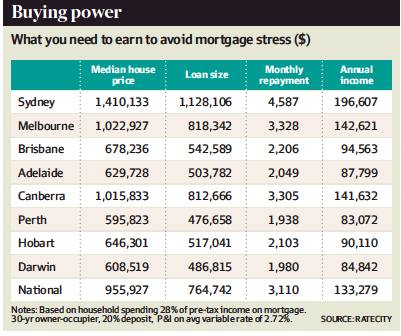
Shannon Day-Herbert’s plan to buy a family home on Sydney’s northern beaches has been dashed by rising prices pushing the annual income needed to service a median Sydney house purchase to $197,000.

Day-Herbert, a preschool teacher, and her partner, Peter Matthews, a lawyer, have been outbid by buyers with more cash for a deposit or a bigger appetite for debt.

‘‘We have grown up in this area and wanted to marry and raise our family here,’’ says Day-Herbert, explaining why they wanted to buy in Curl Curl, about 19 kilometres north-east of Sydney’s central business district.

Median house prices in the coastal suburb have jumped more than 30 per cent in the past year to more than $3 million, according to CoreLogic, which monitors property markets.

The relentless rise in property prices means that average incomes are no longer enough to afford a house without causing mortgage stress in all state capitals except Perth and Darwin. Mortgage stress is defined as paying more than 30 per cent of household pre-tax income on mortgage repayments.

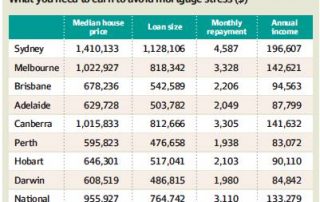
In Sydney, a person on the average full-time salary of $92,000 with a 20 per cent deposit for a $1.4 million house would need another $105,000 income a year to avoid the stress threshold on one income. (See table, which assumes the buyer has a 30-year principal and interest, owner-occupier loan with a headline variable rate of 2.72 per cent.) These calculations are based on someone paying 28 per cent of their pre-tax income, to allow for increases to mortgage rates without tipping over into mortgage stress.

Day-Herbert and her partner will seek to avoid the stress of a big mortgage by looking for a cheaper house on the Central Coast, further north of Sydney.

For buyers in Melbourne and Canberra, where median house prices are about $1 million, a household would need to have a combined income of more than $140,000 to purchase on the same terms and conditions as the Sydney buyer. Average wages in those cities are $91,000 and $99,000 respectively.

‘‘Price rises for anyone already in the housing market can work in your favour, particularly for investors,’’ says Sally Tindall, research director for RateCity, which compares rates and financial products. ‘‘But owning a house is getting further and further out of reach for those trying to get in.’’

Household debt to income is rising for many households as incomes fall because of COVID-19, even though record low interest rates are keeping a lid on monthly mortgage repayments.

‘‘Buyers might be getting the green light from the banks, but they are still shooting themselves in the foot by taking on high levels of debt,’’ Tindall says.

A combination of rising prices, increased debt and the impact of COVID-19 on income are contributing to mortgage stress beyond the 40 per cent of households on lowest incomes that it traditionally affects, say analysts.

Reduced hours, lower bonuses, unemployment or disrupted household cash flow are pushing mortgage stress to a record high of more than 1.5 million households (equivalent to about 42 per cent of mortgage holders), according to Digital Finance Analytics.

Fiona Guthrie, chief executive of Financial Counselling Australia, says people who have never needed help before are calling its National Debt Helpline seeking financial assistance.

Guthrie says mortgage stress issues are on the rise, particularly in NSW and Victoria, with about one in four small businesses saying they are not continuing or planning to reopen.

‘‘People have less money because they have fewer work hours or have lost their jobs,’’ she says. ‘‘Small businesses are struggling and unable to keep staff on and pay all their loans and bills.’’

Information on mortgage issues has risen to the second most frequently visited section on Financial Counselling Australia’s website, after general information about surviving a financial crisis.SI

10 tips for creating a buffer zone

Try not to overstretch yourself no matter how tempting it might be to take out a bigger loan for the ‘‘dream home’’. Ensure you have a buffer so you can absorb a rate rise of 1 per cent or 2 per cent.

Work your way up the property ladder. If you can’t afford a house in your preferred suburb, consider a unit or another suburb.

Think about relocating out of expensive cities. It’s an increasingly popular way of dealing with rising costs and has been made easier with working from home. Popular locations are typically about two hours’ drive from workplaces, with good roads and rail links.

Look at becoming a ‘‘rentvestor’’. This is where you rent where you want to live but buy an investment property where you can afford.

Consider an offset account that is linked to the home loan and can help reduce interest paid. Any money in the account can be used to offset the balance of the loan, reducing the amount of interest charged each month.

Consider a split loan. It involves having part of the home loan balance charged at a variable rate and part at a fixed rate. Borrowers can choose how to split the loan. It means borrowers have the flexibility of an offset account and can make extra repayments on the variable rate.

Cut back on expenses and debts. Review discretionary spending such as streaming services or gym memberships to see what can be reduced.

Don’t just rely on the bank to tell you how much you can borrow. ‘‘Work out how much you are comfortable with,’’ Tindall says. Most banks provide a loan calculator setting out how much you can comfortably borrow assuming different scenarios, such as starting a family.

Pay down as much as you can while rates are low.

Regularly shop around for a cheaper mortgage. Lenders are competing for new business and will offer better rates for borrowers with a good repayment history who have built up equity in their property. There are plenty of mortgages with headline rates below 2 per cent.SI

Worried about mortgage stress? You’re not alone2021-10-12T10:11:09+11:00

APRA likely to intervene in housing: Westpac

AFR Thursday 29 July 2021 page 4

House prices will increase 18 per cent across the country in 2021, according to Westpac, including 22 per cent in Sydney despite the long lockdown, setting the scene for tightening of lending criteria early next year.

Prices are forecast to lift a further 5 per cent in 2022 before falling 5 per cent the following year pushed lower by higher interest rates, stretched affordability and a tightening of macro-prudential policies.

‘‘Deteriorating affordability is likely to weigh on owner-occupier demand, and a tightening in macroprudential policy settings will restrain the supply of credit,’’ Westpac chief economist Bill Evans said.

‘‘We expect housing credit growth to exceed 7 per cent by the first half of 2022 triggering a likely policy intervention. The precise response will depend on the composition of lending over the next year.’’

Previous macroprudential tightening targeted investors, and new loan commitments to investors almost doubled between June 2020 and May 2021, according to the Australian Bureau of Statistics.

However, while the total value of investor commitments at $91.1 billion in May was close to highs seen in 2015, the percentage of overall loans at 25 per cent remains below the 45 per cent level hit during that period.

Regulatory market interventions could target higher loan-to-value ratios, higher household debt-to-income ratios or potentially the issuing of interest only loans, similar to caps last seen in 2017.

Or if gains are driven by a more general lift in credit growth, the regulator may instead place a limit on aggregate lending for investors (as in 2015), according to Westpac.

In the meantime, Brisbane and Hobart house prices will lift 18 per cent this year, followed by Melbourne (16 per cent), Adelaide (14 per cent) and Perth (12 per cent), weighing on affordability.

‘‘The upswing that emerged at the start of this year has continued to run ahead of expectations with markets carrying strong momentum into the second half,’’ Mr Evans said.

‘‘Prices nationally rose 12.2 per cent over the first six months, an extraordinary 25.6 per cent pace in annualised terms.’’

Westpac was the first major bank to tip rate rises ahead of the Reserve Bank’s current 2024 guidance, with Mr Evans forecasting the first increase above the current historically low 0.1 per cent in early-March 2023.

Most economists now expect the RBA to begin raising rates over 2023 and 2024 to a natural rate of about 1.25 per cent. Westpac estimates rates any higher would place ‘‘significant stress’’ on household finances.

House prices as a ratio of household disposable income nationally have risen from about 2.5:1 in 1991 to more than 5:1 in 2021, according to the RBA, while the household debt to income ratio has climbed from 0.7:1 to close to 2:1.

APRA likely to intervene in housing: Westpac2021-08-25T13:43:14+10:00