chelsea

About Chelsea Tran

This author has not yet filled in any details.
So far Chelsea Tran has created 59 blog entries.

Mortgage pain set to get worse: RBA

The already-record share of income households spend on mortgage repayments will increase even further, the Reserve Bank has warned, causing borrowers to dip into savings to meet the rising cost of living.

Surging home loan repayments were successfully reducing household spending and helping the central bank get inflation back to target, Chris Kent, the RBA’s assistant governor for financial markets, said in a speech yesterday.

But Dr Kent said the RBA would likely respond to any evidence that inflation was not on track to return to the central bank’s 2 per cent to 3 per cent target by December 2025 with another interest rate rise.

‘‘We’ve made it pretty clear we would be not wanting inflation to take much longer,’’ Dr Kent said, pointing to a significant upward price shock as a potential trigger for a 13th cash rate increase.

The RBA has cited the strength in interest rate pass-through as a reason for leaving the cash rate on hold at 4.1 per cent since June, as the central bank assesses the cumulative effect of its 12 cash rate rises since May 2022.

On Tuesday, International Monetary Fund analysis showed households in Australia devoted a greater share of their income to mortgage repayments than in any other advanced economy.

Dr Kent said scheduled mortgage repayments had risen to almost 10 per cent of disposable income from 7 per cent since the RBA began lifting rates from a record low 0.1 per cent 17 months ago. These figures include households without a home loan.

‘‘This is above estimates of the peak reached in 2008 when the cash rate was 7.25 per cent,’’ he said.

‘‘And for those households with a large mortgage, required payments are a much higher share of their income.’’

The share of household income spent on mortgage repayments will increase further as borrowers on pandemic-era fixed rate mortgages roll off onto variable rates, which are 3 to 4 percentage points higher. The share of fixed rate credit has already fallen substantially to 20 per cent of all home loans from 40 per cent in early 2022, Dr Kent said.

While high interest rates cool the economy, Dr Kent said the main way they slowed demand was by making mortgages more expensive, known as the ‘‘cash-flow channel’’ of monetary policy.

‘‘Many borrowers have had to cut back on spending to meet higher mortgage payments, while also feeling the pain of rapidly rising living costs. This has led to slower growth in demand for goods and services,’’ he said. Retail sales are in their most prolonged contraction since the global financial crisis, as consumers cut back on purchases of discretionary goods such as furniture and appliances.

The RBA estimates the 4 percentage point increase in the cash rate since May 2022 had reduced overall household spending by about 0.4 per cent to 0.8 per cent per year through the cash-flow channel.

Households accumulated about $300 billion in additional savings during the pandemic, which has provided a cushion to borrowers dealing with rapidly rising interest rates.

However, households had started drawing down on these savings since the start of 2023, RBA analysis shows.

While banks have been under fire for not increasing the deposit rates paid to savers in line with the cash rate, Dr Kent said they had been more generous than their international peers.

Australian banks have passed on about 75 per cent of the 4 percentage point increase in the cash rate since May 2022.

‘‘In New Zealand, for example, the equivalent figure is about 50 per cent, while in the United States it is about 35 per cent.

‘‘Among other things, this difference may reflect Australian banks’ focus on variable-rate borrowing and lending,’’ Dr Kent said.

Dr Kent pointed to the 30 per cent decline in household borrowing capacity since last year and the support provided to the exchange rate from high interest rates as evidence of the contractionary effects of the most rapid tightening cycle in decades.

Mortgage pain set to get worse: RBA2023-10-17T10:47:57+11:00

THE PRICE OF RETIREMENT

Golden years Whether it’s overseas holidays with the family, or a more modest life closer to home, there are retirement plans to suit every budget, writes Duncan Hughes.

About 3000 Australians retire every week and the most pressing question for many is: have I saved enough? The Association of Super Funds of Australia regularly updates what it calls its retirement income standard, which attempts to show what is needed for a ‘‘modest’’ versus ‘‘comfortable’’ retirement.

Assuming mortgage-free home ownership, the annual budget for a couple seeking a comfortable lifestyle is about $70,000, and $45,000 for modest, the analysis shows.

Consultancy BDO has built on that information to provide some estimates for what might be described as an affluent lifestyle. Roughly speaking (very roughly speaking because there are so many caveats), a lump sum at retirement of between $2.5 million and $3 million could provide an annual income of about $150,000, BDO financial advisor Kelly Kennedy says.

At this level, a couple can probably plan two luxury holidays a year, home renovations every five to 10 years and comprehensive health insurance.

‘‘Everyone’s retirement planning is a puzzle with unique pieces that fit their lifestyle,’’ Kennedy says, adding that the most common mistake is not planning early enough. It is also very important for couples to agree on their goals and expectations before they formally exit the workforce, she says.

‘‘If you need to make changes or sacrifices in the lead-up to retirement, being on the same page can make that less challenging.’’

The budget for affluent retirees is about four times that of a couple retiring with “modest” private savings of about $100,000 and access to the government-funded age pension, giving them $45,000 a year.

As official figures from the Australian Bureau of Statistics show, the retirement phase of life is increasingly long. Women retiring at the age of 64 have a typical life expectancy of another 20 years – for men it is 16 years.

So, where to start?

The government-sponsored MoneySmart Retirement Plan (https://moneysmart.gov.au/retirement-income/retirement-planner) is free and can estimate income from super and the age pension, how contributions, investment options and retirement age affect retirement income, as well as how working part-time or taking a break from work affect a super balance.

‘‘The big questions new retirees ask is how much do they need for a comfortable retirement, how long will their savings last, will it keep up with inflation and how can they make it last longer,’’ says Wayne Strandquist, president of the Association of Independent Retirees (AIR), which represents current and future partly and fully self-funded retirees.

For many Australians, the age pension remains a critical part of retirement planning, particularly for older retirees who need to top up on depleted lump sums, he says.

Olivia Maragna, co-founder of Aspire Retire Financial Services, which typically advises high-net-worth clients, recommends pre-retirees monitor their lifestyle and living costs by checking their bank and credit card accounts over a three-month period and then multiply by four to get an approximation of annual spending.

‘‘A lot of people say they do not live lavishly but are surprised to find their annual budget is around $250,000,’’ she says.

Fund manager Paul Huggins is more fortunate than many in that he can afford to live very well in retirement. He says a good lifestyle will mean being able to pursue hobbies ranging from buying art and fine wines to long days on the golf course, travelling, or indulging in his passions: classic cars.

He is provisioning for the typical budget of a classic car enthusiast, which is between $100,000 and $250,000, and says although money is important, the most successful retirees are those with plenty of interests. ‘‘I don’t have a retirement date,’’ Huggins says. ‘‘I get the most joy from cars and working.’’

Other would-be retirees might find planning and budgeting a bit more challenging.

Author Bec Wilson, who is next week launching a new podcast about preparing retirement with Nine, which owns AFR Weekend, says the first step is to take time to build a vision of life post-work. The process can take months or even years, she says. ‘‘Take time to ponder your goals and dreams. Read as widely as you can for inspiration.’’

The second step is to break those dreams down into specific line items from which to construct a budget. ‘‘I suggest people budget their retirement costs out in two separate spreadsheets – one for budgeting your cost of everyday living, and the other for budgeting out your one-off expenses,’’ Wilson says.

‘‘Both need to be based on specific itemised expenses you expect.’’

Think particularly hard about the first 10 to 15 years of your retirement because they are the years when spending is typically highest because retirees are in the best health, Wilson says.

‘‘Maybe there’s a special multi-generational family holiday that you want to fund your family on to celebrate an anniversary or significant birthday.

‘‘Then think about your cars, and how often you might want to replace them, and how much you want to allocate, as a periodic budget, and how that would divide back to an annual figure. And think about what you might need in your budget to maintain your home, or modify it to age with you.’’

The third and final step in the budgeting process is to try and work out what that looks like for you as a total capital amount over your lifetime. And, seek advice.

‘‘Financial advisers have excellent software that they can plug all your budget numbers into and project how much you might need to live your retirement dreams, and they’ll keenly use all the hard work you’ve done here to get there,’’ Wilson says.

BDO’s Kennedy says the amount needed for retirement varies for each client depending on lifestyle, age and whether they want to provide for their children or ‘‘SKI’’, an acronym for ‘‘spend kids’ inheritance’’.

‘‘I’ve even had clients saying the last cheque can bounce,’’ she says.

‘‘But then I’ve had other clients who want to retain the value of their capital throughout retirement because they want to leave a specific legacy. And some people might have charitable and philanthropic wishes. Clients are also asking about how providing a house deposit for their adult children is going to impact my ability to fund my retirement.’’

When working on scenarios with clients, Kennedy builds in assumptions such as the likelihood that expenses will decrease by about 10 per cent every five years.

She says some of the common mistakes of retirement planning include underestimating the impact of inflation, which can be especially hurtful for people on fixed incomes.

Another is underestimating how long you will live, or longevity risk. ‘‘I generally do modelling for my clients to age 100 because it’s best to err on the side of caution,’’ she says.

Working out a lump sum with which you need to retire is also tricky. Wilson says simply multiplying the total expense budget per year by the number of years you plan to live will not calculate the amount you need.

‘‘You need to consider how your total investments will compound over time,’’ she says. ‘‘The 10/30/60 rule of thumb says that we generate 60 per cent of our investment returns during our retirement years from the money we have invested – so you many not need as large a topline amount as you think.’’

A recent Intergenerational Report found that many retirees are living too frugally because they feared they would run out of money before they died and not be able to afford medical care.

Treasurer Jim Chalmers is among those calling on super funds to produce better ways to give members confidence that their retirement savings will last.

Greg Lowe, 64, and his partner Marina are attempting to boost their super savings by using their real estate investments to achieve a ‘‘comfortable retirement’’ income of about $70,000 a year.

The Canberra-based maintenance officer is using the large backyard of his Canberra investment property to build a three-bedroom apartment to generate additional rental income.

‘‘It may be pretty valuable,’’ says Lowe, a father of three adult children and three grandchildren, about his retirement income strategy.

Strong demand and rising rents help to offset fluctuating returns in their account-based pension caused by volatility in global equity and bonds markets.

For Lowe, the ASFA retirement lifestyle guide predicts the couple will be able to have one holiday in Australia a year, own a reasonable car and afford an occasional bottle of wine.

They will also be able to continue private health insurance, take part in a range of regular leisure activities and buy good clothes.

Brendan Ryan, principal of Later Life Advice, an independent financial adviser, says couples who own a home and have an asset test threshold of just over $1 million could still be eligible for a part-age pension. “If you are eligible for $1 of pension you can unlock a suite of discounts, entitlements, rebates and preferential thresholds,’’ Ryan says.

Some retirees experiment with ways to boost their budgets, including tapping equity in the family home or downsizing and adding extra contributions to super.

Frank Walmsley, a director of Canberra Granny Flat Builders, says many people coming up to retirement have big gaps in their super because mandatory funding was not introduced until 1992.

‘‘They are using a second house on their property to generate income for their retirement,’’ Walmsley says. He says typical three-bedroom backyard apartments costing around $300,000 are producing rents of about $700 a week in Canberra.SI

THE PRICE OF RETIREMENT2023-10-17T10:32:46+11:00

House price rally not seen as sustainable

The recovery in property prices, led by surging population growth and a severe housing shortage, could prove short-lived if unemployment rises and the Reserve Bank keeps the cash rate high, economists warn.

House prices are up 6.3 per cent this year, according to data from property consultancy CoreLogic, rebounding after the fastest rate-rising cycle in three decades had initially cooled demand.

‘‘I am worried that the recovery in property prices is a false rally,’’ said Warren Hogan, economic adviser at Judo Bank. ‘‘The Australian housing market is yet to be stress-tested by a genuine slowdown in economic activity and softness in the labour market.’’

The Australian economy cooled to an annual pace of 2.1 per cent from 2.4 per cent in the June quarter.

Mr Hogan predicted that house prices would fall in 2024-25, but said the decline would be cushioned by population growth and the shortage of new dwellings. Building pipelines were near the lowest on record and almost one in three large home builders was struggling with rising wages and material costs, leading to a surge in insolvencies.

Exacerbating the housing shortage is a post-pandemic rebound in immigration. In May, the government’s budget forecast 1.24 million arrivals over the next four years.

Even so, Bob Cunneen, chief economist at MLC, doubts that this year’s rebound in property prices will last, and says the strong demand and constrained housing supply have overwhelmed the impact of higher interest rates and poor housing affordability this year.

The Reserve Bank has raised the cash rate 12 times since last year to 4.1 per cent and has indicated that it could increase this again to bring inflation back to its 2 per cent to 3 per cent target, from 5.9 per cent currently. Housing affordability is at record lows and Australian households are among the most indebted worldwide.

‘‘A more moderate pace of immigration next year and the lingering impact of higher mortgage rates should again weigh against house prices,’’ Mr Cunneen said. Migration is forecast to return to normal patterns from 2024-25.

Half of the 42 economists polled by The Australian Financial Review in a quarterly survey expect at least one more rate rise and financial markets agree, implying a one-in-two chance of another increase.

Stephen Anthony at Macroeconomics Advisory is also sceptical about the robustness of house prices.

‘‘It is more a reflection on the long and variable lags of monetary policy,’’ he said, noting that the government’s large increase in temporary visa holders had swelled the pool of demand for rental accommodation and soaked up the inventory of unsold housing stock.

Sean Langcake, head of macroeconomic forecasting at Oxford Economics Australia, also expects property prices to dip as more stock comes onto the market. ‘‘But we expect this to be a very modest downswing relative to recent cycles,’’ he said.

Jarden’s chief economist, Carlos Cacho, estimated that households had been hit by a 30 per cent reduction in borrowing capacity amid ‘‘the worst affordability on record’’.

‘‘The two key risks for the housing market are higher rates for longer and a material increase in supply,’’ he said. Many borrowers were optimistic that the RBA would start cutting rates sooner rather than later, he added.

Goldman Sachs expects the housing market to ‘‘materially soften’’ – reflecting additional tightening by the RBA. The bank’s chief economist in Australia, Andrew Boak, forecasts one more rate increase in November in response to sticky inflation.

AMP chief economist Shane Oliver also expects property prices to slip as a pick-up in unemployment leads to distressed sales. ‘‘A further rate hike and delay in rate cuts next year would add to this risk,’’ he said.

Some economists, including RBC Capital Markets’ Su-Lin Ong, are not as bearish but caution that the best of the property market rally has passed.

‘‘We do not expect the near 5 per cent gain of the last six months to be repeated in the next six months,’’ she said, highlighting a subdued housing outlook.

David Bassanese of Betashares echoed the view. ‘‘At best, prices seem likely to only level out rather than fall back all that much,’’ he said.

He noted that this year’s rally partly reflected the fear of missing out whereby investors ‘‘buy the dip’’ on expectations that the RBA is nearing the end of its tightening cycle.

David Robertson at Bendigo predicted that house prices were likely to be ‘‘much more modest’’ compared with the past decade, as core inflation would probably remain high.

House price rally not seen as sustainable2023-10-13T08:27:03+11:00

Poorer times loom without reform: RBA

A further slowdown in global trade, the cost of the transition to net zero emissions and waning business dynamism could drive down productivity growth and make Australians poorer, the Reserve Bank has warned.

Echoing recent statements by former RBA governor Philip Lowe, economists at the central bank also said yesterday that Australia would not achieve the same high rates of income and productivity growth as previous decades without another round of ambitious economic reform.

The release of the research, Recent Trends in Australian Productivity, comes as the economy is hit by the largest fall in labour productivity on record, souring the outlook for inflation and incomes.

The decline has caused alarm among economists, given productivity improvements are the main driver of higher wages and living standards over the long run. Output per hour worked, a proxy for labour productivity, has fallen 6.5 per cent since its peak in March last year, pushing productivity down to March 2016 levels.

RBA economists Angelina Bruno, Jessica Dunphy and Fiona Georgiakakis pointed to a fading appetite for sweeping economic reform as one of several reasons for lacklustre rates of productivity growth over the past decade.

‘‘Without further economic and regulatory policy reforms, the same growth in productivity experienced in past reform decades is unlikely,’’ the trio said, citing research from the OECD showing elements of Australia’s regulatory landscape were excessively complex.

From the 1990s to the mid-2000s, productivity grew at an average rate of 2.1 per cent per annum, spurred on by deregulation, pro-competition policy reforms, and the uptake of new digital technologies, the RBA said.

That period included the Keating-era

‘‘However, the global nature of the productivity slowdown suggests economies must be dealing with common shocks, not only country-specific regulatory developments,’’ the economists said.

Productivity accounted for more than 80 per cent of national income growth over the past 30 years, according to the Productivity Commission.

A further slowdown in global trade, which the OECD said this week had declined by 2.5 per cent in the year to June, would also weigh on future productivity growth.

‘‘International trade increases competition, improves the reallocation of National Competition Policy, devised in response to Fred Hilmer’s sweeping review into competition in 1993.

Under the policy, states received about $600 million a year over a decade for implementing a host of important policies that limited anti-competitive behaviour and reformed the rules of the game for government-owned businesses.

Productivity growth in the decade before the pandemic was about 1.3 percentage points lower than the 1999 to 2004 period. The RBA found the finance, utilities, and manufacturing sectors recorded the biggest fall in productivity growth over this period. resources to more productive firms and reduces the costs of production by increasing the availability of intermediate inputs,’’ the RBA economists said.

Another key risk, they said, was the transition to net zero emissions.

‘‘Abatement measures will generally increase production costs for firms, weighing on productivity growth.

‘‘Over the longer term, as the benefits of these technologies are realised, the net impact on productivity may improve.’’

RBA governor Michele Bullock warned last month the sheer volume of investment required to meet Australia’s target of net zero by 2050 could push inflation higher over the medium term.

While the pandemic caused an unprecedented surge in the uptake of technology, including cloud computing and software enabling remote work, the RBA researchers said it was unclear whether businesses would face the same pressure to innovate now the health crisis is over.

Businesses where board members had relevant technological backgrounds were more likely to profitably adopt new technologies.

Poorer times loom without reform: RBA2023-09-26T11:56:59+10:00

Number of recent buyers in loss-making sales triples

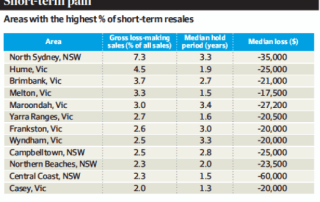
The proportion of pandemic-era home buyers bailing out within two years and selling for a loss more than tripled to 9.7 per cent in the June quarter from a year earlier, as mortgage stress worsened, CoreLogic’s latest Pain and Gain report shows.

With dwelling values still 4.6 per cent lower than they were before interest rates started rising, homeowners reselling within two years incurred a $30,000 loss on average, according to the data provider’s report.

More than 8000 homes resold in the June quarter were held for only two years or less, up from 7400 in the previous quarter.

‘‘We’re seeing more pain among people selling within two years, particularly if they’re selling in a market that has not fully recovered from the recent downturn,’’ said Eliza Owen, CoreLogic head of research.

‘‘The transaction costs around property are so high that you’d really have to be quite motivated to sell within a short timeframe and to sell for a loss.’’

The sales came at an uncertain time for Australia’s highly regional housing markets, as expectations of a pause in interest rate increases had pushed prices back up since March – reducing some of the losses suffered by forced sellers, Ms Owen said.

‘‘I think the rebound in values came at a very fortunate time for a lot of people that were transitioning from low fixed rates to a high variable rate in the event that they needed to sell,’’ she said.

Even so, the mounting economic pressures were leaving many people with no choice, Ms Owen said.

‘‘In the context of rapidly rising interest rates together with high cost-of-living pressures, the challenge of servicing a mortgage may be one such motivation,’’ she said.

Higher prices have already boosted profitability in home resales for the first time in a year. The portion of profit-making sales increased to 92.8 per cent in the June quarter, up from 92.4 per cent in the previous three months.

This could continue, Ms Owen said.

‘‘Property prices are continuing to rise, albeit at a softer rate than what we were seeing through April and May across the major capital city markets, so we could potentially see higher profitability when we do the September-quarter analysis.’’

Owner-occupiers comprised the bulk of the loss-making sales of homes held for up to two years at 72.1 per cent compared to 27.9 per cent by investors.

Houses made up 66 per cent of the short-term, loss-making resales, and 63.3 per cent were in the capital cities.

Northern Beaches, Campbelltown and Central Coast in Greater Sydney were among the areas posting a high portion of short-term loss-making sales. Vendors sustained up to a $60,000 loss on average.

Homeowners reselling within two years in Melbourne’s, Hume, Melton, Yarra Ranges and Casey incurred up to a $25,000 loss on average.

‘‘Two years is a significant time period because we are two years on from the height of pandemic-related lockdowns, low interest rates, and have just passed the peak of transitions from low fixed rates to high variable rates,’’ Ms Owen said.

Short-term resales also spiked in regional areas where the portion of homes resold within two years climbed to 11.1 per cent, a sharp increase from the 7.2 per cent decade average.

‘‘I think this speaks to the slight reversal in the popularity of regional Australia,’’ Ms Owen said.

Despite the increase in homes being sold within two years, most owners still hold their property for longer, according to a separate report by Domain.

Tenure, the number of years a property is owned before being resold, has gradually lengthened in many cities as people move less frequently, Domain’s new Tenure Report found.

House tenure extended to nine years, up from seven years in 2013, while units increased to eight years.

‘‘This highlights the ongoing challenges of housing affordability and transactional costs – factors that discourage people from relocating to homes better suited to their needs – and subsequently reduce the efficient use of the housing stock and housing mobility,’’ said Nicola Powell, Domain’s head of research and economics.

‘‘So I expect tenure will continue to lengthen until we start to see better policies in terms of taxation rules.’’

Number of recent buyers in loss-making sales triples2023-09-22T09:25:08+10:00

Tax, loan interest to take bigger bite of income

Australians will devote almost one in every four dollars of their earnings to paying income tax and loan interest by the middle of next year, as hundreds of billions of dollars of fixed-rate mortgages roll off and workers lose wage gains to bracket creep.

Households spent a record 21 per cent of their gross income on home loan interest and income tax in the three months to June, and economists predict the drain on their budgets will increase even further without action.

This includes reform to address the growing reliance of the federal government’s revenue base on income tax, which former Treasury secretary Ken Henry last month labelled an ‘‘intergenerational tragedy’’. A near-record 16.2 per cent of household incomes were lost to income tax in June, according to AFR Weekend analysis of the latest national accounts.

That figure has risen sharply over the past year, and is well above the income tax burden faced by workers a decade ago, when income tax consumed about 12 per cent of household income.

Jarden chief economist Carlos Cacho said the recent increase in the tax burden came down to bracket creep.

‘‘It’s the gift that keeps on giving for the government budget,’’ Mr Cacho said.

‘‘We’ve had compensation for employees, which is the broadest measure of earnings, growing at almost 10 per cent . . . and that means that people are moving into higher tax brackets and paying more tax.’’

Because tax brackets are not indexed to inflation, increases in nominal wages lead to increases in average taxes because a greater proportion of a worker’s pay is pushed into the highest bracket applicable to them. Economists call this bracket creep.

The stage three tax cuts, which come into effect on July 1 next year, would slice about 1 percentage point off the income tax burden, Mr Cacho said, but the effect would only be temporary.

The tax cuts will consolidate the 32.5 cent and 37 cent tax brackets into a single 30 per cent bracket applying to incomes between $45,000 and $200,000.

UNSW Business School professor of economics Richard Holden said the increased share of income going to tax and loan repayments highlighted the urgency of calls for tax reform.

‘‘Given that roughly two-thirds of GDP comes from household consumption and that tax and interest are the two largest and most obvious first claims on income, it means it is going to put obvious downward pressure on consumption and therefore GDP growth,’’ he said.

‘‘Against that backdrop, it’s not too surprising that per capita GDP is going backwards.

‘‘We’re taxing incomes more and more and we’re out of step with other advanced economies in terms of the amount we tax income, relative to the amount we tax consumption,’’ he said.

Compounding pressure on household budgets is the rapid rise in interest rates, which has resulted in the share of gross income consumed by mortgage interest increase to 4.8 per cent from 2.5 per cent over the past year.

Mr Cacho said this figure would increase even further, because only two-thirds of the RBA’s interest rate rises had flowed through to borrowers due to the roll off of pandemic-era fixed-rate loans.

‘‘We’re currently at the peak pace of fixed rates rolling off onto variable of about $30 billion a month. As we move through this year, even if there are no further RBA hikes, we’re going to continue to see those interest payments increase,’’ he said.

Combined with interest on consumer debt such as credit cards and the cost of owner-operator business debt, Mr Cacho said almost one-quarter of gross household income nationally would be lost to income tax and interest.

Wentworth MP Allegra Spender, who is leading a push to review tax, said fixing the reliance on income tax remained ‘‘one of the most neglected but important issues facing the country’’.

‘‘It’s an issue that we find very hard to talk about but it’s an issue too important to ignore,’’ she said.

Tax, loan interest to take bigger bite of income2023-09-13T16:58:17+10:00

Rate pain won’t hit households until 2024

Australian households are yet to feel the full impact from the Reserve Bank’s tightening cycle on mortgage repayments, with economists tipping the first half of 2024 to be the most challenging for consumers.

Several economists in TheAustralian Financial Review’s quarterly survey said the September quarter was too early to assess the full impact of a cash rate at 4.1 per cent and the rollover of mortgages from fixed rate to variable rates.

Commonwealth Bank chief economist Stephen Halmarick said the final three months of 2023 and the first quarter of 2024 would be when households on variable rates would be likely to feel the maximum impact from the fastest monetary tightening in a generation.

The central bank this week kept the cash rate on hold at 4.1 per cent for July but flagged that further increases would be needed in the coming months to get inflation back to the RBA’s 2 per cent to 3 per cent target. It has added four percentage points of rate increases since May 2022. ‘‘There is a large volume of fixed rate mortgages expiring in the second half of 2023 and there is a similar three-month lag between when a fixed rate mortgage expires and the new variable rate mortgage interest rate is paid,’’ Mr Halmarick said.

Despite CBA’s forecasts showing the cash rate to peak at 4.35 per cent in August, he expects tighter financial conditions for households in the December and March quarters.

KPMG chief economist Brendan Rynne agrees, saying. ‘‘A greater proportion of households who have been relatively shielded from cash rate increases to date will have rolled off their fixed rate contracts by the end of the first quarter of 2024 . The September quarter is when this starts to gather pace, but it peaks during the first half of 2024.’’

Barrenjoey economist Jo Masters said households were already in the toughest period, citing the second and the fourth quarter of 2023. Inflation remains high and there are expectations that mortgage repayments are set to increase.

For December 2023, she expects trimmed inflation to slow to 4.3 per cent, the same as the survey’s median forecaster.

Ms Masters said there was ‘‘no doubt’’ that the household sector was being squeezed, but she said that ‘‘the pain is not evenly spread across the sector’’.

‘‘Highly leveraged households are being confronted by high interest costs, while those with no debt and high savings – typically older Australians – are benefiting from higher interest income and rental income,’’ she said.

Judo Bank economic adviser Warren Hogan said for those looking to the labour market to measure the health of the economy, the ‘‘real fright’’ would be when job losses started in the fourth quarter of 2024.

He predicted Australia’s unemployment to rise to 3.9 per cent in the December quarter, before going to 4.5 per cent in the June quarter of 2024.

‘‘The extent of the job losses will determine how much of a fright the broader household sector gets,’’ Mr Hogan said. ‘‘If people are worried enough by the extent of the slowdown in economic activity and the loss of jobs that comes with it, then we should expect to see a risk in precautionary saving.’’

MLC Asset Management senior economist Bob Cunneen said households would feel the pain over at least three quarters into halfway through 2024 amid ‘‘the crushing impact of high interest rates and surging rents and electricity prices’’.

‘‘Households face little choice but to cut spending given these cost pressures while the weaker labour market and renewed weakness in housing prices will caution even those who have some savings buffers,’’ he said.

QIC chief economist Matthew Peter said the worst phase for households was already behind them. He acknowledged that many households would convert to variable rates in the September quarter but he said ‘‘real disposable incomes will be supported by increasing wages, a slowing in the rate of inflation and support from government subsidies’’.

He expects trimmed inflation to slow to 4.4 per cent in the December quarter before further dropping to 3.3 per cent in June 2024.

Rate pain won’t hit households until 20242023-07-10T16:17:24+10:00

How AI can help make us more productive

While artificial intelligence (AI) is a constantly evolving technology, it is not new. It has been a focus at Amazon for over 25 years. We are helping democratise the technology, making it accessible to anyone who wants to use it, including more than 100,000 customers of all sizes and industries.

As an Amazon Web Services chief technologist, I have the opportunity to help customers solve their biggest challenges with the latest technologies.

For example, using AI to drive sales and enhance the customer experience is a common question I get asked. Ticketek saw more than a 200 per cent increase in conversion rates when they leveraged AI to personalise the weekly email newsletter, allowing the events ticketing company to target and promote more relevant shows.

Online fraud can also be detected faster and more accurately. Using insights from historical data, companies can construct a customised AI fraud detection model. This model can identify suspicious online payment transactions before processing them, as well as differentiate between legitimate and high-risk account registrations.

Evolving contact centre operations is a low-hanging fruit that organisations can harvest to drive positive customer outcomes. By using virtual AI assistants to answer commonly asked questions, companies can reduce costs, while also driving quicker first call resolution rates. ‘‘Nibby’’ is a chatbot from health insurance company, NIB. Nibby is not just text-oriented but also voice-based, so members can converse with a very human-like bot. NIB receives 150,000 calls per month, so if 10 per cent of these calls can be addressed by Nibby, it can represent great efficiency gains for both agents and callers.

What’s next for AI? The talk of the year is generative AI. It helps enable new capabilities that are now more accessible for consumers and businesses, such as code generation, drafting written content, creating images based on text prompts, and transforming existing ML-powered capabilities such as web search and chatbots.

The responsible use of this new technology is also important to consider. Research by IDC showed about two-thirds of Asia Pacific organisations are either exploring potential use or have already invested in generative AI projects in 2023.

ChatGPT has been one of the first, broad, generative AI applications that has recently sparked a wave of interest and inspiration, leading many to rapidly experiment with how to take advantage of it, much like the early days of the internet. However, this is just one example of what generative AI can do. The potential uses for generative AI are boundless.

Customers want to understand how they can leverage generative AI to create new capabilities that could increase productivity, like bringing data together from disparate systems into one holistic view, to enable better outcomes through data analytics and natural language search queries. That’s why we are focused on democratising access to generative AI, giving businesses choice and flexibility to pick between different solutions, helping to bring down their costs and reduce complexity. There is opportunity for all industries to capitalise on this nascent technology, across both technical and nontechnical roles in departments such as marketing, sales, and HR.

Companies need to upskill their staff to better understand how to seize the transformative potential. For local startups, there is also a great opportunity to build innovative industry-specific solutions. For example, retailers could query a virtual assistant, powered by generative AI, on stock levels across their stores, predict busy periods, and even order more inventory all from a single chat interface.

In healthcare, generative AI assistants can analyse patient data from multiple sources, help identify patterns, and then present a summarised view of findings for review, augmenting the skills of medical professionals and improving patient outcomes.

The technology can also help architects generate building designs with proven patterns to minimise energy consumption or perform large-scale modelling and simulations resulting in more sustainable urban and regional planning.

To address the shortage of software engineers in Australia, developers are also starting to leverage AI-assisted coding companions to help them to create code for routine tasks.

These are just a few industry examples. We’ll continue to help customers accelerate innovation while assisting them on the responsible use of generative AI.

Factors like accuracy, privacy, copyright, and bias need to be addressed collaboratively by industry and government.

Globally, AWS is working alongside others like the OECD AI working groups, the Partnership on AI, and the Responsible AI Institute to develop new approaches and solutions.

Generative AI is an exciting disruptor for businesses. It has the power to impact our world by enhancing our abilities, solving some of humanity’s most challenging problems, and boosting our productivity.AFR

Rada Stanic is chief technologist, Amazon Web Services Australia and New Zealand.

How AI can help make us more productive2023-06-14T16:20:06+10:00

Katoomba leads worst suburbs for arrears

Mortgage arrears are climbing as borrowers run down their savings and collide with a tighter refinancing market that has escalated financial stress, S&P Global says.

The credit ratings agency observed arrears in residential mortgage backed securities rose notably for prime and less stable non-conforming securities, which it attributed to ‘‘rising interest rates and cost-of-living pressures’ weight on debt serviceability’’.

‘‘The cumulative effect of multiple interest rate rises is taking effect and borrowers’ savings buffers are eroding as the cost of living rises,’’ S&P said.

While refinancing had so far ‘‘tempered arrears’’, this market has tightened as the Reserve Bank lifts interest rates and banks put an end to aggressive cashback incentives, moderating competition. This, according to S&P, will mean ‘‘tougher’’ conditions and lead to more arrears later this year.

‘‘As interest rates continue to rise, refinancing conditions are becoming tougher for many borrowers, particularly those who are more highly leveraged. This is likely to add to arrears pressure because refinancing is a common way for borrowers to self-manage their way out of financial stress.’’

The worst hot spots for arrears in NSW are the Blue Mountains suburb Katoomba (5.6 per cent of loans in arrears), Sydney suburbs Bonnyrigg (4.9 per cent), Dolls Point (4.9 per cent) and Allawah (4 per cent), and the Southern Highlands suburb of Alpine (4.5 per cent).

Forrestfield in Western Australia (4.9 per cent), Avoca Dell in South Australia (4.1 per cent) and Barkly in Queensland (4 per cent) underperformed. In Victoria, Broadmeadows (4.1 per cent) and West Melbourne (4.2 per cent) stood out for arrears.

Prime RMBS arrears rose from 0.76 per cent in December to 0.95 per cent in March to ‘‘nudge up against long-term averages’’. Non-conforming arrears lifted from 3.2 per cent to 3.7 per cent, but were ‘‘unlikely to reach financial crisis peaks’’, the ratings agency said.

Lead analyst Erin Kitson told The Australian Financial Review the uptick was ‘‘reasonable’’, but said predicting how much further bad loans would rise was impossible given the dispute around the RBA’s intentions.

The RBA has lifted the cash rate in 11 of the past 12 meetings to 3.85 per cent, tightening monetary policy to fight runaway inflation which raced to 7 per cent in the March quarter.

Ms Kitson said the severity of arrears would ‘‘depend on the duration of the interest rate rises’’. ‘‘As long as interest rates go up, arrears will go up as well because people have to find more money to pay their mortgage,’’ she said.

Historically low unemployment of 3.7 per cent had put a floor under arrears, she said.

Despite this, S&P declared the overall economic and industry risks to the banking sector to be relatively low, in a separate report released on Monday. ‘‘The risk of a sharp price fall in property prices has eased,’’ S&P said.

‘‘Credit losses over the next two years should remain low, and close to pre-pandemic levels even as rate hikes erode debt serviceability for highly leveraged borrowers,’’ it said.

‘‘Nevertheless, banks in Australia remain exposed to elevated risk of a jump in credit losses due to high household debt, rising interest rates and uncertain economic conditions.’’

Katoomba leads worst suburbs for arrears2023-06-07T16:14:42+10:00