chelsea

About Chelsea Tran

This author has not yet filled in any details.
So far Chelsea Tran has created 59 blog entries.

HOW TO NOT OUTLIVE YOUR SUPER

Retirement Work out which of these five retiree types you are to guide your spending after you stop working, says Joanna Mather.

Longevity risk – or the prospect that you will live longer than you anticipate and therefore run out of retirement savings – keeps many people up at night.

Take actuary David Orford, the managing director of annuities business Optimum Pensions, whose mother died of a heart attack at 72. Her father also died of a heart attack at 72. Orford, 62, has had a heart bypass operation and takes cholesterol medication and reckons it is possible he will live longer than his father who died at 93.

Then again, 47 per cent of people die before they reach life expectancy, and he could get hit by a bus tomorrow.

‘‘People often say variability of investment returns is the biggest risk postretirement, but I think it’s 100 per cent longevity risk,’’ Orford says. ‘‘That’s apart from losing your spouse, which has no effect on women but results in reduction of life expectancy for men.’’

The point is not to be flippant about Orford’s mortality but to acknowledge that life expectancy projections are just that – best guesses. As such, the biggest financial question many people face is how to budget for an enjoyable retirement while minimising the risk of outliving their savings.

The retirement income of most Australians comes from the government-funded means-tested age pension, an account-based pension (an amount withdrawn regularly from superannuation), or a combination of both.

How much to spend

Even before they get to longevity risk, many retirees struggle with working out how much to spend.

‘‘Clients ask three things,’’ says David Reed, who runs Sydney-based The Retirement Advice Centre. ‘‘‘When can I retire?’ ‘How much can I spend each week?’ ‘How long is it going to last?’ And the thing that answers all of those questions is their withdrawal rate.’’

There are some free guides. The federal government’s Moneysmart website offers a retirement income calculator, as do many superannuation funds.

The Association of Superannuation Funds of Australia developed a ‘‘retirement standard’’ in 2014 and updates it regularly to track changes in cost of living.

The current ASFA standard for a ‘‘comfortable’’ lifestyle is $71,723 income a year for couples and $46,620 for singles. The lump sum required for a ‘‘comfortable’’ lifestyle for a couple is $690,000 and $595,000 for a single. A ‘‘comfortable’’ lifestyle includes the occasional restaurant meal, an annual domestic trip and an international trip once every seven years.

The annual income guide for a ‘‘modest’’ lifestyle is $50,981.27 for couples and $32,417.48 for singles. The lump sum required for a ‘‘modest’’ lifestyle is $100,000 for both a couple and a single.

‘‘There tends to be a level of conservatism built into the way many people spend their money in retirement,’’ says Jonathan Scholes, who specialises in wealth management at financial advisory and accounting business Findex. ‘‘As financial planners, we are often talking to clients about taking that holiday or buying that new car rather than necessarily saving for when they are 95.’’

‘‘In many instances, our clients are sacrificing their own personal standard of living to leave more to the children and their beneficiaries. But we still do have individuals who spend more money than perhaps their capital allows.’’

For a fee, financial planners will use life expectancy data, actuarial insights and computer modelling to devise suggestions for how much clients can confidently spend each year.

With that in mind, Smart Investor asked Challenger’s head of technical services, Andrew Lowe, to model five typical retiree types to see how much they might be able to draw from their savings each year without running out of money before they hit life expectancy.

The five retiree scenarios are: age pensioner; part age pensioner couple; self-funded couple soon to become part age pensioners; self-funded couple; and self-funded single. The modelling uses Challenger’s retirement illustrator tool for financial advisers, based on assets and super balances at age 67.

Different scenarios

Each scenario is detailed on the next page, while the graphic above shows the annual sum each retiree type might be able to spend based on their superannuation, other savings, age pension eligibility and life expectancy.

The table on the next page shows the ‘‘safe spend’’ for balances from $200,000 to $3.8 million.

For each scenario, Lowe provides an amount at which the retiree/s can have varying levels of confidence – ranging from 50 per cent to 80 per cent – that they won’t outlive their savings.

Given the federal government wants superannuation funds to ensure customers have access to financial products that guarantee lifetime income and Challenger is in the business of selling annuities, Lowe has included the purchase of a CPI-linked lifetime annuity in two of the five scenarios.

Annuities provide guaranteed income over a set period in exchange for an upfront cost – Lowe’s scenarios involve using 20 per cent of super savings to buy an annuity.

All superannuation in the scenarios is assumed to be invested 50 per cent in growth assets such as shares and 50 per cent in defensive assets such as bonds.

All modelling is to life expectancy, which is the age(s) to which an average Australian of a given age can expect to survive (or at least one of the people in a couple is expected to survive), based on Australian life tables 2015-17.

‘‘In many ways the key is confidence,’’ Lowe says. ‘‘When retirees have the confidence that they will have money available later, they can spend more earlier in their retirement. Current behaviour, with the majority drawing only the minimum, suggests that retirees do not have that confidence to spend.’’

The mandated drawdown rate from super in retirement ranges from 5 per cent to 9 per cent according to age, and many people use the minimum rate as a rule of thumb for what they should spend.

For many retirees, this results in unnecessary penny-pinching, according to the federal Labor government, which has called for submissions to a Treasury review looking at how to give retirees more confidence to spend their retirement savings, either via new products or better advice.

‘‘The problem is most retirees do not have access to the appropriate products to help them maximise their super over their lifetime,’’ Assistant Treasurer Stephen Jones said when he launched the review in December. ‘‘In fact, 84 per cent of retirement savings are held in account-based or allocated pensions, with only 3.5 per cent held in annuities. Unlike account-based pensions, annuities offer the option of receiving regular payments for life, regardless of how long a person lives.’’

Brisbane couple Glenn and Annette Mitchell purchased an annuity when they retired in 2014. They ran a business manufacturing sheepskin seat covers for 34 years and felt capable of managing their retirement finances.

‘‘That was a mistake,’’ says Glenn, a father of two and grandfather of four. ‘‘We did not know the rules that governed Centrelink benefits and the impacts of investments on pension entitlements.

‘‘The biggest issue for us was the income from our rental property investment was not sufficient to sustain our outgoing expenses throughout retirement, so we needed an alternative, assured income.’’

Glenn says that the annuity lifted the couple’s annual income from roughly $44,000 a year to $89,000.

Some would argue the government-funded, means-tested age pension paid by Centrelink is the ultimate longevity hedge. If you run out of money, then you’ll qualify.

The Treasury discussion paper says retirees tend to worry about the upfront cost of annuities, don’t like the idea that large sums of money are ‘‘locked away’’ when health or aged care emergencies might arise, and are worried about ‘‘wasting capital’’ if they die at an early age.

Superannuation funds and insurance providers are working on ways to make annuities more attractive, such as allowing the withdrawal of capital in an emergency.

The government is trying to figure out ways it could make the products cheaper by taking on some of the insurance risk.

Retiree types

Age pensioner | The first retiree type is a single woman who is renting and eligible for the full age pension. She has $300,000 in super, $30,000 in cash and term deposits and $10,000 worth of personal assets (such as cars and jewellery). She has a life expectancy of 90.

Lowe’s modelling shows she can draw $45,400 a year (indexed with inflation each year) with 80 per cent confidence she can maintain that level of annual spending to her life expectancy. If her retirement savings run out, she will need to rely on the age pension, currently $28,514 a year for a single ($42,998 for couples). ‘‘If she were to ask me how much she could spend in retirement, I would take her maximum rate of age pension – which is $28,500 – and combine it with [an account-based pension using] her $300,000 super to find she can buy a very confident additional level of income,’’ Lowe says. ‘‘She can have a 50 per cent degree of confidence that she could spend $48,600 a year and a 90 per cent degree of confidence at $43,500 a year.’’

Part-pensioner couple | The home-owning couple in this scenario has $650,000 in combined super, $50,000 in cash and deposits and $20,000 of personal assets. Their life expectancy is 94.

If they draw a combined income of $70,100 a year, they have an 80 per cent chance of having sufficient funds to maintain that budget to age 94.

Initially, less than one-third of their income comes from the age pension and two-thirds from super and private savings. But over time the age pension increases to represent more than half of their income.

Self-funded couple soon to become part-pensioners | As homeowners with $1 million in super, this couple just misses out on qualifying for the age pension when they retire at 67, although they will become eligible in a couple of years.

They can draw a combined income of $78,200 a year with 80 per cent confidence they will not outlive their savings.

If the couple allocates 20 per cent of their retirement savings to a CPI-linked lifetime annuity (at a cost of $200,000), their confidence level rises to 89 per cent.

The annuity would guarantee lifetime income of an extra $10,500 a year.

Self-funded retiree couple | These homeowners have $1.6 million in combined super, $100,000 in cash and term deposits and $50,000 of personal assets.

They can draw a combined income of more than $97,000 a year with 80 per cent confidence that they will not outlive their savings.

If they were comfortable with a 50 per cent degree of certainty, they could dial up their annual drawdown to $110,000 a year. They are likely to become eligible for a part-pension later in life.

If they invested 20 per cent of their super savings in a lifetime annuity ($320,000), they would get more than $16,500 a year of guaranteed, CPI-linked income for as long as they live and their account-based pension would last longer.

Self-funded single | This single homeowner has $1.9 million in super, which puts her at the upper end of what is allowed in tax-free retirement phase super accounts. She is also likely to be eligible for a part age pension later in life.

With an 80 per cent level of confidence, she is unlikely to run out of money spending $111,500 a year. For the first decade or so of retirement, her income is derived from an account-based pension and other income (interest on savings) until she becomes eligible for a part age pension at 90.SI

HOW TO NOT OUTLIVE YOUR SUPER2024-01-29T16:59:20+11:00

Investors warn on ‘unmoored’ global debt load

London | Investors are warning governments around the world over ‘‘unmoored’’ levels of public debt, saying excessive pre-election borrowing promises risk sparking a bond market backlash.

Government debt issuance in the US and the UK is expected to soar to the highest level on record this year, with the exception of the early stages of the COVID-19 pandemic.

Emerging markets are set to add to the deluge of bond sales, after government debt climbed to a high of 68.2 per cent of GDP last year, according to the Institute of International Finance.

Deficits are ‘‘out of control and the real story is that there’s no mechanism for bringing them under control’’, said Jim Cielinski, global head of fixed income at Janus Henderson.

He added that the issue would become a serious concern to markets ‘‘in the next six to 12 months as something that matter[s] a lot’’.

The US Treasury will issue around $US4 trillion ($5.9 trillion) of bonds this year with a maturity of between two and 30 years, according to estimates from Apollo Global Management, up from $US3 trillion last year and $US2.3 trillion in 2018.

Net issuance, which is adjusted for Federal Reserve purchases and debt falling due, will be $US1.6 trillion over 12 months to the end of September, according to calculations by RBC Capital Markets, the second-highest year on record. The Canadian bank estimates that net issuance in 2024-25 will surpass pandemic-era levels.

The scale of borrowing is likely to distract markets from their more typical focus on the future path of interest rates, fund managers say.

‘‘We are truly in an unmoored environment for government debt compared with previous centuries,’’ said Robert Tipp, head of global bonds at PGIM Fixed Income.

‘‘Everyone is getting a pass right now, whether you are in the US or Italy, but there have been some signs recently that investors and rating agencies are starting to think about this again.’’

The UK, where an election is expected this year, is also on course for its second-highest year of debt sales, behind only 2020 when the Bank of England stepped in to hoover up supply during the early stages of the coronavirus pandemic. Issuance net of BoE purchases and including its gilt sales is expected to be about three times more than the average over the past decade.

Sir Keir Starmer, whose Labour Party enjoys a substantial lead in the polls, has scaled back a promise to borrow £28 billion ($53.1 billion) a year for its ‘‘green prosperity plan’’ amid concerns about the level of public debt.

Sir Robert Stheeman, head of the UK’s debt management office, warned in an interview with the Financial Times that ‘‘in a world where we have debt to sell, policymaking cannot be divorced from the reality of the market’’.

In Europe, 10 of the eurozone’s largest countries will issue about €1.2 trillion ($2 trillion) of debt this year, around the same as last year, according to estimates from NatWest. But the bank expects net issuance – which includes the impact of quantitative tightening and excludes refinancing existing bonds – to rise by about 18 per cent this year to €640 billion.

Scrutiny of debt levels comes in a historically busy year for elections that boosts the incentives for political leaders to raise spending. As the US gears up for its presidential election on November 5, there is little sign of appetite for fiscal restraint from the main contenders, say investors.

‘‘Given the two apparent frontrunners . . . it doesn’t seem like much will change even when the election is over, and they will continue to spend at a high level,’’ said David Zahn, head of European fixed income at Franklin Templeton, referring to US President Joe Biden and his likely opponent, former president Donald Trump.

‘‘Eventually that could create a problem for the US.’’

The US budget deficit as a proportion of gross domestic product is set to hover between 6.5 per cent and 8 per cent over the next four years, according to forecasts from the IMF, a sharp increase from less than 4 per cent in 2022. Interest payments are forecast to rise from less than 3 per cent of GDP in 2022 to 4.5 per cent by 2028.

The IIF, which acts as a global trade group for the finance industry, warned that a swath of elections and ongoing geopolitical frictions in the emerging world ‘‘raise concerns about increased government borrowing and fiscal discipline, including India, South Africa, Pakistan and the US.

‘‘If upcoming elections lead to populist policies aimed at controlling social tensions, the result could be still more government borrowing and still less fiscal restraint,’’ the IIF said, adding a surge in government expenditures during this global election cycle ‘‘could further increase the interest burden for many sovereign debtors’’.

Investors warn on ‘unmoored’ global debt load2024-01-11T14:56:12+11:00

This is why Asian students choose our universities

International students The sector has rebounded to pre-2020 levels, with flexibility of course content key to attracting visitors, writes Michael Smith in Tokyo.

Janine Wan was still in high school when she decided to move from Singapore to finish her education in Australia.

Wan, who is now 25, jokes about getting into trouble for asking too many questions; she wanted a higher education system that was less rigid where she could challenge her teachers.

‘‘I was always getting into trouble at school in Singapore because I am the type of person who likes asking a billion questions. The Singapore system can be quite structured in that way, so it wasn’t best suited for me,’’ she says.

‘‘It was really refreshing moving to Australia and being able to ask those questions and feeling supported in that way.’’

The boom in international students has been a success story for the Australian university sector, making up 27 per cent of total revenue.

Despite the disruption from COVID-19, the numbers have now bounced back. International student numbers are now greater than they were in 2019, with 655,000 student visa holders as of July – 200,000 more than at the beginning of 2023.

The mix of students has also shifted. Chinese students, who accounted for one in every four new enrolments in 2019, have fallen by 37 per cent. Indian student enrolments, particularly in the vocational education sector, are up by the same amount.

Wan, who completed a law degree at Canberra’s Australian National University in 2019 and now works as a corporate lawyer for King & Wood Mallesons (KWM) in Singapore, had also heard Australian universities were more flexible than in other countries, and courses could be tailored to the individual.

This was important for Wan who had several potential career paths at the time and wanted to be able to pursue all her options. Before studying law, she initially wanted to be a biological anthropologist.

Wan moved to Melbourne to finish high school as a boarding student with the aim of eventually ending up at an Australian university. She completed years 10, 11 and 12 at Presbyterian Ladies’ College in Melbourne.

‘‘There were definitely challenges moving at that age, but I enjoyed it. I have always been independent,’’ she says.

Wan chose Australia over the United Kingdom not only because of its proximity to Singapore but also the flexibility of the education system, which allows high school students to take a university class. Wan completed two history courses at Melbourne University while still in school.

‘‘The reason why I considered moving to Australia for the education system was because I heard it was a lot more flexible and a lot more tailored to the individual with a focus on critical analysis.’’

After finishing year 12, Wan chose ANU because of its anthropology program and because she could do a law degree while studying other subjects as well. ANU ranks third overall in The Australian Financial Review’s Best Universities Ranking. ‘‘There was a lot of flexibility to explore your broader interests which is quite unique,’’ she says.

‘‘The prestige of ANU was definitely attractive. The approach is more intimate and the learning experience, I felt like I could get a lot of face time with the professors and really dig into what you were studying.’’

Wan made friends with students from all over the world at ANU and says the diversity was a major positive. ‘‘I have been lucky to be in very multicultural environments both in my Melbourne school and in Canberra. You get exposed to a lot of different experiences and opinions.’’

In the end, Wan chose law over anthropology and completed a four-year law degree at the end of 2019. She recalls the bushfires sweeping through Australia that summer and her sadness at leaving behind a close-knit group of friends in Canberra.

Asked if there were any negatives about her experience, she says the only issue was that international students looking to work in Australia after graduating could find it hard to secure a job.

‘‘The reality is it can be quite hard in certain industries looking for work in Australia as an international student. Some places don’t consider international students. That is something a lot of people struggle with,’’ she says.

Wan did not have any trouble finding work. She decided to move back to Singapore, partly for family but also for the huge opportunities working in Asia. She found a job with a big local law firm in Singapore and moved back in April 2020 just as COVID-19 hit.

She says some of her seniors at the firm told her Australian universities were considered inferior to those in the United Kingdom, but she saw no evidence of that when she was interviewing for jobs. Two years ago, she joined KWM where she is now an associate on the firm’s mergers and acquisitions team.

KWM already employed Australian graduates so she didn’t have a problem. ‘‘Singapore and Australia have put a lot of work into partnerships and university connections, I didn’t feel at all I was disadvantaged.’’

Employers in Asia say they like graduates from Australian universities despite some tough competition from institutions in the United States, the UK and Canada.

‘‘All four, including Australia, are still in the top bucket,’’ says Robert Quinlivan, who sits on the board of the Australian Chamber of Commerce in Hong Kong, and knows many of the city’s employers. ‘‘But there are some questions around the US because of safety/ guns etc. Canada has some visa benefits which are attractive for people post-grad.

‘‘Australia has the benefit of being close and [students from there] tend to be able to get jobs in Hong Kong.

‘‘I have three children at Australian universities at the moment, so my sense is that the overall proposition is pretty good.’’

While Australian universities compete with popular Hong Kong universities such as the University of Hong Kong and the Hong Kong University of Science and Technology, wealthier parents in mainland China prefer to send their children overseas.

A breakdown in China-Australia diplomatic relations in 2019 triggered a wave of negative stories about safety in Australia in the Chinese media, putting some parents off. However, Australia is back in favour with the Chinese government and media, although a slowing economy means parents have less money to send their children overseas.

This year’s unexpected spike in international student numbers has prompted backbench criticism of policies that make it easier for ‘‘lower quality’’ foreign university students to stay in the country and to work.

A report from the Grattan Institute in October, Graduates in Limbo: international student visa pathways after graduation, warned Australia offered international students more generous rights to stay and work after they graduated than other countries. It argued this gave them ‘‘false hope’’ to graduates who would never gain permanent residency, and threatened Australia’s reputation as a destination for tertiary study.

It said temporary graduate visa-holders in Australia would almost double to about 370,000 by 2030.

For Hong Kong-born Natalie Chan, the main attraction of studying in Australia was the multicultural atmosphere.

‘‘I liked the multiculturalism which creates a broader way of thinking, the friendly vibe of the university and the staff who were super supportive of foreign students, although this didn’t really make up for the pricey tuition fee,’’ says Chan, 30, who studied a master of communications at Melbourne’s RMIT university from 2018.

She liked an environment which she says allowed students to be creative and act like themselves compared to Hong Kong which was more constrained.

Now back in Hong Kong, Chan says the advantages of studying in Australia or other English-speaking countries is that employers like overseas graduates and their language skills.

She says RMIT has a good reputation in creative industries and offered opportunities to network with the local industry which helps students find jobs after graduating. AFR

This is why Asian students choose our universities2023-11-22T12:55:48+11:00

How your SMSF stacks up, in eight charts

Take control DIY super funds can build wealth for a luxury retirement. Here is who has them, and what they invest in. Tom Richardson reports.

Australia’s system of compulsory superannuation means most workers have substantial retirement savings by midlife, with smart investment decisions and savings discipline the key to unlocking a blue-chip retirement.

Most Australians build their retirement wealth within an industry or retail superannuation fund, but others use a self-managed superannuation fund (SMSF) that they set up (in accordance with Australian Tax Office rules).

Given the average Australian male between 45 and 49 has just $224,200 in superannuation (as of 2022, according to Deloitte), and the average woman’s balance is just $146,400 for the same age group, many Australians, particularly in midlife, see setting up an SMSF as a better option to boost their retirement savings.

These funds are described as ‘‘selfmanaged’’ because the members make their own decisions about what investments to buy and hold in the fund.

‘‘SMSFs are subject to the same tax concessions as other types of super funds and the same rules when it comes to not being able to access your money until you retire,’’ says Peter Burgess, CEO of the SMSF Association.

The funds are set up as trusts and require a deed that outlines their governance and names the trustees who are also the legal owners of the assets.

Here are seven charts that explain who has SMSFs, what they invest in, and the average size of their balance.

What are SMSFs and how popular are they?

In Australia, there are 610,287 funds boasting self-managed assets under management totalling $878 billion, ATO data shows.

The total number of SMSFs in operation has been growing steadily (the number has risen to today’s 610,287 from 580,479 in 2021 and 533,716 in 2015).

The graph below shows industry super funds manage the highest amount of superannuation money at $1.2 trillion, followed by the SMSF sector.

More people are opting for SMSFs because they can have control and flexibility over their investments, and there are certain investment rules set up for SMSF investors, Burgess says.

‘‘So, for example, you’re not restricted to choose investments from a menu like you typically are in larger funds – you can invest in shares, residential or business property for example,’’ he says.

Contributions up to $27,500 per year (including compulsory super) may be made per member into SMSFs during a financial year at concessional tax rates of 15 per cent, which is commonly lower than other income tax rates.

Women and young people are two demographics driving the rising uptake of SMSFs, says Drew Meredith, a director at private wealth manager Wattle Partners.

‘‘I put this down to greater levels of financial literacy, given the popularity of podcasts and education in the last three years post the pandemic,’’ says Meredith.

What type of person has an SMSF?

The tax office’s data shows about 69 per cent of all SMSFs have two members as trustees, as cohabiting or married couples commonly combine funds.

Single members represent 24 per cent of all funds and 7 per cent of funds have three to six members. Funds with three to six members may also include children, other family or unrelated investment partners.

‘‘A self-managed super fund is a fund that has no more than six members. The vast majority have one or two members normally as spouses, so the members are the trustees,’’ says Burgess.

The highest proportion of average income per SMSF member is between $0 and $20,000, at 22.5 per cent. This reflects the fact that 55.1 per cent of members are 60 or over and are retired or semi-retired.

(The median Australian employee earned $65,000 in 2022, the Australian Bureau of Statistics says.)

The chart above shows at least 40 per cent of SMSF members earned above the median income even after accounting for the fact that many have relatively low incomes in retirement. In other words, many SMSF members may be asset rich, but income poor because of their advanced age.

‘‘There is a tendency for those with higher levels of wealth to be better engaged with their investments,’’ says Meredith.

‘‘It tends to be that those with higher asset levels want greater control of their money, or at least transparency over where it is invested. They tend to see it as a real asset, not someone else’s.’’

Meredith also says that much SMSF advice is driven by financial advisers, who are unaffordable to many, so it’s natural that those on higher incomes, getting financial advice, might gravitate to them.

‘‘As you get more money, you want more control, it’s also driven by financial advice and SMSFs are more recommended by financial advisers to people with significant assets of $500,000 or more.’’ he adds.

When do most people start an SMSF?

According to the ATO, the average age of an SMSF member is 61.

‘‘The majority of SMSFs are set up by retirees, so they tend to have more cash as they need it and more income-producing, rather than growth, assets,’’ says Meredith.

Many people wait until they are nearing retirement, or their super balance has tipped over a certain amount, before starting an SMSF because at that point it becomes more cost-effective to have money in a DIY fund.

Meredith says SMSFs in the accumulation phase (before retirement) are often set up by professionals in blue-collar jobs, or by successful small business owners.

SMSFs with more than $500,000 should be cheaper to run than paying an industry or retail fund’s fixed fees on an annual basis, says Burgess. For example, paying an industry fund 1 per cent would equal $5000 in fees paid every year on a balance of $500,000, with SMSFs able to be run at a cheaper cost than this per year.

‘‘For individuals with large balances, SMSFs can be typically cheaper than being in a large fund once you go over $500,000,’’ says Burgess. ‘‘But remember you have that additional responsibility as the trustee of your fund, although you might not have the same protections that come with being in a large fund.’’

What is an SMSF’s typical balance?

As SMSF members contribute more to their funds over time, their balances increase on top of investment returns via capital growth and dividends. This means older investors tend to have accumulated the highest balances, says Meredith. By the time SMSF members reach their mid-70s, they have an average of about $1.4 million.

But the median SMSF size – discounting the impact of exceptionally high balances – is $467,187.

According to data from SMSF platform provider Class, the average contribution per member in financial 2022 for concessional (or pre-tax) amounts taxed at a lower rate was just over $20,000. The average non-concessional (after-tax) contribution was just over $60,000 per year. This shows many members have significant disposable incomes to invest in their SMSFs.

What do SMSFs invest in?

SMSFs’ largest single investments are listed shares at $260 billion. Data from Class shows the most popular shares to invest in on its platform are Commonwealth Bank, BHP, Woodside Energy and Westpac.

Blue chips are common holdings as they’re among Australia’s largest companies and pay good dividends, Meredith explains.

‘‘Retirees need cash and want to see income coming in so the easiest way to do that is to get dividend income coming in and hold cash, as you still have to pay the bills in retirement,’’ he says.

‘‘An SMSF is like an extra bank account for retirees, and you can get 5 per cent on cash now, so people like to have it more than ever.

‘‘Plus with companies that pay fully franked dividends you get franking credits, so you get a free kick of around an extra 30 per cent [of taxable income benefits] if you’re in retirement or pension phase.’’

After listed shares, the next biggest asset class is cash and term deposits totalling $147.4 billion. Then there’s $108.3 billion in unlisted trusts, $81.1 billion in nonresidential property, $52.7 billion in listed trusts such as managed investment schemes, $53.2 billion in other managed investments, $44.8 billion in residential property, $14.1 billion in overseas shares, $10.1 billion in debt securities, and $943 million in cryptocurrencies.

Residential property is not necessarily more attractive than other investible asset classes because, while it can be bought via an SMSF, it cannot be lived in by the SMSF owner or rented by them or anyone related.

‘‘An SMSF can acquire residential property as long as it’s not being acquired from someone related to the fund. Once the property is sold down the track, if it’s owned by the fund it’s taxed at concessional rates of CGT compared to other types of investment vehicles,’’ Burgess says.

Other asset classes including artwork and overseas property make up the difference to take the total value of SMSF assets to $876.5 billion as at June 30, up from $843.7 billion at the same time in June 2022.

How much do retirees end up with?

According to ATO data for the tax year to June 2021, the average SMSF member balance for those aged between a standard starting retirement age range of 60 to 64 is $911,974 – it is, however, skewed by some exceptionally large SMSF balances.

This is far higher than the average (non-SMSF) superannuation balance of $402,838 for men aged between 60 and 64, or $318,203 for women the same age.

Meredith says SMSF investors tend to have higher incomes, financial education and literacy, which explains why they accumulate larger balances by retirement age. SI

How your SMSF stacks up, in eight charts2023-11-21T14:39:03+11:00

Inflation rate highest of advanced economies

Australia’s headline inflation rate is the highest among the world’s largest advanced economies, prompting economists to warn the Reserve Bank may need to deliver further interest rate rises to quash persistent price pressures.

Australia’s consumer price index increased 5.4 per cent in the year to September 30, topping the list of headline inflation rates in the world’s 15 largest advanced economies, according to analysis by AFR Weekend.

The figures highlight the distinctive nature of Australia’s inflation outbreak, which started and peaked months after many other advanced economies, meaning price pressures have persisted well into 2023.

Sean Langcake, head of macroeconomic forecasting for Oxford Economics, said there was no single story explaining Australia’s higher inflation rate. While timing played a role in explaining why inflation was lower in Canada and the US, he said Australia seemed to have stronger underlying price pressures.

‘‘The thing that stands out is just the strength of our core CPI. I think we might be a little bit different on the breadth of inflation,’’ he said.

Australia’s underlying inflation, which strips out volatile price movements, was 5.2 per cent in the 12 months to September 30, exceeded by only Belgium and the United Kingdom.

National Australia Bank senior economist Taylor Nugent said a lot of the cross-country variation in headline inflation had been driven by exposure to the energy price shock resulting from Russia’s invasion of Ukraine.

‘‘Countries like the Netherlands and Spain saw very sharp increases in energy prices, but normalisation in prices is now weighing directly on headline inflation and more broadly easing cost pressures in the economy,’’ he said. ‘‘In Australia, energy prices have not risen as much, but have passed through to CPI more slowly because retail prices adjust infrequently. Government subsidies have pushed some of the measured impact out further into 2024, when subsidies unwind.’’

While core inflation peaked in Australia at a similar level to other countries, Mr Nugent said progress on taming price pressures had been harder to come by. ‘‘Domestic cost pressures are driving still-elevated services inflation. The September quarter data showed the RBA was overly optimistic on how quickly those domestic inflation pressures would recede, and their current forecasts imply only a very gradual easing. The RBA’s upgraded forecasts can readily justify some further tightening in policy.’’

Mr Langcake said population and rent growth may explain some of the relative strength in underlying price pressures. ‘‘Outside Canada, no one’s dealing with the same kind of net inward migration. If you think about housing markets, where supply can’t react [to demand], that’s where you’re getting more of an inflationary impulse.’’

Deutsche Bank chief economist Phil Odonaghoe said the figures demonstrated monetary policy had more work to do in Australia. ‘‘It is worth highlighting that many of the relevant peer economies in [the] sample have policy rates at or above 5 per cent – the US, UK, Canada, for example – while here in Australia, the cash rate is still below 4 1/2 per cent.

‘‘While Australia’s variable rate mortgage market helps explain why some of that gap to policy rates in peer economies might be able to persist, we don’t think variable rate mortgages can justify all of it.’’

Mr Odonaghoe said he expected the RBA would need to deliver one more rate rise, which would take the cash rate to 4.6 per cent.

While markets are almost certain the RBA will leave the cash rate on hold at 4.35 per cent in December, Mr Langcake said he expected the board would raise the cash rate. ‘‘I don’t think there’s any disagreement out there that inflation is coming down in year-on-year terms. The first part of the disinflation is the easy part. Now is where it gets trickier. There’s more upside risks than downside risks, and we could end up with inertia and persistence keeping us away from target for longer.’’

Inflation rate highest of advanced economies2023-11-21T14:35:12+11:00

Reached midlife? Rewrite rules of life’s journey

A growing number of us will live to 100, but there is no rule book for the second half of the journey. The Baby Boomers wrote the first chapters: get a good education, secure a job, build a career, start a family, educate your children. But then what?

The 40-, 50- and 60-somethings of today are looking forward to decades of good health ahead, with greater financial security than ever before thanks to 31 years of compulsory superannuation and rocketing property values.

They have an insatiable will to travel the world and a passion for lifestyle, leisure and the ‘‘good times’’ that no older generation could have afforded. They want to get to the good bits of life before they retire by enjoying their 50s and 60s as their kids become more independent.

That means using their hard-earned self-confidence to find new challenges that align more closely with their passions than their obligations, even if it means a downward shift in salary.

In the second half of life, some things that may not have seemed important or attainable move within reach. Like seeing the world, furthering your education or teaching others, really participating in family now you have the joyful years of grandparenting ahead, and being a more active part of the community.

If you’ve hit midlife, know your superannuation and investments are in place, and you’re confident that the way you have them invested will allow them to compound in the years before you retire, it takes the pressure off. It allows you to be curious about what work might feel more purposeful and what activities you could pursue that might give your life a greater sense of meaning.

For some, that means shifting from an executive role to a portfolio of nonexecutive and advisory roles centred around a core area of interest. For others, it is starting a business or stepping into a different field altogether. It will appeal to some to use their skills in a way that might leave a legacy by working for not-for-profits, charities or social impact ventures. Leaving a meaningful legacy becomes more important in the second half of life, and when I say legacy, I don’t mean leaving your kids an inheritance.

If we’ve got a shot at living to 100, then we need to start planning for the second half of life much earlier. Traditional retirement planning, retirement benchmarks and the software of major financial planning groups currently plans to about 88 years.

So the new paradigm is to understand your longevity, and get some professional advice to craft a robust financial plan that leans into it. Start saving early, diversify your investments, and give them plenty of time to compound.

Plan for pre-retirement | Notice the new phase of life that is emerging before retirement and the slow transition that the journey into retirement can become – embrace it. Set goals for these prime-time years and go out there and live well while you’re young-ish. Take a sabbatical, or a gap year, buy that caravan and take time to spend with your partner, kids and young grandkids. Don’t wish away your best years.

Keep learning | Too many people reach midlife and say to themselves ‘‘I’m too old to go back to university’’ or ‘‘I don’t have time to benefit from courses and a change in career direction.’’ Those are the old rules.

Challenge yourself to keep expanding your mind, your interests and continued education that will drive your fulfilment. You might just have decades to use all that knowledge and experience yet. You might have a whole third-act career ahead.

Portfolio life | Think about how you can reshape your skills and leverage your experience to land you in more flexible, enjoyable work and charitable roles. Portfolio careers are the ideal option for those who want choice, flexibility and excitement in their second half of life.

Your portfolio could be made up of a mix of paid and unpaid roles, and temporary and long-term tasks.

Build on your capabilities, and build up your portfolio so you can work on the things you choose for longer than previous generations, and reap the benefits, financially and socially.

Make your health your wealth Living longer requires a strong focus on health. Regular exercise, a balanced diet, and proactive preventive healthcare should become integral parts of everyone’s daily life. Invest time and effort in maintaining your physical, cognitive and mental health, with deeper self-awareness of when you’re letting things slip.

Embrace community | The longest, happiest lives in the world are lived in villages and towns where there is a very close-knit sense of community. So take the time to nurture your relationships and build lasting bonds with family, friends and the community you live in.

Invest in meaningful connections, and build a network of people around you that supports and enriches your life. Social isolation is one of the biggest issues among today’s older generations.

Lean into change | The only constant in life in the 21st century is change, and adapting to it gracefully is vital. Cultivate resilience, be open to new experiences, and welcome change as an opportunity for growth and discovery. Gone are the days when we could age bitterly. Consider the concept of ageing curiously instead. It’s much more appealing.SI

Bec Wilson is the author of How to Have an Epic Retirement and the host of the new podcast, Prime Time with Bec Wilson.

Reached midlife? Rewrite rules of life’s journey2023-10-27T09:24:10+11:00

Population growth to drive housing demand

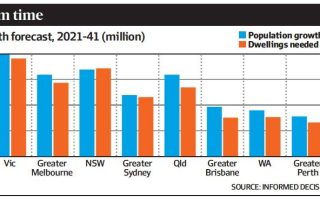
Housing demand is set to soar across the country’s four most-populous states over the next two decades fuelled by a predicted 7.4 million national spike in population, analysis by PEXA-owned Informed Decisions shows.

Victoria is poised to rack up the largest increase in population with 2 million people to be added by 2041.

NSW is set to rise by 1.7 million, Queensland by 1.6 million and WA by 904,000, spurred by strong migration.

Tim Lawless, CoreLogic research director, said housing markets in those states would benefit from the strong population growth, which could support price growth.

‘‘Population growth is a proxy for either rental or purchasing demand because all these people are going to need a roof over their head,’’ he said.

‘‘So it will provide a fundamental driver enhancing prices unless you see an appropriate supply response.’’

Australia’s population is expected to increase by 2 million people to 27.7 million by 2026.

It will increase to 31.3 million by 2036 and jump to 35 million by 2046, or about 420,000 people per annum.

Ivan Motley, founder of .id, a wholly owned subsidiary of PEXA, the ASX-listed e-conveyancing platform, said population growth was a key driver for housing supply.

‘‘People go where there is somewhere to live,’’ he said.

‘‘Clearly there’s a shortage of housing and the lack of affordability, so we need to increase supply to address that.

‘‘At the moment we’re not building enough dwellings to maintain stable vacancy rates and average household sizes.’’

Melbourne is forecast to add 1.6 million people during the same period, outpacing Sydney’s predicted population growth of 1.2 million.

Brisbane’s population is set to increase by 974,000 while Perth is expected to gain 979,000.

To meet the housing demand for those increases in population, an estimated 723,000 homes would be needed across Melbourne.

Sydney would need an additional 582000.

Across Brisbane, an extra 381,000 homes are required while Perth would need 334,000.

Melbourne’s west, south-east and the inner city are forecast to post the strongest population growth, with nearly a million people set to be added in the next two decades.

The combined population growth, which accounts for 46 per cent of Victoria’s overall population growth, will require 422,000 additional dwellings.

Within these regions, population growth is concentrated in certain suburbs such as Truganina, Mickleham and Cranbourne South.

Arjun Paliwal, head of research at InvestorKit, said Melbourne was ripe for solid house price growth in the medium-to-long term.

This was boosted by increased demand from strong population growth and its lacklustre performance in the past few years.

‘‘I think investors should position themselves in areas like Melbourne because having a lower period of price growth in a city that usually has a history of strong growth can actually be a good sign,’’ he said.

‘‘Prices have not grown much over the last few years, so they will start to look more attractive.

‘‘We’re also seeing rental growth really pick up, and it’s clear that the rental supply isn’t there, so cash flow will be more palatable.’’

In Sydney, suburbs in the southwest, Blacktown, Parramatta and the inner city are predicted to rack up the strongest population growth over the next 20 years.

An additional 572,000 people are poised to move into those areas which would require an additional 267,000 dwellings.

Meanwhile, the report predicts new housing supply could be built in River-stone, Penrith, Leppington, Campbell-town, Gilead, Parramatta and Sydney city during the same period.

Population growth to drive housing demand2023-10-26T16:47:58+11:00

Tribunal rejects bank statements as basis for deductions

A businessman’s attempt to claim $48,000 in tax deductions for expenses including airfares, meals and overseas accommodation by relying on bank and credit card statements has been roundly rejected.

Brisbane-based William Smith took the matter before the Administrative Appeals Tribunal (AAT) earlier this year after the Australian Tax Office rejected all his expense deductions for financial year 2020.

From the outset, AAT member Lee Benjamin, who previously led complex tax litigation for the government solicitor and worked as a tax specialist for law firm Gadens, suggested Mr Smith was in trouble. ‘‘A taxpayer who does not obtain and retain appropriate records of his deductible expenditure faces an uphill battle to discharge their onus,’’ Mr Benjamin said. ‘‘There is little mystery or magic to it.

‘‘The substantiation rules are one of the few areas of the income tax law that is easily understandable and well understood by most taxpayers – obtaining and retaining written evidence of work-related expenses, typically in the form a receipt, is a primary requirement for seeking to claim a deduction.’’

Across hundreds of individual transactions, Mr Smith, an executive from the energy sector, claimed $12,700 for transport, $12,300 for meals and drinks, $13,300 for accommodation in Singapore and Melbourne, and $4500 for phone and internet expenses.

The ATO said Mr Smith’s furnishing of bank and credit card statements, diary entries and an accompanying spreadsheet explaining each expense did not satisfy substantiation requirements under Australia’s tax laws.

‘‘At best, the statements only show payments were made to certain payees on the dates recorded and not the nature of the goods or services purchased,’’ the ATO said in submissions.

‘‘For example, a payment to ‘Coles’ does not suggest that food was bought, given supermarkets sell a variety of goods (e.g. cat food, laundry detergent).

‘‘Similarly, a payment to Officeworks says nothing about the nature of the items purchased (e.g., school supplies, arts and craft supplies, IT items). Likewise, a payment to an airline like Tiger Airways says nothing about the flight details (origin, destination or dates of the flights).’’

Under examination, Mr Smith was asked about an expense for $275 at Aburiya Boat Quay, with counsel for the ATO Joshua Sproule asking if that was a restaurant.

‘‘Boat Quay is the area in Singapore. Aburiya must be the restaurant,’’ Mr Smith responded. He went on to say the meal was probably with shareholders and likely involved alcohol. ‘‘I can’t recall, but I imagine so,’’ he said.

Asked about other claims at the Shangri-La Hotel, Mr Smith appeared defensive.

‘‘I really can’t recall. This is, you know, we’re talking four years ago. I can’t recall every restaurant I went to and who I was with and whether I had alcohol,’’ he said. ‘‘I’m assuming that I – if it’s an evening meal . . . not if it was lunch – if it was an evening meal, I would’ve had a glass of wine. But I just can’t recall who I was with at these meetings four years ago.’’

Mr Benjamin was unpersuaded.

‘‘Without wanting to labour the point, the absence of receipts means that, again, the tribunal is unable to verify that the goods and services were purchased on the dates that are mentioned in the bank statements,’’ he said.

Tribunal rejects bank statements as basis for deductions2023-10-26T16:45:46+11:00

Tax change could stifle business travel, tourism

Moves that could classify tourists and business travellers who spend more than 45 days in Australia as tax residents risk stifling economic activity by discouraging visitors, the Albanese government has been warned.

The government is consulting about plans in the 2021 federal budget to dramatically simplify outdated and clunky individual tax residency rules that govern who has to pay tax and lodge annual returns with the Tax Office.

Included is a new primary ‘‘bright line’’ test that would result in individuals treated as Australian tax residents if they are in the country for 183 days in a year.

But moves to update residency rules designed in the 1930s risk catching tourists and business travellers who spend more than 45 days in Australia, under a proposed secondary test.

Institute of Public Accountants general manager for technical policy Tony Greco said it could act as a disincentive for some foreign workers, tourists and other short-term travellers, potentially hurting economic activity.

Other factors to be considered as part of tax residency rulings include the right to reside permanently in the country, close family ties here, access to accommodation, and Australian economic interests.

Mr Greco said it would also breach the principle of adhesive residency, which provides that it should be harder to stop being an Australian tax resident than to become one.

The 45-day test was recommended because it is longer than the traditional annual leave period of four weeks. The median stay in Australia for tourists and other short-term visitors is 11 days and all but a few short-term visitors stay for less than two months.

IPA has recommended a 90-day secondary test. In New Zealand, individuals cease to be a tax resident if they spend less than 40 days in the country. Britain uses a 46-day test.

‘‘We say 45 days is too low a threshold because then it reverts you back into those subjective tests that we’re currently having trouble with,’’ Mr Greco said.

‘‘Maybe the bar is too low. It is going to suck in too many players if you strike at 45 days. You’re quickly back into the complexity of the old scheme.’’

He said the case for change was strong, describing the current tax residency rules for individuals as outdated and incompatible with the modern world, where increased global mobility, advances in technology and changing social norms had shifted the goal posts.

‘‘What we do know is private binding rulings for residency are going through the roof because it’s so subjective and it’s litigated. The definitions that are used are quite subjective and you have to do a fact-based analysis to actually come up with an arguable position.’’

Treasury said the 45-day proposal predated the COVID-19 pandemic and could be revised. It argues a strict day count ‘‘ensures that residency outcomes are clear, the rules are administrable, and disputes are avoided’’.

When first announced, the then Coalition government estimated the new rules would deliver regulatory savings of about $110 million a year.

BDO’s national tax leader, Lance Cunningham, said 90 days would better accommodate skilled workers and Australians working abroad.

‘‘Where individuals flying in and out of Australia for business purposes may be subject to the commencing residency rules, this may prove unattractive to businesses overseas in sending skilled workers to Australia for special projects or short-term employment,’’ he said. ‘‘As an example, mergers and acquisitions, change management, global expansions and specific short-term projects might exceed the 45-day period.

‘‘For example, an ex-Aussie resident who may be ideally skilled to return to Australia for a short-term project but is reluctant due to fears of being deemed a resident due to satisfaction of the 45-day requirement along with two other factors, such as right to reside, legacy Australian economic interests.

‘‘Increasing the 45-day period to 90 days will provide an incentive for business travellers and holidaymakers to stay in Australia for longer without fear of compromising their tax residency status. Longer stays may result in an increased economic contribution to the Australian economy, particularly tourism expenditure.’’

Tax change could stifle business travel, tourism2023-10-26T16:44:01+11:00

The myth of the mortgage ‘cliff’

Monetary policy Much-hyped concerns that people rolling off cheap fixed-rate home loans could be caught up in a wave of defaults and mortgage arrears have so far proved overblown.

Households and the domestic financial system look well braced to withstand the 4 percentage points of interest rate increases so far, amid the possibility of more monetary policy tightening by the Reserve Bank of Australia.

The exaggerated fixed-rate mortgage ‘‘cliff’’ has turned out to be a manageable staircase for borrowers graduating from super-cheap fixed loan rates of about 2 per cent to variable mortgage rates of 6 per cent or so. While there is a painful financial squeeze on a subset of borrowers, there is little evidence to suggest monetary policy is biting households in aggregate too hard.

If anything, the RBA’s Financial Stability Review published last Friday should give the central bank confidence that it can lift interest rates further if underlying inflation proves more persistent than hoped when the September-quarter consumer price index is published on October 25.

Much-hyped concerns that people rolling off cheap fixed-rate home loans could be caught up in a wave of defaults and mortgage arrears have so far proved overblown.

Banks issued about $400 billion of fixed-rate mortgages in 2020 and 2021. Ultra-cheap fixed-rate loans were turbocharged by the RBA’s $188 billion term funding facility (TFF) offering loans to commercial banks for three years at rates of 0.1 per cent to 0.25 per cent.

The stock of housing credit outstanding with fixed-rate loans doubled to almost 40 per cent and the flow of fixed-rate home loans was even higher.

Now, about half of the loans by value have rolled off onto higher interest rates, with the vast majority of borrowers opting for variable-rate loans. The peak of the roll-off passed in the June and September quarters. Most of the remaining cheap fixed-rate loans will expire over the next 12 months.

‘‘The majority of current fixed-rate borrowers are estimated to have sufficient income to continue meeting their obligations after moving onto higher mortgage payments,’’ the RBA notes.

‘‘The majority also have large savings buffers,’’ the review says. ‘‘Fixed-rate loans yet to roll off do not appear materially riskier than those that have already rolled off.’’

The RBA won’t be surprised the apocalyptic mortgage cliff has failed to materialise.

Historically, fixed-rate borrowers were a bit riskier than variable-rate borrowers. But during the pandemic, a large new cohort of fixed-rate borrowers emerged to take advantage of the very low rates.

Hence, fixed-rate borrowers closely resembled typical variable borrowers. The performance of fixed and variable rate borrowers converged.

Many borrowers used the low rate era to build up extra savings and get ahead on their mortgage. Of the remaining fixed rate owner-occupier borrowers, about two-thirds have liquid savings equivalent to at least 12 months of scheduled mortgage payments – similar to variable-rate owner-occupier borrowers.

Fewer than 20 per cent of fixed-rate borrowers who will roll off onto higher interest rates have much lower savings buffers, equivalent to less than three months of scheduled mortgage payments. This is the tail the RBA will be keeping a close eye on.

Unsurprisingly, arrears rates for all loans were higher for borrowers with high ratios of loan to value (LVR) or loan-to-income (LTI), and moderately higher for first home buyers.

As long as unemployment stays relatively low, most borrowers will navigate the squeeze. The August jobless rate was unchanged from July at 3.7 per cent.

To be sure, the impact of interest rates on households is very uneven. For low-income households that have a mortgage (many rent), the lowest income quartile are devoting an average of 43 per cent of their income to mortgage payments, compared to just 8 per cent for the top income quartile.

It won’t surprise the RBA that the unfortunate side effect of monetary policy is distributional consequences. Monetary policy is a blunt tool that operates at the margin to squeeze household cash flow.

Paradoxically, low-income households (with and without a mortgage) have recorded a big increase in real employment income of between 5 and 10 per cent over the year to June 30, even discounting for inflation. Higher-income households have recorded a bigger squeeze.

The surprising dichotomy is because the employment earnings of low-income people are more cyclical and tied to the performance of the labour market.

In the hot labour market of the past couple of years, low-income earners have been able to secure more jobs and hours. But as the economy slows and unemployment edges higher, these marginal workers are most likely to be the casualties.

Hence, the RBA is trying to navigate a soft landing to retain employment gains since the pandemic, while trying to gradually reduce inflation.

Financial stress is creeping in for a small minority of borrowers. Since May, required household mortgage payments – interest plus scheduled principal repayments – have risen from about 7 per cent of household disposable income to almost 10 per cent.

About 5 per cent of variable-rate owners-occupiers are earning income that is less than their combined mortgage payments and essential living expenses, up from 1 per cent in April 2020.

Including broader ‘‘essential’’ items such as private health insurance and school fees, 13 per cent are in negative cash flow.

Households in Melbourne and Sydney, where borrowers take on more debt because of high house prices, are being stretched a bit more.

Nevertheless, the negative cash flow does not necessarily indicate acute mortgage stress because some of these borrowers have savings or are ahead on their mortgage.

Slightly more borrowers are dipping into their household savings in offset and redraw accounts – but only about 15 per cent, compared to about 11 per cent six months ago. In aggregate, households are still adding to savings, albeit at a slower pace.

The question on the minds of commercial bankers is what happens if the RBA increases the cash rate beyond 4.1 per cent. Households have already tightened their belts and some have very limited capacity for a further round of spending cuts.

Besides tackling the primary goal of underlying inflation, another related factor the RBA will need to consider is the surprise continued growth in house prices. The ‘‘wealth effect’’ could cushion weak consumer spending and challenge its plan to reduce the 5.2 per cent inflation rate to the 2 per cent to 3 per cent target by 2025.

Hence, the last mile of the inflation fight will be the most challenging for the RBA and households.

John Kehoe is The Australian Financial Review’s economics editor.

The myth of the mortgage ‘cliff’2023-10-17T10:50:30+11:00