AmcoTax.Admin

About Angela Shannon

This author has not yet filled in any details.
So far Angela Shannon has created 101 blog entries.

Top property picks for 2022

AFR Article 19 December 2021.

Housing market With many suburbs already hitting record highs, investors need to conduct thorough research to avoid paying above market value. Nila Sweeney highlights 11 areas with potential.

The housing market is predicted to slow significantly in the year ahead and even contract once interest rates start rising later next year, but there are plenty of opportunities for investors looking to cash in on the next wave of growth, experts say.

The rapid rise in home prices also forced many aspiring homebuyers back into renting, fuelling a surge in demand for rental accommodation.

During October, the vacancy rate fell to a decade low of 1.6 per cent nationwide, SQM Research data shows.

‘‘I think it’s a good time to invest because money is still cheap and people have a lot of disposable income,’’ says Victor Kumar, a buyer’s agent specialising in investment property at Right Property Group.

‘‘The greatest catalyst for growth is yet to come – the reopening of the border and restarting immigration. So if you’ve bought the right property in the right area, you’d do well. You just need to be careful as to what and where you’re buying.’’

With many areas already hitting record highs, investors need to conduct thorough research to avoid paying above market value, says Peter Koulizos, program director at the University of Adelaide’s School of Architecture and Built Environment.

‘‘The main risk is paying too much for a property, with so many people paying ridiculously high prices for property at the moment,’’ he says. ‘‘Once this boom is over, property prices will flatten, and in some locations may dip slightly. You don’t want to be in negative territory when the market slows.’’

It is also important to focus on the long term, not on small price movements as they tend to be immaterial over a decade, says Doron Peleg, co-founder of buyer’s agency BuyersBuyers. ‘‘Try instead to think about where prices will be 10 years from now.’’

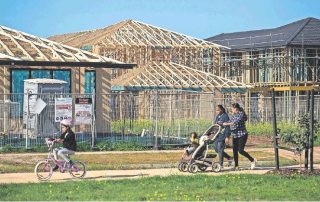
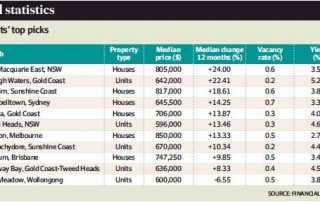
So which areas offer potential for strong capital growth and rental returns? Here are the experts’ top picks.

Wynnum, Brisbane: Pete Wargent, cofounder of BuyersBuyers, picks Wynnum for its good transport links and city access, proximity to water and desirability for buyers and renters alike. ‘‘Rental vacancy rates are very tight in Wynnum, at just 0.5 per cent, and we expect rents to rise strongly in 2022 and beyond,’’ he says.

Carrara, Gold Coast: ‘‘The rental market on the Gold Coast is very tight due to strong internal migration. With rents rising quickly, the market is attractive for landlords,’’ says Wargent.

‘‘Rental vacancy rates are extremely tight in Carrara, at just 0.3 per cent – as close to zero as you’ll likely ever see – and we expect rents to rise strongly in 2022 and beyond.’’

Buderim, Sunshine Coast: ‘‘Buderim has a fine, elevated position yet is still relatively close to the beaches,’’ says Wargent. ‘‘The centre of Buderim has a strong community vibe and attractive small-town feel.’’

Rental vacancy rates are tight, at just 0.6 per cent, and rents are set to rise strongly in the near to medium term.

Croydon, Melbourne: ‘‘The suburb has strong connectivity and transport for the city with its bus and rail links, and has homes on attractively spacious blocks of land, which will appeal to families,’’ says Wargent.

Rental vacancy rates are tight, at just 0.5 per cent.

Campbelltown, Sydney: Affordability will begin to bite for houses in Sydney’s top-performing suburbs next year, but there are still suburbs and pockets where prices have not yet soared out of reach, says Wargent.

‘‘Campbelltown to the south-west of Sydney covers a large area, and buyers need to choose their asset carefully, but there are still potentially attractive entry points for buyers looking for detached-house investments,’’ he adds.

Burleigh Waters, Gold Coast: Units are not cheap, with the median at the end of November touching $650,000. But demand is high relative to supply, says Jeremy Sheppard, research director at Select Residential Property. ‘‘Units spend about a month listed for sale before being snapped up. That’s about three times faster than the long-term, national average advertising period,’’ he says. ‘‘Median rents have climbed an impressive 25 per cent in the last 12 months taking the typical yield up over 5 per cent. A tight vacancy rate of 0.2 per cent should lead to even further rent rises,’’ he says.

Fairy Meadow, Wollongong: More than 40 per cent of units listed for sale are to be sold by auction, indicating strong demand from buyers.

‘‘There is a strong probability this suburb is about to enter its next growth phase,’’ says Sheppard. ‘‘Searches made online for property in Fairy Meadow are around 1300 per property listed for sale. This is a reflection of strong demand relative to supply.’’

Tweed Heads, Gold Coast: The vacancy rate for units in Tweed Heads at the end of November was 0.3 per cent. Rents have increased by 12 per cent over the past year, leading to a healthy yield of 4.6 per cent. Growth in neighbouring suburbs over the last year has been a lot higher than Tweed Heads. That growth should flow over into Tweed Heads, says Sheppard.

Runaway Bay, Gold Coast: The median unit price at the end of last month was $636,000. And while selling times are a bit sluggish, a 100 per cent auction clearance rate suggests there’s heat in this market from buyers, says Sheppard. ‘‘The vacancy rate is just 0.4 per cent leading to some good growth in rents and a yield of 4.5 per cent,’’ he adds.

Maroochydore, Sunshine Coast: Units are going for $670,000 and achieving a 4.4 per cent yield, says Sheppard. ‘‘Yields had climbed with rents rising 19 per cent in the last 12 months, but they could go even higher in the coming year with a vacancy rate of only 0.2 per cent,’’ he says. ‘‘Demand is ahead of supply, indicated by one in two properties listed for sale being sold via auction.’’

Lake Macquarie East, NSW: The three suburbs of interest are Tingira Heights, Cardiff Heights and Macquarie Hills, says Kent Lardner, research director at Suburb Trends.

‘‘There’s a lake on one side and beaches on the other, with plenty of national parks and hills to capture views,’’ he says.

‘‘It’s an easy commute to Sydney once or twice a week and buyers are flowing up from the Central Coast and down from Newcastle.

Weekly rents for houses have increased by $50 in the last 12 months with vacancy rates for the area currently 0.66 per cent.SI

Top property picks for 20222022-02-03T11:24:24+11:00

Why house prices will rise before falling 20pc

AFR Article: 6-7 November 2021 page 26

When you write about bricks and mortar, it inevitably attracts a lot of hyperbolic attention: you tend to be typecast as a preternatural ‘‘bull’’ or ‘‘bear’’. To be clear, I am neither: my task is to try to accurately anticipate what will unfold.

After explaining that Aussie house prices would have to correct by 15-25 per cent if (heaven forbid) the RBA ever lifted its target cash rate by 100 basis points or more, some readers responded that they had never seen us predict price falls before. While I will address this misperception later, let’s first deal with the future direction of the $9 trillion residential real estate market.

More than a decade ago, we argued that the community should expect much more volatility from residential property because of the huge increase in the household debt-to-income ratio, which had made borrowers far more sensitive to interest rate changes. At the time, we asserted that this would generate a more frequent boom-bust cycle in prices as a result of variations in borrowing rates.

If you look at the chart of CoreLogic’s eight capital city hedonic index, you can see that substantial drawdowns in prices were relatively rare between 1980 and 2003. And yet since 2003, there have been six distinct episodes in which prices have declined with what appears to be increasing severity. It might come as a surprise that the single biggest fall in Aussie house prices over the past 40 years was the innocuous episode between September 2017 and June 2019 when capital city values dropped by a record 10.2 per cent care of APRA’s macro-prudential constraints on lending. The losses at this juncture were, in fact, much worse than those experienced during either the GFC or the pandemic-induced recession.

Since the end of the 2017 correction, capital city home values have climbed by a robust 30 per cent. The capital gains after the much milder COVID-19 retrenchment have been 21 per cent. Going back to the end of the 2010-2011 downturn, we find that homeowners have profited from a 72 per cent increase in the value of their most important asset. That means that dwelling values have appreciated at a circa 6 per cent annualised pace over the last decade. And that is at the overall asset (or property) level, assuming no gearing. Accounting for the use of significant amounts of leverage, the actual tax-free return on equity homeowners have captured has been much higher again.

The RBA has made it abundantly clear that it is going to be highly resistant to lifting its cash rate until it observes consistent annual wage growth of 3-4 per cent coupled with core inflation sustainably sitting at or above the mid-point of its target 2-3 per cent band. This implies that it will not touch rates until sometime between late 2022 and mid-2023.

We are still forecasting ongoing house price appreciation until the RBA hikes and/ or banks materially lift mortgage rates. More specifically, home values should climb by another 5-10 percentage points. So there is some upside left in this trade. Yet if and when the RBA does seek to normalise the cash rate, prices should fall, as night follows day. And if the RBA is able to lift rates by 100 basis points or more, it will likely be the largest correction on record.

Assuming rates increase relatively promptly over, say, a 12-month period, we would expect national home values to decline by 15-25 per cent. It is possible that the adjustment is smaller if the RBA moves more slowly and the value of residential real estate mean reverts partly via household income growth over time. But our central case would be a circa 20 per cent decline after the first 100 basis points of hikes.

It’s worth noting that if we apply the RBA’s internal housing valuation model to this question, we get somewhat larger numbers. The model developed by former RBA economists Peter Tulip and Trent Saunders, which we have replicated and refined, suggests dwelling values could drop by about 33 per cent following 100 basis points of hikes. While renters might embrace this prospect, homeowners would obviously rather avoid it.

Bull v bear backstory

I want to conclude with some comments on the relentless ‘‘bull’’ versus ‘‘bear’’ stereotyping. We are neither: we are just trying to divine the direction of the market.

By way of background, we were the first to call a 10 per cent correction in Aussie house prices in 2017, which is what transpired between September 2017 and June 2019. We were also the first to anticipate a 10 per cent rise in prices in April 2019, which is what materialised before the COVID-19 shock.

To the best of our knowledge, we were the only forecasters to predict both a modest 0-5 per cent drop in home values between March and September 2020 (they fell 2.7 per cent across the capital cities) and a subsequent 10-20 per cent increase in prices starting in September that year.

Since September 2020, capital city dwelling values have appreciated 21 per cent. Our 10-20 per cent forecast for future capital gains following a modest dip between March and September 2020 was predicated on the assumption of 100 basis points of rate cuts. Accounting for the steeper fixed-rate mortgage reductions that ensued care of the RBA lending $188 billion of ultra-cheap, three-year money to banks, we adjusted our expectation for the price rise to 20-30 per cent, which we are on track to achieve.

Going back further, we forecast that prices would soften in late 2010 after a series of aggressive RBA rate hikes, which they did (capital city prices declined by 6 per cent between late 2010 through to the end of 2011). Yet in 2010, doomsayer Jeremy Grantham (co-founder of global fund manager GMO) had other ideas, claiming that Aussie house prices would plunge 42 per cent. We bet Grantham $100 million against the CoreLogic index that prices would be higher, not lower, in three years’ time even though we were a little bearish on the immediate-term outlook. Over the period covered by this proposed wager, dwelling values did indeed climb by 5.8 per cent.

In early 2012, we got into a debate about whether the housing market was starting to recover: our data suggested it was, whereas others felt prices were still falling. We now know prices began appreciating in January that year.

In 2013 we argued that the RBA’s rate cuts would trigger a housing boom and years of double-digit price growth, which would eventually morph into a bubble. The RBA panned the proposition at the time. Yet that’s precisely what we got between 2013 and 2017, which eventually compelled APRA to aggressively intervene.

Finally, way back in 2008 we argued that the national housing correction wrought by the GFC would be modest, regularly debating the likes of Australian economist Steve Keen and others who predicted much more calamitous 30-40 per cent price falls. In practice, dwelling values retrenched by just 6.4 per cent in 2008 and promptly rebounded by 12.2 per cent in 2009.

So we have a bit of history with housing. My introduction to the topic was a result of co-authoring the 2003 Prime Minister’s Home Ownership Task Force report on the demand- and supply-sides of the market. I also co-founded a business that developed the daily hedonic house price indices that CoreLogic now publishes and the associated automated property valuation models that leverage off the same technology.SI

Christopher Joye is a portfolio manager with Coolabah Capital, which invests in fixed-income securities including those discussed in his column.

Why house prices will rise before falling 20pc2021-12-09T10:38:25+11:00

Worried about mortgage stress? You’re not alone

AFR Article 25 September 2021 page 30

Safety margin Understand how much of your income should be going towards your home loan without pushing you over the edge, writes Duncan Hughes.

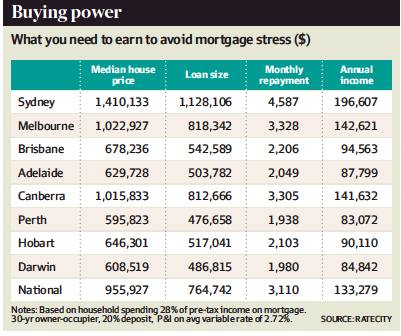
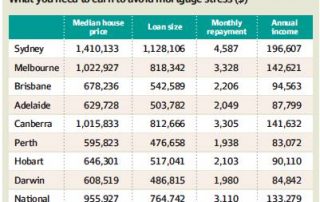
Shannon Day-Herbert’s plan to buy a family home on Sydney’s northern beaches has been dashed by rising prices pushing the annual income needed to service a median Sydney house purchase to $197,000.

Day-Herbert, a preschool teacher, and her partner, Peter Matthews, a lawyer, have been outbid by buyers with more cash for a deposit or a bigger appetite for debt.

‘‘We have grown up in this area and wanted to marry and raise our family here,’’ says Day-Herbert, explaining why they wanted to buy in Curl Curl, about 19 kilometres north-east of Sydney’s central business district.

Median house prices in the coastal suburb have jumped more than 30 per cent in the past year to more than $3 million, according to CoreLogic, which monitors property markets.

The relentless rise in property prices means that average incomes are no longer enough to afford a house without causing mortgage stress in all state capitals except Perth and Darwin. Mortgage stress is defined as paying more than 30 per cent of household pre-tax income on mortgage repayments.

In Sydney, a person on the average full-time salary of $92,000 with a 20 per cent deposit for a $1.4 million house would need another $105,000 income a year to avoid the stress threshold on one income. (See table, which assumes the buyer has a 30-year principal and interest, owner-occupier loan with a headline variable rate of 2.72 per cent.) These calculations are based on someone paying 28 per cent of their pre-tax income, to allow for increases to mortgage rates without tipping over into mortgage stress.

Day-Herbert and her partner will seek to avoid the stress of a big mortgage by looking for a cheaper house on the Central Coast, further north of Sydney.

For buyers in Melbourne and Canberra, where median house prices are about $1 million, a household would need to have a combined income of more than $140,000 to purchase on the same terms and conditions as the Sydney buyer. Average wages in those cities are $91,000 and $99,000 respectively.

‘‘Price rises for anyone already in the housing market can work in your favour, particularly for investors,’’ says Sally Tindall, research director for RateCity, which compares rates and financial products. ‘‘But owning a house is getting further and further out of reach for those trying to get in.’’

Household debt to income is rising for many households as incomes fall because of COVID-19, even though record low interest rates are keeping a lid on monthly mortgage repayments.

‘‘Buyers might be getting the green light from the banks, but they are still shooting themselves in the foot by taking on high levels of debt,’’ Tindall says.

A combination of rising prices, increased debt and the impact of COVID-19 on income are contributing to mortgage stress beyond the 40 per cent of households on lowest incomes that it traditionally affects, say analysts.

Reduced hours, lower bonuses, unemployment or disrupted household cash flow are pushing mortgage stress to a record high of more than 1.5 million households (equivalent to about 42 per cent of mortgage holders), according to Digital Finance Analytics.

Fiona Guthrie, chief executive of Financial Counselling Australia, says people who have never needed help before are calling its National Debt Helpline seeking financial assistance.

Guthrie says mortgage stress issues are on the rise, particularly in NSW and Victoria, with about one in four small businesses saying they are not continuing or planning to reopen.

‘‘People have less money because they have fewer work hours or have lost their jobs,’’ she says. ‘‘Small businesses are struggling and unable to keep staff on and pay all their loans and bills.’’

Information on mortgage issues has risen to the second most frequently visited section on Financial Counselling Australia’s website, after general information about surviving a financial crisis.SI

10 tips for creating a buffer zone

Try not to overstretch yourself no matter how tempting it might be to take out a bigger loan for the ‘‘dream home’’. Ensure you have a buffer so you can absorb a rate rise of 1 per cent or 2 per cent.

Work your way up the property ladder. If you can’t afford a house in your preferred suburb, consider a unit or another suburb.

Think about relocating out of expensive cities. It’s an increasingly popular way of dealing with rising costs and has been made easier with working from home. Popular locations are typically about two hours’ drive from workplaces, with good roads and rail links.

Look at becoming a ‘‘rentvestor’’. This is where you rent where you want to live but buy an investment property where you can afford.

Consider an offset account that is linked to the home loan and can help reduce interest paid. Any money in the account can be used to offset the balance of the loan, reducing the amount of interest charged each month.

Consider a split loan. It involves having part of the home loan balance charged at a variable rate and part at a fixed rate. Borrowers can choose how to split the loan. It means borrowers have the flexibility of an offset account and can make extra repayments on the variable rate.

Cut back on expenses and debts. Review discretionary spending such as streaming services or gym memberships to see what can be reduced.

Don’t just rely on the bank to tell you how much you can borrow. ‘‘Work out how much you are comfortable with,’’ Tindall says. Most banks provide a loan calculator setting out how much you can comfortably borrow assuming different scenarios, such as starting a family.

Pay down as much as you can while rates are low.

Regularly shop around for a cheaper mortgage. Lenders are competing for new business and will offer better rates for borrowers with a good repayment history who have built up equity in their property. There are plenty of mortgages with headline rates below 2 per cent.SI

Worried about mortgage stress? You’re not alone2021-10-12T10:11:09+11:00

IMF warns of rocketing house prices

AFR Article 25 September 2021 page 3

The International Monetary Fund has called on Australia to address the rising financial stability risks posed by surging house prices, which are expected to increase by up to 20 per cent this year.

The IMF also warned there would be a ‘‘reckoning’’ for so-called zombie companies once pandemic supports were withdrawn, which could result in a spike in corporate insolvencies, particularly in small and medium firms.

Australia’s consistent lack of large-scale systemic tax reform also needed attention, according to the global financial institution, which said a failure to act on productivity-enhancing reforms would come with a long-term cost.

‘‘We think the tax reform would help economic efficiency and strengthen Australia’s position fiscally over the medium term … but also in terms of economic efficiency by realising gains from having a better system of direct taxation,’’ IMF’s Australian division chief, Harald Finger, said.

Echoing recommendations from the OECD last week, the IMF called for Australia to reduce the income tax burden on households and business – which is higher than the OECD average – by increasing GST revenue and offsetting the regressive effects on low- and middle-income households.

‘‘Not pursuing the reform basically means losing out on the gains that one can have from better incentivising investment,’’ Mr Finger said.

Treasurer Josh Frydenberg last week ruled out any change to the GST.

The recommendations came at the conclusion of the IMF’s biannual (and this time online) assessment of Australia’s economy, which forecast growth of 3.5 per cent by the end of the year and 4.1 per cent next year.

Of note was the IMF’s projection that inflation would grow to 2 per cent by the end of next year and stay within the Reserve Bank of Australia’s target band of 2 per cent to 3 per cent. This would suggest interest rates could begin to lift by the end of next year, ahead of the RBA’s current 2024 forecast.

The release of the IMF report came as Prime Minister Scott Morrison and his ambassador to the United States, Arthur Sinodinos, met with IMF managing director Kristalina Georgieva in Washington on Friday (AEST).

The meeting focused on the international economic outlook and the world’s recovery from the COVID-19 crisis, particularly the challenges for Australia’s neighbours in the Pacific and its largest trading partner, China.

On Australia’s booming housing market, Mr Finger said the IMF’s concerns were growing affordability issues and the potential for rising financial vulnerabilities. ‘‘We think that requires a comprehensive policy response,’’ he said. ‘‘Macro-prudential policy should be tightened to address gradually rising financial stability risks.’’

Possible options include increasing interest-serviceability buffers (the stress test on household for their ability to pay loans with higher interest rates), as well as caps on debt-to-income ratios or loan-to-value ratios.

The chief executives of the Commonwealth and ANZ banks this week said they were concerned about rising house prices, and CBA boss Matt Comyn said the bank, which is Australia’s biggest residential mortgage lender, has already increased its rate benchmark from 5.1 per cent to 5.25 per cent.

Mr Comyn suggested this was a more nuanced approach to dealing with financial instability issues than caps on loan ratios, which had the potential to disadvantage certain groups, such as first home buyers.

Reserve Bank of Australia assistant governor Michelle Bullock this week said the RBA was monitoring the situation closely, given the risk to financial stability caused by high household debt-to-income ratios.

Australia’s top grouping of watchdogs, the Council of Financial Regulators, held its quarterly meeting on Friday and discussed potential measures to cool the property market.

While no immediate crackdown is planned, regulators are nudging banks to ensure prudent lending.

IMF warns of rocketing house prices2021-10-12T09:58:35+11:00

RBA warns on household debt risk to stability

AFR Article 23 September 2021 page 3

The Reserve Bank of Australia has warned it may be necessary to clamp down on household debt to income levels as growing debt driven by booming property prices could increase the risk of financial instability.

The central bank is finding it hard to judge in real time whether prices are out of line with market fundamentals, and said the macro-financial risks posed by growing household debt warranted close attention.

‘‘Sharp rises in housing prices that are not associated with fundamentals could lead to instability by raising the risk of a subsequent decline,’’ RBA assistant governor Michele Bullock said in an online speech yesterday.

In other words, if there is a bubble in house prices, it could pop.

‘‘Whether or not there is need to consider macro-prudential tools to address these risks is something we are continually assessing,’’ Ms Bullock said. However, she gave little indication the RBA believed an intervention was necessary at this stage.

The consequences of higher household debt could make the economy more susceptible to downturns if there was a shock to incomes or house prices, Ms Bullock said, but at the same time she acknowledged the strong property market had been a key economic support in the COVID-19 crisis.

But although banks had strong balance sheets and lending standards were currently being maintained, she said, ‘‘with the increase in housing prices and housing debt, risks to financial stability could be building’’.

Ms Bullock said, given the potential for growing risks, there was an open question about what authorities could do aside from sit and watch.

Noting that housing credit was growing at an annualised rate of 7 per cent and could reach 11 per cent by early next year, the RBA views the risks as broader than previous high-growth periods driven by investors.

Investor loan commitments reached about $9.3 billion in July, according to the latest Australian Bureau of Statistics lending indicators, the highest level since the peak of the last housing credit boom in April 2015.

But the build-up in growth has been sharper over a shorter period than in the past and has coincided with a large increase in owner-occupier lending supported by record-low interest rates and government stimulus programs.

Investor loans made up about 30 per cent of the value of commitments in July 2021, compared with close to 50 per cent in April 2015.

The growth in investor lending over 2014 and 2015 prompted the Australian Prudential and Regulation Authority to introduce a 10 per cent speed limit on investor loan growth known as a lending benchmark.

Ms Bullock said that while it had been picking up in recent months, investor activity in the housing market was currently nowhere near the level it was in 2014 when the lending benchmark was introduced.

‘‘Nevertheless, when prices are rising very rapidly and there are expectations that this will continue, borrowers are more likely to overstretch their financial capacity to purchase property,’’ she said.

‘‘We are therefore watching developments in housing markets and credit very closely.’’

In the event the regulators felt it necessary to intervene to slow credit growth and lower the risk of financial instability, Ms Bullock said, the current mix of lending meant previous measures would not be appropriate.

RBA warns on household debt risk to stability2021-10-12T09:55:06+11:00

APRA likely to intervene in housing: Westpac

AFR Thursday 29 July 2021 page 4

House prices will increase 18 per cent across the country in 2021, according to Westpac, including 22 per cent in Sydney despite the long lockdown, setting the scene for tightening of lending criteria early next year.

Prices are forecast to lift a further 5 per cent in 2022 before falling 5 per cent the following year pushed lower by higher interest rates, stretched affordability and a tightening of macro-prudential policies.

‘‘Deteriorating affordability is likely to weigh on owner-occupier demand, and a tightening in macroprudential policy settings will restrain the supply of credit,’’ Westpac chief economist Bill Evans said.

‘‘We expect housing credit growth to exceed 7 per cent by the first half of 2022 triggering a likely policy intervention. The precise response will depend on the composition of lending over the next year.’’

Previous macroprudential tightening targeted investors, and new loan commitments to investors almost doubled between June 2020 and May 2021, according to the Australian Bureau of Statistics.

However, while the total value of investor commitments at $91.1 billion in May was close to highs seen in 2015, the percentage of overall loans at 25 per cent remains below the 45 per cent level hit during that period.

Regulatory market interventions could target higher loan-to-value ratios, higher household debt-to-income ratios or potentially the issuing of interest only loans, similar to caps last seen in 2017.

Or if gains are driven by a more general lift in credit growth, the regulator may instead place a limit on aggregate lending for investors (as in 2015), according to Westpac.

In the meantime, Brisbane and Hobart house prices will lift 18 per cent this year, followed by Melbourne (16 per cent), Adelaide (14 per cent) and Perth (12 per cent), weighing on affordability.

‘‘The upswing that emerged at the start of this year has continued to run ahead of expectations with markets carrying strong momentum into the second half,’’ Mr Evans said.

‘‘Prices nationally rose 12.2 per cent over the first six months, an extraordinary 25.6 per cent pace in annualised terms.’’

Westpac was the first major bank to tip rate rises ahead of the Reserve Bank’s current 2024 guidance, with Mr Evans forecasting the first increase above the current historically low 0.1 per cent in early-March 2023.

Most economists now expect the RBA to begin raising rates over 2023 and 2024 to a natural rate of about 1.25 per cent. Westpac estimates rates any higher would place ‘‘significant stress’’ on household finances.

House prices as a ratio of household disposable income nationally have risen from about 2.5:1 in 1991 to more than 5:1 in 2021, according to the RBA, while the household debt to income ratio has climbed from 0.7:1 to close to 2:1.

APRA likely to intervene in housing: Westpac2021-08-25T13:43:14+10:00

Banks’ future prospects worry investors

Banks, it seems, are finding it increasingly difficult to live up to lofty investor expectations.

After dazzling investors with their ability to largely withstand the economic upheaval caused by the pandemic, and after benefiting from writing back billions in provisions they squirrelled away to cover soured loans, banks are struggling to convince investors that they’ll be able to continue to grow their earnings.

And that’s left investors anxious that the banks’ share prices are vulnerable to even the slightest disappointment, given that so much optimism – both about the economic outlook and on bank earnings – is already priced in.

For instance, the share price of the country’s largest lender, the Commonwealth Bank, has climbed from a low of 57.66 last march, to close at $98.78 in trading yesterday – a rise of 71.3 per cent.

But investors are reining back some of their previous enthusiasm which pushed the Commonwealth Bank’s share price as high as $103.69 last month.

Part of the investor malaise reflects a growing unease over the outlook for the home loan market.

After all the strong rebound in earnings of the big four banks largely reflects the astonishing surge in demand for home loans. As a rough rule of thumb, every 1 per cent increase in mortgage lending boosts the banking sector’s earnings by 1 per cent.

But there are growing doubts as to whether activity in the property market can continue at such a frenzied clip.

Especially since there are signs that the prudential regulator could be looking at ways to take some heat out of the market, either by raising the interest rate buffer on new loans, or by imposing limits on loan to valuation ratios, or how much debt people can take on relative to their income.

Meanwhile, the latest lockdown of greater Sydney will weigh on bank earnings, because a number of home loan and business customers will decide to defer their loan repayments.

What’s more, the Sydney lockdown will also make the big banks much more cautious both with respect to releasing some of the provisions they set aside during the pandemic to cover the expected surge in bad debts, and to calculating their dividend payments.

More importantly, however, the lockdown will likely undermine consumer and business confidence.

The Westpac-Melbourne Institute Index of Consumer Sentiment shows that consumer confidence has already been shaken, with a 13.6 per cent drop in Sydney, and a 10.2 per cent decline in NSW.

As Westpac chief economist Bill Evans pointed out, it’s likely that when the survey was taken, many respondents were anticipating a shorter lockdown period.

‘‘Ominously, that suggests confidence in Sydney and NSW could fall significantly further, if lockdown measures are unsuccessful or slow to act in containing the outbreak,’’ he noted.

And although there has been a slight pickup in business investment, partly in response to tax incentives contained in the budget, bank lending to companies dropped 2 per cent in the year to May 2021.

Bankers point out that the closure of international borders means that there are whole sectors of the economy – such as tourism, aviation and education – where businesses are trying to whittle down their debts.

More broadly, the Sydney lockdown is causing investors to worry that the country’s vaunted economic rebound may not be as robust as it appeared.

And this makes it more likely that the Reserve Bank will be correct in its forecast that official interest rates will remain close to zero until 2024.

For the country’s banks, this means that the squeeze on their interest rate margins – what they pay on deposits and what they earn on loans – will persist for years.

Indeed, it’s likely to worsen. The banks benefited from around $200 billion in ultra-cheap three-year loans from the Reserve Bank, but this program has now ended.

Similarly, they were able to protect their interest rate margins by nudging down the rates they pay on term deposits, but this repricing is now largely completed.

At the same time, banks are increasingly competing on price, particularly in the coveted home loan market. As a result, local bankers are bracing for further erosion in their net interest margins.

But big four locals at least have some consolation. Investors were equally underwhelmed by the blockbuster second quarter results that both Goldman Sachs and JPMorgan unveiled this week.

The two giant Wall Street banks both benefited from a surge in merger and acquisition activity, which has been fuelled by ultra-low borrowing costs.

Corporate chiefs, private equity firms and blank-cheque companies have spent hundreds of billions on corporate takeovers.

Meanwhile, investors have been lining up to buy the hundreds of billions of shares issued by corporates making their share market debut.

Fees in Goldman’s investment banking were up 36 per cent compared with the same period a year earlier, to $US3.6 billion ($4.8 billion). And at JP Morgan, investment banking fees rose 25 per cent to an all-time high of $US3.6 billion.

This buoyant investment banking activity helped Goldman report quarterly profit of $US5.5 billion, on revenue of $US15.4 billion.

Meanwhile, JP Morgan posted profit of $US11.9 billion, on revenue of $US30.4 billion.

Still, although the results of both banking giants exceeded expectations, investors were underwhelmed.

Goldman’s share price – which has climbed 80 per cent in the past year – finished 1.2 per cent lower. And JPMorgan, whose share price has climbed close to 60 per cent in the past year, finished 1.5 per cent lower.

Although they celebrated the sharp rebound in traditional investment banking activity, investors were somewhat disheartened by the steep slide in trading revenue.

What’s more, there are worries that the new coronavirus variants could still weigh on the global economic recovery. Investors are conscious that the US bond market continues to point to more muted pickup in activity.

And this was reinforced by the anaemic loan growth. JPMorgan, the largest US bank, reported that loans outstanding were flat relative to a year earlier at around $US1 trillion.

There are also concerns that moves by the Biden administration to stamp out anti-competitive practices could weigh on investment banking earnings. Proposed mergers and acquisitions could come under far greater regulatory scrutiny if there is pressure to more vigorously enforce antitrust laws.

Increasingly, investors are questioning whether the spectacular recovery in bank share prices since the dark days of the pandemic can continue.

The author owns shares in the major banks.

Banks’ future prospects worry investors2021-07-29T10:28:01+10:00

Get ready for negative rates: APRA to banks

AFR Article 13 July 2021. Page 16

The prudential regulator wants banks to be prepared for zero and negative interest rates, and has called on them to take all ‘‘reasonable steps’’ to ensure their technology systems can deal with extreme monetary policy settings.

The Australian Prudential Regulation Authority said yesterday that it had written to the banks seven months ago, asking them if they would have any problems in implementing negative interest rates.

The Reserve Bank has said many times that a negative cash rate would be highly unlikely in Australia. Such a setting could support economic activity, by keeping downward pressure on borrowing rates and exchange rates. But negative rates could also make it harder for banks to lend and encourage saving over spending.

The banks’ responses showed they were typically well-placed to deal with negative market interest rates on products managed by their treasury operations, APRA said.

But some banks pointed to the operational challenges if negative rates were applied to lending and deposit products (which means they would have to pay customers to park funds with them). Other banks flagged the costs of fixing the existing systems to deal with negative rates.

APRA said that at the very minimum, banks should ‘‘develop tactical solutions’’ – short-term fixes to create workarounds on existing systems – to implement zero and negative market interest rates and the cash rate by April 30, 2022. It wants this done for all products referencing the cash rate or a market interest rate. This includes business lending, residential mortgages, personal loans and credit cards.

The regulator said it would finalise its expectations by October 31 and wanted feedback by August 20.

Its focus on a potential negative interest rate world comes as financial markets consider that the Reserve Bank might lift official rates faster than expected, despite its governor, Philip Lowe, insisting that they will not rise before 2024.

The regulator acknowledged the RBA’s position that a negative cash rate is unlikely. Dr Lowe said in December it was ‘‘extraordinarily unlikely’’ the central bank would adopt such a position, which would involve ‘‘clear costs’’ including on the supply of credit by making it harder for banks to lend.

But APRA said it still wanted banks to be prepared, because ‘‘it is possible that other interest rates determined in the financial markets could fall to zero or below zero at any time’’.

Negative interest rates have been implemented in Europe, Japan, Sweden, Switzerland and Denmark.

The Reserve Bank of New Zealand has also asked Australian banks to be prepared for a negative policy rate: it sent a communication similar to APRA’s December letter in May last year.

APRA said there were risks if banks were not prepared for zero and negative interest rates, and these were material enough to trigger its Prudential Standard CPS 220 on risk management.

It wants banks to ensure they have controls to address operational risk in a negative rate world, and to consider the potential for conflicts of interest and the fair treatment of customers.

Banking analysts say negative interest rates would harm earnings.

In an analysis of the prospect of negative rates published last year, Macquarie said banks would ‘‘be able to navigate the negative rate environment through repricing measures’’, but ‘‘earnings headwinds will be difficult to offset in full’’. Banks with a higher proportion of deposit funding would be hit harder as they would lose their funding cost advantage, Macquarie added.

Get ready for negative rates: APRA to banks2021-07-29T10:23:29+10:00

Pressure to cool housing market intensifies: ANZ

AFR Article 9 July 2021. Page 10

The pressure to cool the booming housing market has intensified as the growth in lending to buy a home almost doubled over the past year, and investor loans accelerated by more than 30 per cent in the past three months, ANZ’s economists warn.

With housing credit growth expected to surge further and threaten to outstrip income growth by a significant margin, the Australian Prudential Regulation Authority could be compelled to step in with harder measures by the end of the year, said ANZ senior economist Felicity Emmett.

‘‘I think the rate of growth in overall housing finance is really very strong at the moment, and I think it will accelerate quite sharply in the coming months,’’ she said.

‘‘Once those credit growth numbers start sprinting at these higher rates, I think that the regulators are going to become concerned.’’

While the Reserve Bank of Australia and APRA have pointed out in recent months that they do not target house prices, they were worried about the level of household debt relative to income, Ms Emmett said.

‘‘The May data shows that credit growth is already outpacing income and the gap is likely to widen,’’ she said.

‘‘Our expectation is that credit growth will lift above 7 per cent by the end of 2021 and will grow above household income by a significant margin for the next few years.’’

ANZ’s forecast already assumes house price growth will slow in the coming months as slightly higher mortgage rates feed through and macroprudential policy is implemented by the year’s end.

The bank expects home prices to rise between 15 per cent and 20 per cent in capital cities through 2021.

Ms Emmett said APRA was already using a soft-touch approach to tame the housing market, but harder limits looked likely in the next few months. ‘‘We already know that APRA has written to the banks to question them about their lending standards to make sure they’re lending responsibly.

‘‘This is generally the first step that tells us that APRA has a fairly soft touch approach to start with,’’ she said. ‘‘But I think it’s clear that the regulators are thinking about what sorts of measures they would include. So while they might not be ready to pull the trigger just yet, they are certainly planning for a potential intervention, later this year potentially.’’

RBA governor Philip Lowe on Tuesday flagged measures such as increasing the buffer banks use to calculate the size of home loans people can get from the current 2.5 percentage points above the advertised mortgage rate.

The RBA is also looking at putting a limit on the number of high debt-to-income ratio loans and low-deposit mortgages the banks could write.

Curbs on investor lending and interest-only borrowing were also an option, but probably further down the track, Ms Emmett said.

‘‘The strongest likelihood is that more than one measure is introduced, and the choice will depend on how the data evolves,’’ she said.

‘‘At this stage, I think it’s unlikely the regulators will target investment lending and interest-only loans as they are not at [concerning] levels … but it doesn’t mean in four months’ time they may not use those measures if the rate of investor lending accelerates further.’’

Pressure to cool housing market intensifies: ANZ2021-07-29T10:17:55+10:00

Developers and buyers ‘should be quaking’

AFR Article 3-4 July 2021 Page 28

Economic forecast A key government report warns that the biggest drivers of residential real estate growth could be starting to weaken, writes Duncan Hughes.

Property buyers will be caught in ‘‘machine gun alley’’ if predictions by an influential government study into future economic growth that flag sharply rising interest rates and falling population growth turn out to be true.

The new Intergenerational Report calls time on the 25-year property boom – fuelled by falling interest rates and undersupply – which has driven up prices and made it increasingly difficult for first-home buyers to enter the market.

Chris Richardson, a partner with Deloitte Access Economics, warns property developers will be under pressure as population growth slows and the risk of oversupply rises, particularly in traditional hubs such as Melbourne and Sydney.

‘‘At face value, it is not a pretty document for developers and buyers,’’ said Richardson about the federal government’s latest Intergenerational Report on the big-picture economic issues of the future.

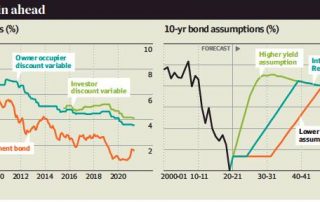
Key issues affecting property buyers and developers include slower population growth and lower levels of migration because of restrictions on travel caused by COVID-19. The report assumes 10-year bond yields will increase over time back to levels consistent with nominal gross domestic product growth of about 5 per cent. Bond yields are currently about 1.5 per cent.

‘‘That would be machine gun alley for property buyers and should have them quaking in their boots,’’ Richardson said of a trend that could more than double average 30-year variable mortgage rates to about 7 per cent.

The accompanying chart shows the relationship between the benchmark 10-year Australian government bond yield and home loan rates.

‘‘If the long-term expectation for the benchmark is 5 per cent – or about 3.5 per cent higher than today’s yield – it is a reasonable expectation that loan rates for owner-occupiers and investors would also be around 3.5 per cent higher over the long term than today’s low rates,’’ Canstar financial commentator Steve Mickenbecker said.

That would result in the average variable rate of owner-occupier loans doubling from 3.59 per cent to 7.09 per cent, or adding another $2000 to the monthly repayments on a $1 million, 30-year principal and interest loan.

‘‘A 5 per cent, 10-year bond yield will also mean that inflation has taken off so that salaries will have increased. But with today’s escalated loan amounts, there will be stress attached to the higher repayment,’’ Mr Mickenbecker added.

Interest rates are already beginning to creep up, particularly for four- and five-year fixed rates as funding costs rise.

Shane Oliver, AMP Capital’s chief economist, said the convergence of economic growth and bond yields is a reasonable assumption consistent with ‘‘long-run historical relationships’’.

‘‘If migration levels only get back to pre-pandemic levels by 2024-25 and don’t make up for lost ground through the pandemic, then the population in five years will be nearly 1 million smaller than previously assumed, and this will mean a net loss in demand for homes of around 350,000 over five years compared to what might have been expected pre-pandemic,’’ Oliver said.

‘‘If dwelling construction continues around its current pace, this will see the property market move into oversupply in the years ahead.’’

Two key drivers of the long-term property boom that began in the mid-1990s – low interest rates and undersupply of property – will come to an end, he says.

‘‘It would be good – or at least better – news for new home buyers,’’ Oliver said. ‘‘But it may not be so good for property developers – particularly those in cities like Sydney and Melbourne – who have become dependent on rapid property price appreciation.’’

Borrowing commitments by investors are at an 18-year high, having increased by nearly 13 per cent to nearly $8 billion in the three months to the end of May, according to government statistics.

The nation’s home-building pipeline is full, with demand for supplies and labour exceeding availability even as the sugar hit of the government’s HomeBuilder stimulus drops out of the system, according to economists.

Critics of the Intergenerational Report contest some of the underlying assumptions about the size of any rate rises and suggest strategic responses for property investors and developers.

Deloitte’s Richardson argues weakness in the economy, weak wages growth, low inflation and structural changes will keep a lid on rates.

Andrew Wilson, the chief economist at My Housing Market, adds: ‘‘We are continuing to find factors hampering any return to long-term normal, particularly income growth.’’

Wilson said the types of property investors were seeking had also changed, with demand for fringe developments and high-rise being replaced by more competition for bigger townhouses. Circumstances were changing, he said, and the past may not be an accurate guide to future events.

Simon Pressley, a buyers’ agent and head of research for Propertyology, said population growth was ‘‘way down the list of influences on property prices’’ after interest rates, jobs and economic confidence.

‘‘Given that all overseas migrants rent property, it is the rental market – as opposed to property values – that is likely to be more affected by border closures,’’ Pressley said. ‘‘Also, regions have very little reliance on overseas migration. Further, an increasing number of people are relocating from capital cities, especially Melbourne and Sydney.’’

Mickenbecker said the prospect of higher rates meant buyers should start paying off their loans while rates remain low.

‘‘There is time now to build a buffer through making extra repayments while interest rates are low. But as rates rise whether two or three years away, that will get tougher,’’ he said. SI

Developers and buyers ‘should be quaking’2021-07-29T10:11:22+10:00