AmcoTax.Admin

About Angela Shannon

This author has not yet filled in any details.
So far Angela Shannon has created 101 blog entries.

What It Means For Your Money

There are numerous opportunities for astute investors and consumers to take advantage of. Aleks Vickovich and our expert writers break it down.

As expected, the Morrison government’s pre-election budget had plenty of sweeteners. The 2022-23 budget documents revealed total expenditure of $628.5 billion, of which social security and welfare ($221.7 billion) made up the lion’s share, alongside funding for health ($105.8 billion), education ($44.8 billion), defence ($38.3 billion) and transport and communications ($18.9 billion).

Included was a one-off, $8.6 billion package of short-term handouts described by The Australian Financial Review as a ‘‘shameless voter bribe’’.

Whether the cash splash is effective remains to be seen, with voters to go to the polls in May. But the budget’s short- and long-term measures contain a range of opportunities that astute investors and consumers may seek to take advantage of.

Here’s what you need to know.

Women

Australian women remain on track to earn $2 million less than their male counterparts due to what economists and critics deem a lacklustre, pre-election federal budget.

While it included $9 million in funding to support emerging female entrepreneurs and $58 million in funding for endometriosis, experts warn the measures do not go far enough to promote women’s earnings capacity and – in the case of the paid parental leave changes – may even backfire.

The government’s paid parental leave scheme will now be 20 weeks shared at the couple’s discretion at the minimum wage. Previously, primary carers – who tended to be mothers – were eligible for 18 weeks, while partners were eligible for two weeks. The income test will be changed to a household limit of $350,000 each year rather than the individual test.

‘‘It’s done under the guise of flexibility and allowing more leave sharing between partners,’’ says Grattan Institute CEO Danielle Wood. ‘‘That’s great in the small percentage of households that want to do that, but my theory is it will actually lead to more gendered norms around who cares [for children] in the early years.’’

That policy, coupled with no movement on childcare, confirms Grattan modelling that finds the average mother will earn $2 million less over her lifetime compared to the average father, says Wood.

‘‘[The budget] was a missed opportunity to address some of the disincentives to women’s workforce participation, particularly the higher cost of childcare,’’ she adds.

Industry groups also characterised the budget as lacking for women.

Tax Institute analysis of childcare costs and subsidies found the secondary earner, who is often the mother, faces a steep disincentive to return to full-time paid work.

‘‘If they’re back to a full-time schedule, the secondary earner is only gaining $6 extra for the tenth day of work in a fortnight. By the time they’ve commuted to work and bought a morning coffee, they’re paying to go to work that day,’’ says Tax Institute tax policy and advocacy general manager Scott Treatt.

‘‘The secondary earner in a family can be taxed at an effective rate, including net childcare costs, of more than double the top personal marginal tax rate. This makes returning to work financially impossible for many parents who might otherwise like to.’’

LUCY DEAN

Retirees

In a measure foreshadowed by the Financial Review in March, the government committed to extending its changes to the superannuation minimum drawdown requirement for another year. ‘‘The government has extended the 50 per cent reduction of the superannuation minimum drawdown requirement for account-based pensions and similar products for a further year to June 30, 2023,’’ the budget documents said.

‘‘The minimum drawdown requirements determine the minimum amount of a pension that a retiree has to draw from their superannuation in order to qualify for tax concessions.’’

Drawdown rates range from 4 per cent to 14 per cent, depending on age. The extension of the halved rate would drop the rate from 7 per cent to 3.5 per cent for someone aged between 80 and 84.

While the budget billed this measure as ‘‘supporting retirees’’, experts say it would really only benefit retirees who have already accumulated substantial wealth outside super.

Peter Burgess, deputy chief executive of the SMSF Association, says the extension allows individuals who have access to outside funds to withdraw less than they would ordinarily have to under the normal policy conditions.

‘‘This means they can retain more in their super pension account – which is tax-free – for longer,’’ he says.

The tax benefits of keeping more money in a super environment are clear, says Lisa Papachristoforos, a partner at accounting firm Hughes O’Dea Corredig.

Wealth held in a super fund in pension mode incurs no tax on income and capital gains, she points out – as opposed to income held in an individual’s name, which is taxed at marginal rates.

But tax advantages are not the only potential benefit. The extension of the minimum drawdown also provides ‘‘continued flexibility’’ on how much retirees need to withdraw to fund standard of living, Papachristoforos adds.

Aside from tax efficiencies, leaving more money in super means more can be invested, generating further returns.

Plus, while the policy may be aimed at retirees, all super fund members may profit from the extension regardless of their age or distance from retirement.

‘‘Super funds are potentially faced with an additional year of lower minimum pension withdrawals paid to their members, allowing them to utilise that forgone withdrawal at a pooled level for investment purposes,’’ Papachristoforos says.

‘‘As such, extending the minimum drawdown rule could positively affect all superannuants, not just those drawing an income stream from their account, and the investment managers of super money will have more funds to invest.’’

Certified financial planner Josh Dalton, of Dalton Financial Planners, agrees there are potential tax minimisation benefits from the extended minimum drawdown policy, as well as the prospect of opening up more money to be invested in markets.

But he warns the measure is not suitable for all retirees. ‘‘Retirees need to estimate their annual expenditure and get a good grasp on how much income they can live on comfortably,’’ he suggests.

‘‘They can then decide to reduce their pension payments in line with their budget estimate and conserve more of their account-based pension capital if it suits.’’

ALEKS VICKOVICH

Home buyers

Borrowers planning to apply for the expanded Home Guarantee Scheme should start preparing their applications soon because competition is expected to be fierce, say lenders.

First home-loan applications surged when previous allocations were announced to allow first home buyers and single parents to get into the property market with a deposit of between 2 per cent and 5 per cent without needing to pay for expensive lenders mortgage insurance.

Applicants need to choose a loan from a lender on the scheme’s list that offers the rates, terms and conditions best suited to their needs. It has to be a principal and interest loan. Investors are not eligible.

Prospective borrowers should gain pre-approval for their loan from the lender, which will involve providing identification, age, proof of income, a prior property ownership test, proof of deposit and intention to be an owner-occupier.

Applicants also need to ensure their loan application is within the price caps set for each city. For example, it is capped at $800,000 for Sydney’s central business district and $500,000 for Ballarat in regional Victoria.

The First Home Guarantee, which supports eligible first home buyers to build or purchase a new or existing home with a 5 per cent deposit, has been increased from 10,000 offers to 35,000 a year from July 1. It is capped at $125,000 annual income for individuals and $200,000 for a couple.

There are also 5000 places for the Family Home Guarantee, which enables eligible single parents with dependents to enter or re-enter the housing market with a deposit from 2 per cent.

Mortgage broker Elodie Blamey says single mothers and fathers can earn up to $125,000 – excluding childcare support – to be eligible. ‘‘Unlike the Home Guarantee Scheme, it is not being used nearly enough,’’ she says. Many single parents might not be aware of the scheme and its conditions, or consider themselves eligible.

Merinda Brooks, a single parent with a three-year-old son, says: ‘‘It has absolutely changed my life.’’

The speech pathologist says it would have been challenging to save a 10 per cent deposit. ‘‘I was working really hard but unsure about how I could have otherwise got a deposit together,’’ she adds.

There are also another 10,000 places a year under the Regional Home Guarantee scheme for anyone who has not owned a property for five years, on the condition they purchase a newly built home or build.

Lenders are awaiting additional details from the government before advising potential borrowers.

DUNCAN HUGHES

Patients

Government changes to the Pharmaceutical Benefits Scheme safety net thresholds, making medicines more affordable, is good news for many self-funded retirees, according to a leading super specialist.

Lower safety net thresholds for the PBS mean potential savings for retirees, and may create an opportunity for others who have ‘‘grandfathered’’ account-based super pensions.

From July 1, the PBS safety net thresholds will be reduced from $326.40 to $244.80 for concession patients, and from $1542.10 to $1457.10 for general patients, which means fewer scripts before the safety net is reached.

Patients will also reach the safety net sooner with 12 fewer scripts for concession patients and two fewer scripts for general patients.

‘‘This is good news for self-funded retirees who do not hold a Commonwealth Seniors Health Card,’’ says Colin Lewis, head of strategic advice for Fitzpatricks Private Wealth.

‘‘There may also be the opportunity for advisers to consider clients who have an underperforming ‘grandfathered’ account-based pension but feel trapped for fear of losing the card if they move.’’

Many CSHC holders have account-based pensions that are ‘‘grandfathered’’ after the income test rule change on January 1, 2015. Account-based pensions started after that date are deemed under the card’s income test, whereas nothing counted with existing pensions. For this reason, many are reluctant to switch pensions or super funds for fear of losing their CSHC.

‘‘It is a matter of doing the numbers.’’ says Lewis. ‘‘Deemed income from a new pension may not push a cardholder over the CSHC income threshold but, where it does, the cost of losing the card is now reduced with a lower safety net, and the potential return from a new pension may well exceed this cost.’’

The same concern may contribute to some self-funded retirees maintaining self-managed super funds rather than switching to a possibly better-performing and cheaper retail or industry fund.

DUNCAN HUGHES

Small business owners

Improving workforce skills, incentives for employing apprentices and increasing investment in technology and digitisation are among the opportunities. Small and medium businesses with a turnover of up to $50 million are getting an additional 20 per cent deduction for the cost of external training provided to employees.

That means a business will be able to deduct $120 for every $100 spent on a course.

As an example, a business needs to train 10 employees in administrative skills to manage jobs. The company enrols them at a cost of $430 per employee. In addition to the $4300 deduction, the company can claim an additional $860 deduction, being 20 per cent of the expense.

There is also $2.8 billion over five years to increase apprenticeships, including $5000 payments to apprentices over the first two years of their apprenticeships, and $15,000 to qualifying employers paid as 10 per cent for first- and second-year apprentices and 5 per cent for third-year workers.

For example, a business employing an apprentice for $40,000 a year will receive $1250 every six months for two years to help with the cost of training. The company can apply for payments of $4000 in the first and second years, and $2000 in the third year.

The calculations were provided by financial adviser Cameron Harrison.

Businesses are also eligible for another 20 per cent deduction for expenses on digital upgrades, such as cyber security systems or subscriptions to cloud-based services, up to $100,000. Installation has to be completed by June 30, 2023 to be eligible.

‘‘This is a no-brainer,’’ says Greg Travers, a director of William Buck. ‘‘Businesses know they need to digitise, and now the government is giving them an incentive to do it. The benefit is not huge . . . but it helps.’’

Digitisation means more pre-filling, data-matching and data-sharing for the Australian Taxation Office.

‘‘The measures are designed to reduce compliance costs for businesses, but also make it easier for the ATO and other revenue authorities to data-match and share information,’’ Travers says. These measures include using real-time data to calculate PAYG tax instalments.

Sam Pratt, chief executive of Render Networks, which develops broadband connectivity, says while it was a good budget for infrastructure, there needs to be more support for the digital economy to keep it competitive with the US and Europe.

Changes to the taxation of employee share schemes will help smaller companies, particularly technology start-ups, attract and retain skilled workers. Limits on the value of shares an employer can issue to employees has been increased from $5000 to $30,000, which puts it in line with international standards.

DUNCAN HUGHES

Aged care residents

With medication management long regarded as the bane of residential aged care, funding to link care facilities with community pharmacists and onsite pharmacists should bring some comfort to residents and nurses.

The delivery of wrong and/or excessive medication has long been an issue waiting to be addressed.

However, at the heart of this and other positive reforms flagged for the aged care sector in the federal budget lies a major problem – recruiting and retaining qualified staff.

Notably absent from the spendathon was any mention of the wage increase for existing or future aged care workers that is so desperately needed to deliver the existing services, let alone promised ones.

Pharmacists are as desperate for the implementation of a workforce plan as the aged care sector, putting a huge question mark over the success of a potentially good idea before it is even rolled out.

The ongoing release of 80,000 home care packages in 2021-2023 – taking the total to about 275,600 people by June next year – is welcome confirmation of intentions to assist older Australians to remain living independently at home.

But the delivery of the packages and other at-home support is also dependent on attracting a suitably skilled workforce to meet the demand.

It is the same for the 8500 new respite services also announced previously as part of an $18.8 billion, five-year reform program following the Royal Commission into Aged Care Quality and Safety.

On that front, the $48.5 million for 15,000 additional aged care training places for new and existing personal care workers, to a total of 48,800 places, is a positive move.

More money for more training is always welcome, says Sean Rooney, chief executive of Leading Age Services Australia and representative of the Australian Aged Care Collaboration. But he says the budget failed to address the key fundamental deficiencies identified in the royal commission – wages and the viability of aged care homes.

Sticking with the commitment to reform the residential aged funding model through the introduction of the Australian National Aged Care Classification Transition Fund, the budget included an additional $34.60 per bed per day.

The proposed residential aged care funding model, scheduled to begin on October 1, is designed to align residential aged care funding to the care needs of each resident.

The starting price is $216.80 a day per resident for standard care – with more for dementia-related care – compared to about $180 a day per resident under the old funding model.

Council on the Ageing chief executive Ian Yates will be looking to see that the additional money is spent on increasing the number of care minutes with residents as intended by the royal commission, which recommended care homes have a target of 200 minutes per resident per day.

Exactly how that will be measured is yet to be worked out. But Yates wants the government to commit to publishing how many minutes of care each residential facility is being funded to deliver, compared to the number of minutes actually delivered, as part of its new star rating system.

With an election on the way, there is still hope for further announcements that will directly benefit older Australians and those who deliver the care they deserve.

Unlike the government, the opposition has centred its budget promises on fixing the aged care workforce with a $2.5 billion pledge for measures, including a wage rise.

BINA BROWN

Young Australians

Successive budgets chasing the ‘‘grey vote’’ have allowed structural flaws in Australia’s economy to form, with younger generations and economists now calling for bold conversations to help strike out the unwieldy debt bill.

The budget features a projected $78 billion deficit for 2022-23. The deficit is expected to linger for the next 10 years, with gross debt peaking in 2025.

While a deficit isn’t necessarily a problem if the debt brings sustained productivity or lifestyle improvements, Australia’s ability to wind back high levels of spending will be the key issue for younger generations, says the Grattan Institute’s Wood. ‘‘We shouldn’t be so fixated on the deficit per se, especially coming out of COVID-19; it partly reflects that we did need to spend a lot to respond, and that it was appropriate to do so,’’ she says.

‘‘But we should think about the structural budget deficit over time, and that does look a bit concerning.’’

Wood says Australia’s spending appears to be fixed at a higher level after COVID-19, with more money flowing through to defence, aged care and the National Disability Insurance Scheme.

‘‘We haven’t really talked about how we’re going to pay for that over time,’’ she says. ‘‘The risk is if we don’t do anything about that and debt continues to creep up as a share of the economy – that’s the concern that young people, quite rightly, might have.

‘‘It’s that longer-term picture and the lack of clarity around how we’re going to square those numbers.’’

The co-founder of intergenerational fairness advocacy group Think Forward, Sonia Arakkal, agrees government debt is a complex issue, but is concerned that the budget puts older generations’ needs before younger generations’ current and future needs.

‘‘Young people have a sophisticated understanding of the economy – we’re a very highly educated generation . . . we want policymakers to take into account our interests,’’ she says.

‘‘So, if they are accruing debt in our name, it should be debt that is invested in climate change or infrastructure – not pork-barrelling in particular marginal seats or particular states.’’

Faced with baked-in higher spending, an ageing population and a need to decarbonise, Arakkal – who is leading calls for a parliamentary inquiry into intergenerational fairness – is calling for Australia’s political class to engage in more difficult conversations about equality.

‘‘We have a system that is overly reliant on income taxes and doesn’t treat asset taxes in the same way, and we shouldn’t be punishing people for working. We should be looking at taxes that are inefficient, like capital gains tax, or how we tax superannuation,’’ she says.

‘‘We need to be having those conversations to set the younger generation up for success.“

There are two options for tackling the deficit, says Wood.

The first is to find ways to make the economy grow faster, as a faster-growing economy will essentially ‘‘fritter away’’ the debt burden.

‘‘Looking at policies which actually promote productivity and growth is important, so that could be tax reform, reforming cities, and how we do planning and zoning regulation?’’ she says.

Supporting more women to return to the paid workforce after having children is also a key way to uncap economic potential, Wood says, expressing disappointment at the budget’s muted changes in that area.

‘‘Over time, I think taxes will have to rise, even if we do tick some boxes on the growth front,’’ she says.

‘‘It’s inevitable that as government has increased as a share of the economy, that there will have to be an increase in taxes to pay for that. That has to be done carefully. What we shouldn’t do is just rely on income tax to do all the heavy lifting, which is what we’ve done historically.’’

LUCY DEAN

Households

Those earning up to $126,000 will be eligible for an additional one-off $420 that will be paid when their 2022 tax return is lodged. There’s also a one-off cost of living payment of $250 to eligible income support recipients and certain concession cardholders. Fuel excise (a federal tax imposed on each litre of petrol) will be halved, intended to reduce the cost of fuel by 22¢ a litre. In addition, costs of taking a COVID-19 test to attend work are tax deductible from July 1.SI

DUNCAN HUGHES
What It Means For Your Money2023-04-21T14:15:56+10:00

CBD apartments rents set to surge even higher

Surging demand and dwindling rental supply have fuelled a jump of more than 22 per cent in median rents in some inner-city Melbourne suburbs in the past 12 months, and more increases are expected as vacancy rates tighten, data from CoreLogic shows.

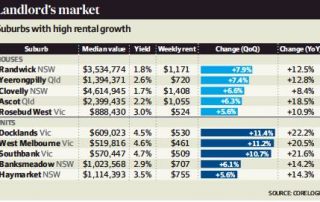
Apartments in inner Melbourne notched up the biggest rise in median weekly rents during the year, with Docklands soaring by 22.2 per cent. Rents in Southbank rose 21.6 per cent, West Melbourne 20.5 per cent and Melbourne city 17.7 per cent.

In Sydney, median rents for Pyrmont apartments jumped by 16.9 per cent, Ultimo 14.6 per cent and Hay-market 14.3 per cent during the same period.

Tim Lawless said many inner-city rental apartment markets had recovered from their pandemic lows.

‘‘These inner-city precincts are bouncing back strongly now off the back of rising demand against rapidly tightening vacancy rates,’’ he said.

‘‘Demand for inner-city rental accommodation is now being driven by a spillover from the lower density sectors of the rental market, where high rents and rental affordability are pushing more renters to consider an inner-city higher-density option.

‘‘This renewed level of demand is being amplified by recently opened borders with overseas students and visitors and permanent migrants adding to rental demand. Additionally, as inner-city precincts become more vibrant as workers return to offices and COVID-19 related restrictions are eased, inner-city areas are likely to become more popular.’’

The inner-city precincts of Melbourne and Sydney were among the hardest hit during the pandemic because of the border closures and migration away from the cities.

In the most extreme examples, rents in some inner Melbourne suburbs dropped by more than 20 per cent from peak to trough, Mr Lawless said.

Strong demand for houses in the more affluent suburbs and coastal locations also sparked a 20.1 per cent jump in rents in Tootgarook on the Mornington Peninsula over the year.

House rents climbed by more than 19 per cent in Bardon and Ascot in inner Brisbane and by 13.9 per cent in Coogee in Sydney’s eastern suburbs.

Although some of Sydney’s more expensive suburbs have posted a drop in value in the three months ended March, rents in suburbs such as Randwick climbed by 7.9 per cent – the biggest quarterly gain for houses across the capital cities.

Clovelly was up 6.6 per cent, Somerton in Adelaide’s south rose 7.4 per cent and houses in Yeerongpilly in Brisbane’s south had a similar rise.

‘‘Available rental supply remains well below average in most areas of Australia and rental demand isn’t likely to ease, with higher overseas migration and more prospective buyers being kept in the rental market due to affordability constraints,’’ Mr Lawless said.

‘‘Available rental stock is around record lows across every capital city and major regional housing market. Rents have risen substantially more than incomes in most areas and renters are having to dedicate more of their incomes to rental payments, which has implications for savings and consumption.

‘‘With the government relying on the private sector to deliver rental housing, it seems that the long period of declining investment activity between 2015 and 2021 is, at least in part, the reason why rental stock has tightened so substantially.’’

Vacancy rates have fallen to a record low of 1 per cent nationwide in March, data from Domain shows.

‘‘We’re likely to see rents move higher in the short term as more first home buyers are kicked into the rental market longer because of their inability to afford to purchase,’’ said Nicola Powell, Domain’s chief of research and economics.

‘‘Vacancy rates are tightening even before the return of international migrants. When they do, we’re likely to see rents rise further.’’

CBD apartments rents set to surge even higher2022-04-19T14:52:13+10:00

Earlier, bigger rise in rates could see sharper price falls

An earlier and potentially bigger interest rate rise could trigger a sharper initial fall in house prices if higher mortgage repayments and lower borrowing capacity spook buyers, experts say.

It could also prompt vendors to preempt the interest rate rises and potentially flood the market with stock, which would further weaken prices.

AMP Capital chief economist Shane Oliver said the Reserve Bank of Australia’s shift to a more hawkish tone on Tuesday suggested a more aggressive rate increase and opened the possibility of larger increases at the start of the tightening cycle, expected to come as early as June.

‘‘The RBA’s statement is consistent with a more aggressive move initially on rates, and that’s where the impact will come in the housing markets,’’ he said. ‘‘There is now a strong chance that the first hike will be 0.4 per cent, taking the cash rate to 0.5 per cent, and we now see the cash rate being increased to 1 per cent by year-end, which would have an impact on the property market quicker than previously. It increases the potential severity of the falls that we’ll see in the second half of this year going into early 2023. I haven’t changed my property market forecasts of a 10 per cent to 15 per cent drop top to bottom, but it’s quite possible that the bulk of the price falls will be felt at the outset.’’

Financial markets have been expecting the RBA to lift the cash rate initially by 0.1 per cent.

An earlier and more aggressive move by the RBA could see buyer demand falling well behind supply, said Nicola Powell, Domain’s chief of research and economics.

‘‘We’ve already seen a build-up of stock, particularly in Sydney, which will continue as more sellers list their homes to pre-empt the interest rate rises,’’ she said.

‘‘But buyers are now becoming cautious and mindful of mortgage affordability and they don’t want to overpay because the market is slowing down, so this weaker demand and heightened supply will drag prices lower.’’

CoreLogic research director Tim Lawless said the prospect of higher interest rates was already weighing on consumer sentiment.

‘‘It’s reasonable to argue that when the cash rate does eventually lift, it will have some further downside consequences for consumer sentiment,’’ he said. ‘‘Considering that purchasing real estate is such a high commitment decision, it’s not surprising that households would want to be confident about their household finances and employment outlook before committing to purchasing a home.’’

Sydney-based buyer’s agent Jack Henderson, of Henderson Advocacy, said the number of active buyers had already dropped significantly in the past few months.

‘‘The buyer pool is probably about a third of what it was six months ago,’’ he said. ‘‘We used to see at least eight serious buyers for every property, now there’s one or two, so we’re seeing many price reductions as vendors become more willing to negotiate.’’

Dr Oliver said that while there would be an initial shock to mortgage holders, he was not expecting a large increase in defaults that could crash the housing market. ‘‘I don’t see a crash in house prices, just a pull back because a lot of households are ahead on their mortgage repayments,’’ he said. ‘‘So a rate rise even by over 2 per cent is unlikely to cause a major rise in delinquencies.’’

Earlier, bigger rise in rates could see sharper price falls2022-04-19T14:40:06+10:00

Deposit scheme ‘will make buying harder’

The proposed extension of the Home Guarantee Scheme to regional areas could worsen housing affordability and fuel higher construction costs as the additional demand squeezes supply, experts say.

At the same time, the amount of new housing that could be generated by the scheme is too small to make a dent on the existing housing shortfall, which has resulted from regional migration.

Said Domenic Nesci, director of buyers’ agency Wealthi: ‘‘It’s going to make it even harder to buy into regional markets because of renewed competition, but it will also mean the market will be tighter as demand increases.

‘‘The scheme will [increase prices] in the regional markets as the grant incentivises people to stretch for homeownership, and will bring forward many homeowners that would have needed to wait the additional two to three years to save the remaining 5 per cent to 15 per cent deposit.’’

The scheme, which aims to help first home buyers make a purchase with just a 5 per cent deposit and without having to paying lenders mortgage insurance, will now be offered to regional buyers with slight variations.

People in country areas who have bought their first home and permanent residence will also have access to the scheme, which guarantees up to 10,000 homes each year from October this year to July 2025.

Home buyers can build or buy a new home in the regional areas within the price cap to be finalised before the release date in October.

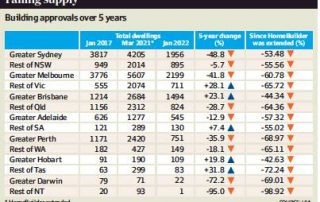
However, the pipeline of new homes in the regions had already fallen sharply since the HomeBuilder grant, which offered a $25,000 subsidy for first home buyers to build their home, was extended in March last year.

Housing Industry Australia data found that total dwelling approvals fell by 55.6 per cent in regional NSW; fell 65.7 per cent in regional Victoria and dropped 64.4 per cent in regional Queensland.

HIA executive director for industry policy Geordan Murray said: ‘‘What we saw throughout COVID was a very sharp change in housing preferences during the pandemic and a surge in demand for housing in regional areas.

‘‘The supply of housing takes a long time to respond to variations in demand.

‘‘While the regional housing markets are responding, they’ve never been in a position where they have had to respond to such a dramatic change in demand.’’

Kent Lardner, director of data analytics and consultancy company Suburbtrends, said the exodus from the city had placed immense pressure on the regions.

‘‘When you count total building approvals in the last 15 months for houses, this represents less than 1.5 per cent of total housing stock in most of these eligible markets,’’ Mr Lardner said.

‘‘Demand already exceeds supply here, which is keeping strong upwards pressure on prices. Any policy that amplifies demand will only push prices up further, given the current market conditions. I can’t see how this policy helps affordability.’’

Henderson Advocacy buyer’s agent Jack Henderson said the small number of available grants would have little impact in boosting supply in the regions.

‘‘There’s only 10,000 new housing expected to be built each year across the regions, that amount of supply will not be enough to satisfy the existing demand,’’ he said.

‘‘We have a huge deficit of regional housing, so I don’t think it will put a huge dent in the overall supply shortfall that we’re in right now.’’

The extra demand for new construction would also fuel further increases in building costs, said Marty Sadlier, director of MCG Quantity Surveyors.

‘‘It will drive higher building costs because of the current tight labour market and material shortage,’’ he said.

‘‘It’s very difficult to build in the regions at the moment, with many tradies having supply issues and heightened demand due to the floods in the east coast.

‘‘Materials will be funnelled to the most impacted areas; therefore the regions will see extended material lead times and severely increased material costs.’’

Deposit scheme ‘will make buying harder’2022-04-01T12:52:14+11:00

SMSF scammers pounce during COVID-19

Fraudsters are setting up 250 fake self-managed superannuation funds each year, a number that is rising quickly, in order to steal the retirement savings of unsuspecting mum and dad investors.

The Australian Taxation Office has said it is witnessing an increase in SMSF identity fraud where crooks use tax professionals to register phony funds to win massive windfalls.

An ATO spokeswoman said: ‘‘While the overall incidence of fraud remains low, we have identified a significant increase in the number of attempted fraudulent SMSF registrations where the victims had their identity stolen due to scams and cyberattacks in 2020-21 as compared to 2019-20.

‘‘They set up the fraudulent funds to access and steal their victims’ superannuation. The perpetrators believe using registered tax agents and other super professionals to register these fake funds will help them avoid detection.’’

Sophisticated criminals conduct the scam by phoning and emailing unsuspecting victims, pretending to be financial advisers or experts in superannuation, and encouraging them to transfer their savings from a fund regulated by the Australian Prudential Regulation Authority to a purportedly high-perfoming SMSF.

The scammers will prompt victims to do a bogus superannuation comparison, often borrowing the name and Australian financial services licence of real businesses, and setting up fake websites to appear legitimate.

‘‘They will tell you there is no need for you to engage directly with the ATO, ASIC or any other tax or super professional,’’ the ATO said.

‘‘If you agree to invest, they will transfer your super into bank accounts they control and disappear with it.

‘‘Even if you don’t agree to invest, if you provide them with enough personal information, they may use this to transfer your super from your existing account without you knowing, ultimately stealing your super savings.’’

There has been a global rise in sophisticated investment scams since the onset of the COVID-19 pandemic. Last year, Britain’s Financial Conduct Authority sounded the klaxon on the ‘‘attack of the clone firms’’, companies hijacking the real-world identities of major institutions and individual bankers. It said more than £78 million ($145 million) had been stolen in 2020 by scammers impersonating big financial institutions.

Last week, the International Organisation of Securities Commissions highlighted how ‘‘the current market environment may have created a fertile ground for fraudulent or scam activity’’.

Meanwhile, the Australian Securities and Investments Commission published a separate report last week into so-called finfluencers who have taken to social media to provide financial advice, tout trades and, in some instances, promote investments.

The dramatic increase in retail share trading – which more than doubled to over 20 per cent of volume in the US – and events such as the GameStop short squeeze have required regulators to probe the phenomenon and consider new approaches.

An ATO spokeswoman said people who registered new SMSFs or changed banking details would generally be alerted by SMS or email.

‘‘We are committed to … ensuring this type of activity is addressed and serious consequences apply to the perpetrators,’’ she said.

SMSF scammers pounce during COVID-192022-04-01T12:50:37+11:00

Winners

Road and rail users $18 billion for new road and rail projects.

Defence industries $15 billion for an east coast submarine base, an upgrade to the Henderson naval shipyard in WA and other defence projects.

Cyber spies $9.9 billion over 10 years for the Australian Signals Directorate to create 1900 jobs and expand cyber and intelligence capabilities, in a package called REDSPICE.

NDIS users Spending on the National Disability Insurance Scheme has grown $40 billion over the forward estimates and will overtake spending on defence in 2024-25.

Motorists $5.6 billion to cut fuel excise by 22¢ a litre for six months until September 28 this year to reduce the burden of global higher oil prices due to Russia’s invasion of Ukraine. $126,000 a year $4.1 billion for a one-off increase to the tax offset for low and middleincome earners to a maximum of $1500 for singles and $3000 for couples.

Pension, welfare recipients $1.5 billion for a one-off $250 payment for 6 million people to ease cost of living pressures. The payments will go to welfare recipients, veterans and concession cardholders in April.

Small business $1 billion over four years so small businesses can claim 120 per cent of the cost of laptops, cloud computing and other services to help them go digital. Another $550 million will cover 120 per cent of the cost of any external staff training course.

Apprentices $2.4 billion over four years for a revamped apprentice scheme.

Women $1.3 billion over six years to reduce domestic and sexual violence against women, plus $107 million over five years to promote women in leadership including $37 million for support women in trades.

Academics $2.2 billion over five years for the commercialisation of university research.

Indigenous rangers $636 million over six years to employ 1089 rangers in remote regions.

Country broadband users $480 million over six years for a million households in regional and remote areas for access to higher speed broadband.

Cystic fibrosis sufferers $475 million over four years to make the drug Trikafta available from April for people with cystic fibrosis aged 12 years and older.

WA cancer sufferers $375 million over four years to create a new cancer facility in Perth.

Parents $346 million over five years to improve the flexibility of parental leave for working parents to share as they see fit.

Tourism operators $146 million over three years to support the recovery of the tourism industry, including $76 million for travel agents and $63 million for marketing.

Farmers $100 million over the forward estimates for tax breaks on carbon credits for abatement and biodiversity stewardship, and $13 million to expand ‘‘patent box’’ rules to support farm innovation.

Koalas $53 million over five years to support the recovery and conservation of koala habitats.

Disadvantaged young people $53 million over five years for a pre-employment program to help 5000 people aged 15 to 24.

Self-funded retirees $50 million for a one-year extension of the lower rate at which they must draw down on superannuation.

Gas producers $50 million over two years to support seven priority infrastructure projects along the east coast, Northern Territory and South Australia.

Aged care workers $48.5 million over two years to subsidise 15,000 training places for new and existing sector workers.

Low emissions technology $30 million over four years for corporate tax breaks for commercialising technologies that lower emissions.

First home buyers $138 million over seven years to allow more first home buyers to find a property with a smaller deposit and without needing to pay mortgage insurance.

Start-ups Will be able to offer staff huge incentives after employee share scheme fix.

Winners2022-04-01T12:48:23+11:00

Stellar run ends for low market as rates rise

The lower end of the housing market has vastly outperformed the top and middle segments over the past 30 years, as suburbs gentrified and incomes improved over time.

But the prospect of higher interest rates and relatively stagnant wage growth could cause the affordable markets to fall behind in the next decade, experts say.

‘‘The lower end of the market tends to be more sensitive to interest rates, and the record low rates had given it a disproportionate boost, enabling people to borrow more and more,’’ said Shane Oliver, AMP Capital’s chief economist.

‘‘But this segment is also more vulnerable to interest rate hikes because gearing tends to be higher and the market is dominated by first home buyers, who may have more limited financial capacity compared to those in the upper end.’’

Between December 1991 and December 2021, the lower end of the market rose by 448 per cent, the middle of the market gained 348 per cent and the high end climbed by 392 per cent, the Aussie Progress Report, compiled by CoreLogic, shows.

‘‘Interestingly, the biggest value gains for the past 30 years have come from the low end of the market,’’ said Eliza Owen, CoreLogic’s head of research. ‘‘This might make sense in the longer term as lower-value stock has had more room to grow, more regions have become gentrified, and incomes and quality of property have improved over time.

‘‘However, the lower end is unlikely to outperform in the next decades due to more stagnant wage growth across the board. It could also suffer from increased densification.’’

Dr Oliver said the upper end was likely to post stronger growth over the next two years, as it was relatively immune to higher interest rates.

In fact, the higher end of the market had already posted bigger growth in the past 10 years as buyers focused on traditionally blue-chip housing markets, Ms Owen said. ‘‘I don’t know if we will necessarily see the enormous growth in any segment of the market that has been delivered in the past 30 years, but there is a certainty and safety in high-end, quality real estate that may make it more resilient over time,’’ she said.

‘‘A lot of the highest end housing markets have retained their position in the past 30 years because, even though they are relatively desirable, they have generally [avoided] increased densification.’’

Vaucluse in Sydney’s eastern suburb kept its top position as the most expensive suburb in the country with a $8.625 million median house price, which had soared by 522.6 per cent over 30 years.

Bellevue Hill was the only other suburb to maintain its rank at No. 3 in the high-end dwelling market, with the median price jumping by 682.2 per cent to $6.52 million.

In the same period, Australian house values climbed 414.6 per cent and apartment values 293.1 per cent.

There had been seven periods of sustained increase in values at the national level, and seven periods of decline in the past three decades, the report said.

During the growth cycle, home values rose by a cumulative 34 per cent on average over 41 months. Meanwhile, periods of peak-to-trough declines have lasted an average of 12 months with an average value drop of 4.3 per cent.

‘‘With potential interest rate rises on the horizon and ongoing debate around where the housing market is headed, this can be a stressful time for aspiring homebuyers, but what is clear from the analysis is that property is a long game,’’ said Brad Cramb, CEO of Distribution, Lendi Group, parent company of Aussie.

Stellar run ends for low market as rates rise2022-04-01T12:43:16+11:00

Home market to ‘languish’ until election

Not even a pick-up in Melbourne auction activity and successful sales could prevent a decline in the national residential property market this week as the preliminary auction clearance rate fell to 69.4 per cent, the poorest response this year.

The Victorian capital chalked up a preliminary rate of 69.7 per cent – up from an initial rate of 68.9 per cent a week earlier – even as the number of scheduled auctions rose to 1606, the most this year.

Sydney’s preliminary rate slipped to 68.1 per cent from 69.7 per cent last week as the number of scheduled auctions rose to 1100 from 1029. The inclusion of more results in coming days will probably drag down final clearance rates, and experts suggest the level will stay low in the run-up to the May federal election.

‘‘I don’t think this slowness is to do with the election at this point, but what it means is it’s unlikely we’ll see any sudden pick-up in the lead-up to the election,’’ SQM Research managing director Louis Christopher told The Australian Financial Review yesterday. ‘‘We can see this type of languishing market last until the election now.’’

In the Mornington Peninsula, the playground of Melbourne’s wealthy, a five-bedroom family home sold at auction on Saturday for less than it could have fetched late last year.

The house on 2642 square metres at 13 Caraar Creek Lane in Mornington was passed in on a vendor bid of $10.85 million and later sold after negotiations within the $10.5 million to $11.55 million range.

It was less than the $12 million-plus figure someone had offered for the property in December, David Morrell, who represented the successful buyer, said.

‘‘We bought it in excess of $1 million less than what someone else offered prior to Christmas,’’ he said.

Selling agent Liz Todd did not dispute higher offers had been made and said the vendors had hoped to be able to get the house on Beleura Hill ready to sell in October, but had not been able to do so in time.

Some properties are still pulling strong results.

A two-bedroom townhouse in Sydney’s northern beaches, at 17/153 Garden Street, Warriewood, that exchanged hands 17 months ago for $1,112,500 sold last week before the scheduled auction for $1.55 million, reflecting a 39 per cent jump in price.

The buyers were a downsizing couple not reliant on finance and able to offer a good price early to avoid an auction, McGrath sales agent Jill Rafferty said.

Home market to ‘languish’ until election2022-04-01T12:38:43+11:00

Some suburbs past their peak as war, rates hit home

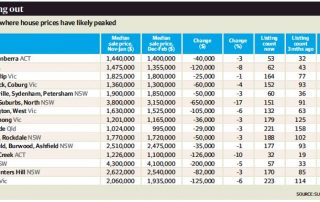
House prices in some inner and middle ring suburbs across capital cities are likely to have peaked as early as September last year, as demand waned amid a surge in listings and heightened worries about the war in Ukraine and interest rates, analysis by Suburb-trends shows.

Almost one in three housing markets nationwide have posted a drop in selling price in the three months to February, and almost four in 10 suburbs within the 40-kilometre radius from the central business districts have also weakened.

Sale prices have been falling in these markets for months, indicating they may already have hit their peaks, said Kent Lardner, director of Suburb-trends.

‘‘We’re seeing a large number of listings hitting the market in those areas, so there are now more sellers than buyers, which triggered a drop in sale prices,’’ he said. ‘‘On average, the markets in our sample that are now past their peaks and within 40 kilometres of the city have recorded a rise of 42 per cent in listings count.’’

In Sydney’s eastern suburbs, the median sale price has dropped 17 per cent in the past three months and is now $650,000 lower than the prices achieved last November, as the number of listings jumped 66 per cent.

House prices are likely to have peaked during the three months to December when they rose to $3.9 million. Since then, the median sale price has fallen to $3.8 million in January and is now down to $3.15 million.

In Manly, median house prices have dropped by 5 per cent, or $200,000, to $4.1 million after likely peaking at $4.3 million in January.

In the past three months, listings numbers have climbed by 74 per cent.

During the three months to February, sale prices in the Marrickville-Sydenham-Petersham district had fallen by 3 per cent, or $50,000. Prices probably peaked in September last year at $2 million. Since then, prices have steadily fallen to the current $1.85 million.

Sydney-based buyer’s agent Jack Henderson said the persistent negative news about the Ukraine war, interest rate rises and the property market have dampened buyer demand.

‘‘The negative news has likely taken out around 30 per cent of buyers because they are concerned about what’s going to happen with the housing market, the war or interest rates,’’ he said.

‘‘Because there are now fewer buyers, we’ve been able to negotiate good deals such as the property we recently bought in Erskineville. Four months ago, the vendor was asking for $1.2 million but couldn’t find a buyer. It went to auction recently, and we’re able to buy it for $1.1 million after being passed in. So, it’s not surprising to see selling prices fall in many of these areas.’’

Amanda Gould of HighSpec Properties said the number of agents reducing the listed price had risen in the past few weeks.

‘‘I’ve never seen so many agents emailing me about price reductions since the onset of the pandemic,’’ she said.

‘‘I think they’re struggling to get buyers because of the uncertainties. You have the war, then the election and buyers tend to hold off buying when there’s a looming change in the market.’’

In Melbourne, median house prices in the Bayside district in inner Melbourne have also likely peaked at $2.215 million in October. Since then, prices have been falling consistently to the current $1.935 million.

In Unley in inner Adelaide, house prices have likely peaked at $1.475 million in the three months to January, but prices have since dropped to $1.355 million.

Prices are likely to weaken further across more areas if the rise in listings volume is not matched with increase in demand, Mr Lardner said.

‘‘Interest rate rises will determine much of what happens next,’’ he said.

‘‘The pipeline of supply via new building approvals for about 24 of the markets analysed is above average, which will push up listings volumes even further.

‘‘However the biggest impact will be on the demand side.

‘‘As listings volumes start to increase, we need to see a proportionate number of buyers entering the market. If this does not happen, we will see further price falls.’’

Some suburbs past their peak as war, rates hit home2022-03-25T15:13:31+11:00

House values unlikely to double in next decade

People who bought houses in the middle of the pandemic are more likely to double their money over the next 10 years, compared with those buying now, as the market faces a longer downturn followed by a shallower upturn, experts say.

Shane Oliver, AMP Capital chief economist, said the sharp rises in house prices in the past two years and higher interest rates would make it difficult for values to double again within a decade, meaning investors were in for a slower period of growth than the seven-to-10-year-period over which many expect prices to double.

‘‘If you’ve bought in the midst of the pandemic, or in 2017 after the market peaked, you’ve already seen a sharp rise in prices, so even if they come back by 10 per cent during this downturn, there’s a greater chance you’ll see a doubling in value within a 10-year horizon,’’ Dr Oliver said.

‘‘But if you bought just recently, it’s going to be a bit harder because you’re starting from a much higher level with prices being up by 25 per cent compared to the pandemic low point. When you buy high, it takes longer to get a doubling in prices.’’

New CoreLogic analysis shows that since the housing market bottomed out in 2019, the country’s biggest gainers came close to doubling their values, with median house prices in Waverley in Tasmania, Miami on the Gold Coast and North Ryde in Sydney rising 95.1 per cent, 93.8 per cent and 90.3 per cent respectively. Tim Lawless, CoreLogic’s research director said, however, it was rare for housing values to double over a single growth cycle.

Nerida Conisbee, Ray White chief economist, said current Sydney buyers in particular were unlikely to see a doubling in value over the next decade because of slower growth.

‘‘We know that we are in for probably at least 12 months of fairly flat price growth, so it is perhaps less likely to double your money now, than if you bought in April 2020, so timing is a big factor,’’ she said.

Mr Lawless agreed: ‘‘During the previous growth cycle that ran between early 2012 and mid-2017, Sydney housing values increased by roughly 75 per cent, but it was not until August last year that Sydney housing values had recorded growth of at least 100 per cent. In other words, it took approximately 9.6 years across two growth cycles for Sydney housing values to double.

‘‘Arguably, achieving a doubling of housing values in already expensive markets like Sydney will take a longer time than the average historically.’’

Brisbane was a better bet for faster value appreciation, Ms Conisbee said.

‘‘Brisbane buyers have a greater chance because I think Brisbane is undergoing a really big change at the moment and the pricing has been reset,’’ she said.

‘‘If that continues, it’s probably more likely that values will double over a 10-year time period.’’

That is less likely in Hobart.

The CoreLogic analysis finds that since their peak in 2017, house prices in six Tasmanian suburbs, namely Waverley, Primrose Sands, Stieglitz, St Leonards, Turners Beach and George Town have more than doubled their values.

Dr Oliver said the housing market faced greater risks in this cyclical downturn compared to the previous cycles.

‘‘This time around there’s more uncertainty over it because we’re moving into a world of higher inflation, potentially higher interest rates on a longer-term basis, then that tailwind behind property prices may not be as strong as it once was.’’

The record levels of household debt, tighter lending conditions and supply glut could also limit the upside, Mr Lawless said.

House values unlikely to double in next decade2022-03-25T14:22:04+11:00