AmcoTax.Admin

About Angela Shannon

This author has not yet filled in any details.
So far Angela Shannon has created 101 blog entries.

Premium suburbs lead price growth

House prices in some suburbs on Sydney’s northern beaches and the Gold Coast have doubled every three to four years in the past decade, fuelled by low levels of stock and a growing number of affluent buyers, data from Suburbtrends shows.

The more expensive housing markets with the median price above $2 million also outperformed, gaining 13.3 per cent each year on average in the past 10 years. This is more than twice the capital growth of 4.8 per cent posted by the affordable end of the market with a median price under $500,000.

‘‘The premium end of the market performed strongly in the past decade, driven by scarcity, being located near the beach or the harbour,’’ said Kent Lardner, director of Suburbtrends.

‘‘Housing inventory levels in these suburbs remained very low, especially in recent years. The increasing levels of wealth and low interest rates have also created near perfect conditions.’’

The number of ultra-rich Australians with net worth of $US30 million ($40 million) or more surged by 124 per cent over the past five years, and they allocated nearly a third of their wealth to their homes or second dwellings last year, according to estate agency Knight Frank.

House prices in suburbs within the Manly area such as Balgowlah, Balgowlah Heights, Clontarf, Fairlight, Manly and Seaforth surged by 21 per cent each year on average during the past decade – essentially doubling every three years and five months.

House values in the Broadbeach area on the Gold Coast have also doubled within four years, after surging 19 per cent each year on average in the past decade.

House prices in Broadbeach Waters, Burleigh Heads, Burleigh Waters, Mermaid Beach, Miami and Broadbeach jumped by 42 per cent to $1.6 million in the past year.

‘‘Many of the commutable coastal locations boomed in the past 10 years, and in the case of those near Sydney, we did see the ripple effect shifting demand from the eastern suburbs, spreading over to the north shore and up to the Central Coast,’’ Mr Lardner said.

‘‘It is normal to see price gaps start to close between markets when this happens, but the premium markets kept on growing at phenomenal rates as well.’’

A separate analysis by CoreLogic found the top-performing market segments were generally skewed towards houses over units.

‘‘The stronger long-term performance for houses is a trend we have seen historically and is likely a reflection of the underlying land value being driven higher by scarcity factors,’’ said Tim Lawless, CoreLogic’s research director.

‘‘House values will probably continue to appreciate faster than unit values due to the scarcity of supply and what is likely to be persistently strong demand for lower density housing options.’’

Hobart outperformed other cities, with dwelling values surging 101.8 per cent across the greater capital city region over the 10 years to March. Sydney was the only city to record a higher 10-year growth rate, with housing values increasing by 109.5 per cent, according to CoreLogic.

Perth and Darwin were the weakest housing markets over the past decade, as values moved through a long-running downturn, Mr Lawless said.

But Mr Lardner said worsening affordability and higher interest rates could slash capital growth by more than half in the next 10 years as buyers grapple with bigger household debt and lower borrowing capacity.

‘‘Australia’s property market bull run may end this year as the two decades of falling interest rates are about to end,’’ he said.

Shane Oliver, AMP Capital chief economist, said falling demand due to lower immigration could also weigh on house price growth in the coming decade.

While immigration was starting to pick up, he said, ‘‘it may not get back to the highs we saw pre-pandemic, so the underlying level of demand for housing may not be as strong as it has been’’.

Premium suburbs lead price growth2022-04-26T12:08:11+10:00

Investors return as rents soar up to 20pc

Rebound Vacancies below 1 per cent and strong demand is driving renewed interest, writes Duncan Hughes.

Residential rents rising as fast as property prices are attracting investors seeking higher yields, a hedge against inflation and generous depreciation and tax breaks. House rents in some of Australia’s capital cities have risen between 15 and 20 per cent during the past 12 months as supply fails to keep pace with a sharp rise in demand, particularly in higher-density, regional capitals.

‘‘This will attract more investors into the market,’’ says Louis Christopher, chief executive of SQM Research, which monitors property markets.

Investor borrowing, which was running out of steam in February after increasing around 116 per cent in the 12 months to last May 31, is expected to rebound even more strongly as competition grows, says buyers’ advocate Cate Bakos.

Andrew Wilson, chief economist for My Housing Market, a property consultancy, says stock surpluses are being rapidly absorbed around inner-city Melbourne, Sydney, and Brisbane.

‘‘Investor interest is accelerating because of capital growth, rising yields and high demand,’’ says Wilson.

According to SQM analysis, national residential property vacancies are about 1 per cent, the lowest in 17 years and half the amount for the same time last year.

Vacancy rates in Sydney and Melbourne are 1.6 per cent and 1.9 per cent respectively, while in Brisbane, Adelaide, Canberra, Darwin, and Hobart they have fallen below 1 per cent, its analysis shows.

Rents for apartments in Sydney’s central business district have jumped 5.5 per cent in the past 30 days. In Melbourne, rents are up more than 7 per cent in the same period.

In some areas surrounding regional and state capitals, there are no rental properties available. Rosalie Day, managing director of Bell Real Estate, which covers three postcodes around Gembrook, some 65 kilometres south-west of Melbourne, says: ‘‘There are no rentals. If we put anything up for rent, it goes straight away.’’

Day blames restrictive local council regulations, high state government taxes and rising property prices, which have encouraged many landlords to sell.

Many landlords also decided to sell because of issues caused by a freeze on rental increases and tenant evictions during the COVID-19 lockdown.

SQM’s Christopher adds: ‘‘What is happening is unprecedented. A shortage of properties is causing market rents to explode’’. He expects rental prices this year to increase faster than house prices.

In 2021 national house prices rose about 22 per cent, the biggest increase since 1989, says Shane Oliver, chief economist for AMP Capital. This stemmed from record low mortgage rates, home buyer incentives, the pandemic driving a switch to housing, a lack of supply, and fear of missing out.

Demand for rental homes is this year expected to increase because of the strengthening economy, easing of COVID-19 restrictions, and the return of high levels of migration and students, says analysis by the National Housing Finance and Investment Corporation, a government think tank that monitors housing demand, supply, and affordability.

Adding to the pressure in NSW and Queensland is homelessness caused by flooding.

Buyers’ agent Bakos says it’s unusual for investors to enjoy both rising income and capital gains. She adds: ‘‘Many investors turn to bricks and mortar if nervous about the stock market or global outlook.“

Confidence is also boosted by the absence of any federal election policies that might lead to a cutback on generous negative gearing concessions or depreciation allowances.

Property is also an effective hedge against inflation, according to Cushman & Wakefield, a global commercial real estate company. Its analysis shows every 1 per cent increase in inflation is associated with a 1.1 per cent increase in total property returns (capital growth and income).

Investors account for about one-third of mortgages, an increase of about seven percentage points over recent months but below the decade average level of 35 per cent, says CoreLogic, which monitors property markets.

Lenders are easing tough borrowing terms for investors, say mortgage brokers.

‘‘They are lowering interest rates and improving terms, such as allowing more rental income to be included in the loan eligibility assessment,’’ adds Phoebe Blamey, director of Clover Financial Solutions, a mortgage broker.

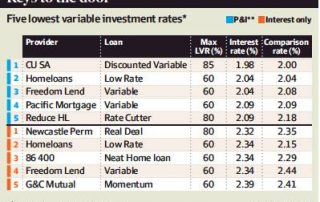
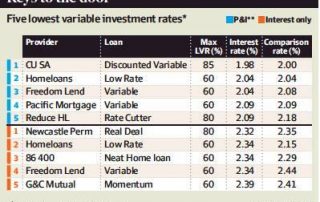
The accompanying tables from Canstar, which monitors rates, shows the cheapest deals for investors seeking principal-and-interest or interest-only loans.

These rates are typically about 130 basis points lower than average loans on offer.

‘‘This highlights the importance of shopping around for the best deal,’’ says Belinda Williamson, Canstar group manager.

Average investor loan sizes increased to more than $556,000 from about $477,000 in the 12 months ended February 28, says Tim Lawless, CoreLogic’s research director.

‘‘Investor lending growth is biggest in areas where housing prices are generally lower than Sydney and Melbourne,’’ Lawless says. These include south-east Queensland, inner-city Brisbane and Adelaide. AFR

Investors return as rents soar up to 20pc2022-04-26T12:07:15+10:00

Go to the core to handle increased market volatility

The first quarter of 2022 has challenged investors with plenty of market volatility, and it would be foolish to expect the rest of the year to be a smooth ride.

If recent fluctuations in the share market are giving you heartburn, your risk appetite and your portfolio’s asset allocation are probably misaligned and in need of attention.

Most financial headlines focus on the here and now. But for investors, attempting to make decisions based on daily developments, making frequent portfolio adjustments and trying to time the market does not help accumulate wealth over the long run. It typically has the opposite effect.

Rather, it is the asset allocation decisions you make and stick with year on year that will drive solid long-term investment outcomes.

If you are losing sleep over how your portfolio will be affected by the day’s headlines, take a moment to reflect on how your portfolio matches your investment goals and risk appetite.

While the concept of putting together a stable mix of investments that helps weather the peaks and troughs of the share market can be daunting, its actually simple – it’s discipline that matters during these periods of market volatility.

This is where the core-satellite portfolio approach may help. The core-satellite approach is about allocating the core of your portfolio – about 80-90 per cent – to broadly diversified index funds or ETFs, and the remainder to active funds or an active strategy.

This combines the best aspects of both strategies – low cost, broader diversification, tax efficiency and lower volatility for the stable indexed core, and the pursuit of outperformance in your active satellite.

The core portfolio should be as diversified as possible, holding a mix of stocks, bonds and other assets across a variety of geographies, sectors and industries.

Index funds or ETFs can fill this role, holding hundreds or thousands of individual securities and minimising the chance of any specific one affecting its overall performance.

Your whole portfolio should also match your risk profile. If you’re investing for a home deposit in the near future, or if you’re close to retirement, then investing more conservatively to reduce the chances of near-term portfolio losses should be considered.

But if you’re far from retirement or an obvious need to use the investment funds, it makes sense to focus on delivering high growth.

Getting the core portfolio aligned to your risk profile is the key to a good night’s sleep and the investment options at your fingertips put that well within reach of every investor.

But don’t forget that your core portfolio may require rebalancing back to its target if the market moves drastically or if your risk profile shifts over time.

While carving out a small portion of your portfolio for active investing in the satellite portion isn’t backed up by academic studies, it may be helpful to some behaviourally.

It could help you avoid tinkering with the core and free up the satellite portion to pursue other opportunities – whether that’s an interest in stock picking or sectors or other elements you feel strongly about.

If doing it yourself sounds a little too complicated, diversified funds (which offer ready-mixed portfolios of stocks and bonds) are a great core option.

Most fund managers offer diversified funds and ETFs ranging across the risk spectrum from high growth (where a portfolio is 90 per cent in equities and 10 per cent in bonds) to conservative funds (where 70 per cent is allocated to bonds and only 30 per cent in equities).

Many investors aspire to have their portfolios consistently outperform the market averages but, as history has shown, it is much harder than most people think.

A well-diversified core portfolio, aligned to your risk appetite, will help spread your risk and afford you a margin of safety over the long term.

Get this right and keep the restless nights at bay.

While you can afford to not be the best investor in the world, none of us can afford to be a bad one.SI

Duncan Burns is chief investment officer for Vanguard Asia Pacific.

Go to the core to handle increased market volatility2022-04-26T12:05:08+10:00

Tax Office teams delve into dealings of the super rich

Audits Experts believe asset stripping, offshore wealth transfers and governance are top of the hit lists for investigators, writes Duncan Hughes.

About 940 of the nation’s super rich are the target of deep-dive audits into their finances by the Australian Taxation Office due to suspected tax avoidance or non-compliance.

An ATO spokesman says additional funding announced in the federal budget and the development of a specialist group to target wealthy individuals and their associated private groups ‘‘allows us to have more visibility of, and apply scrutiny to, more of the largest and wealthiest private taxpayer groups than ever’’.

Clint Harding, a partner with leading commercial law firm Arnold Bloch Leibler, says: ‘‘Many taxpayers do not appreciate that the onus of proof is on them to prove [their returns] are correct. They can no longer just sit back and hope they’ll stay off the ATO’s radar, which has very sophisticated analytical and data capabilities to monitor tax affairs.’’

Paul Huggins, a director of investment group Hamilton Chase, says the government will also be seeking more tax receipts after billions of dollars in handouts during COVID-19. He adds: ‘‘There has never been a better time for the government to repair its balance sheet.’’

The ATO launches an audit when issues and concerns that are not resolved during a compliance review are escalated for deeper examination. More than 4700 audits have been undertaken in the past six years, which can involve ATO officers visiting a taxpayer’s premises and undertaking more intensive and longer reviews.

Offshore money payments, distributions from trusts and the ‘‘black economy’’ (estimated to be worth $30 billion and costing the nation about $2.5 billion in foregone tax revenue a year) are expected to be among the ATO’s prime targets, say tax experts.

Simultaneous probes are being undertaken into the nation’s wealthiest 500 (who with their associates, trusts, partnerships and super funds control assets worth more than $500 million) and the ‘‘Next 5000’’ privately wealthy, who have more than $50 million. The wealthiest 500 annually pay more than $4.4 billion in income tax and over $2.3 billion in net GST, according to ATO analysis.

In the federal budget the government allocated the ATO an additional $652 million to extend the tax avoidance taskforce by another two years and increase tax receipts from the nation’s richest by $2.1 billion.

Mark Molesworth, tax partner at global consultancy BDO, says the top 500 involves ongoing, one-to-one engagements with the nation’s wealthiest.

The Next 5000 program uses a ‘‘justified trust approach’’, in which it attempts to obtain an understanding of a taxpayer’s governance and risk management practices. ‘‘The ATO is giving the taxpayer an opportunity to prove that its trust in them is justified,’’ says Molesworth.

The ATO is likely to continue probing the use of trusts for unlawful cash distributions and tax-saving arrangements under the guise of family business, according to Arnold Bloch Leibler’s Harding.

Family trusts are required to detail distributions to beneficiaries, including adult children, to ensure they comply with rules on family dealings.

The ATO is expected to continue targeting trust stripping and reimbursement arrangements, which can happen when trustees distribute money to individuals or entities with low or zero tax obligations which is then repaid by the beneficiary back to the trust or another family member for the purposes of tax minimisation.

Undeclared international money transfers of more than $10,000 are another primary target. Transfers of money into and out of Australia are monitored by AUSTRAC and data is shared with the ATO. The combined value of cash in local or foreign currency needs to be declared if it is equivalent to $10,000 or more.

The types of international money transfers likely to be relevant to an individual’s tax returns in Australia are:

Any payments received from rental properties or property sale;

Income generated from an overseas business or sale of a business;

Money earned as an employee overseas; and

Funds received as an overseas pension or superannuation.

The ATO will seek to prevent private companies being used as a tax-free personal piggy bank for owners and their associates. This happens when owners, or associates, receive tax-free benefits from companies, such as cheap or unpaid loans.

Loans are deemed to be a dividend payment to the recipient and assessable. They are ordinarily ‘‘unfranked’’, which means the recipient does not get a franking credit that would reduce tax liability.

Hamilton Chase’s Huggins says cryptocurrency transactions will also be closely monitored. The ATO says it will target users’ record-keeping to ensure expenses claimed for using cryptocurrencies, such as software, commission or brokerage costs, are accurate.

BDO’s Molesworth says: ‘‘In this case, the ATO is not looking at specific transactions but at the systems and processes in place to get the tax payments right.’’

Publicly listed companies typically have well-defined structures of control, such as audit committees, to ensure everything should be done by the book. ‘‘For many private groups this process is not as well documented,’’ Molesworth says.

Issues likely to attract the ATO’s attention include tax payments or financial performance that is unusual when compared to other businesses, low transparency and large one-off or unusual transactions, such as the transfer or shifting of wealth.

Other red flags include aggressive tax planning and extravagant lifestyles that are not supported by after-tax income.

Tax Office teams delve into dealings of the super rich2022-04-26T11:58:18+10:00

Tax Office property win puts foreign investors on notice

Foreign investors who fail to report their investments in Australian assets have been put on notice by the Australian Taxation Office and face significant cash fines after a landmark legal win in which the judge said his intention was to ‘‘wipe out’’ the profits of a serial property buyer.

Between July 2016 and April 2018, Vijay Balasubramaniyan spent more than $1.4 million on three residential properties and a block of residential land in Melbourne’s west.

Justice Barry Beach agreed with the ATO that Mr Balasubramaniyan, who had a temporary visa, breached foreign investor rules six times – four times for the purchases, which occurred without permission, and also for owning two established properties.

Justice Beach, following the first prosecution of such a case, ordered penalties of $250,000, broken down into four $30,000 penalties and two $65,000 penalties. The amount was well above the $162,839 that Mr Balasubramaniyan argued was his net gain.

‘‘The judgment provides a strong base from which we will progress our penalty litigation work as part of the ATO’s overall compliance approach,’’ ATO assistant commissioner Keir Cornish told The Australian Financial Review.

The judgment sets a precedent for how the law treats foreign investors in Australia who do not alert authorities to their acquisition. It is the first such ruling since the Foreign Investment Review Board Act was rewritten in 2015 to introduce civil penalties.

Previously, penalties for international residents acquiring Australian assets without alerting authorities were largely a slap on the wrist. They were forced to divest but could keep any profits gained.

In the three years to June 30, 2020, there were more than 1100 penalty notices for contraventions of the FIRB Act in residential property alone.

‘‘This serves as a clear deterrent to other foreign investors who believe they can operate outside of the law,’’ Mr Cornish said.

‘‘The ATO promotes voluntary compliance of the rules by foreign persons, but where foreign investors resist compliance action, stronger enforcement action is taken.’’

In his judgment, Justice Beach said Mr Balasubramaniyan had made gross capital gains of $710,300.

‘‘This is a significant fact for penalty purposes. General deterrence will only be achieved by a penalty that puts a price on any contravention sufficient to deter others who might be tempted to contravene the Act,’’ he said.

The ATO argued the net gain was $425,000. Justice Beach accepted some of the ATO’s calculations, but cut the number further.

‘‘I do not propose to linger on the arithmetic, save to say that I am satisfied that a figure of around $250,000 represents no less than the respondent’s net gain,’’ Justice Beach said in his judgment.

‘‘I propose to wipe this out by the total penalty that I will impose . . . Indeed, the sum of $250,000 is considerably more than the respondent’s own calculation of the net gain.’’

Lachlan Molesworth, a barrister and specialist in taxation and foreign investment, who represented Mr Balasubramaniyan, said he expected it to become routine for the Commonwealth to seek penalties for people who breach the act.

‘‘There is no doubt this will very much embolden the regulator, and I think it will send a clear message that if you hold assets in Australia without relevant federal clearances, those assets are very much at risk,’’ Mr Molesworth said.

‘‘The Commonwealth were probably waiting for a clear-cut case. The next frontier may well be into other assets classes, commercial investments where there have not been contraventions, and there will be a new level of confidence, we know what considerations will apply.’’

Tax Office property win puts foreign investors on notice2022-04-26T11:49:35+10:00

The rental crisis is just beginning

‘‘There’s a perception that rents are high now,’’ one of the country’s most highly regarded bankers tells me. ‘‘But rents are going to go through the roof once investors start to recognise that there won’t be significant capital gains from now on.’’

This is unequivocally bad news for renters. They had been hoping that the sharp run-up in housing rents – which are on track to climb by at least 10 per cent nationally this year – might start to abate as the boom in house prices finally shows signs of tapering off.

Instead, it appears that we are at the beginning of a period of significant rental stress, as surging demand and a lack of rental stock have sent vacancy rates plummeting to a 16-year low.

Even worse, vacancy rates are expected to tighten further with the reopening of the international border and the resumption in migration and the return of foreign students.

But, the banker explains, there are financial factors at play which will also put upward pressure on rents.

‘‘If you own an apartment, by the time you’ve paid strata levies, repairs and taxes, the returns are pretty meagre,’’ he says.

Until now, investors have put up with that because rising property prices have meant they have enjoyed strong capital gains. So, overall, it’s still worked out to be quite a good investment.’’

But, he warns, this dynamic will change as rising interest rates cause home prices to stabilise – or even decline.

(In its latest Financial Stability Review, the Reserve Bank warned house prices could fall by about 15 per cent over a two-year period if interest rates were to rise by 2 percentage points.)

‘‘If there’s no prospect of significant capital gains, investors will have to try to increase their returns through higher rents’’, he explains.

‘‘And you can see that already. Rents are already going up.’’

What’s more, although lending to property investors nudged up by 3.9 per cent in the 12 months to February 2022, he points out that many property investors have been offloading their apartments.

‘‘This is partly because investors have been taking advantage of high prices to sell, and partly a response to the eviction restrictions that were imposed during the pandemic, which made some investors decided that owning rental property wasn’t such a great deal any more,’’ he says.

‘‘And for others, it’s a desire to reduce their gearing because they’re apprehensive about rising interest rates.’’

Of course, rents are also soaring offshore.

In the United States, for instance, average monthly rents jumped more than 14 per cent in the year to December. In many major cities, including Austin, Texas and Miami, rents increased by more than 30 per cent.

As in Australia, the surge in US rents reflects a number of factors, including a shortage of housing inventory.

At the same time, many people who moved back with family in the early days of the pandemic are now flooding back into the rental market, boosting demand, and making it easier for landlords to increase rents.

In addition, after central banks slashed interest rates close to zero to soften the impact of the pandemic, many people decided to take advantage of ultra-low home loan rates to buy houses. As house prices surged, many people have been pushed out of the buyer market and into the rental market.

Landlords, meanwhile, are looking to claw back the drop in income they sustained during the pandemic when they offered discounted rents to entice new tenants, or when existing tenants missed rental payments.

Of course, people on lower incomes – such as hospitality and retail workers – are those hardest hit by soaring rents, which are rising much faster than their wages.

As the Reserve Bank noted in its April Financial Stability Review, ‘‘historically, renters have been more likely to experience financial stress than indebted owner-occupiers’’.

The RBA added that ‘‘although renters are unlikely to pose direct risks to the stability of the financial system (as they have less debt), financial stress for renters could translate to repayment difficulties for indebted landlords or pose indirect risks by constraining household consumption and so economic activity’’.

Of course, the surge in rents is already sparking calls for increased controls that would limit annual rental increases.

Rent controls have existed in New York since 1943, when the US government legislated a rent freeze in the city to fight wartime housing inflation.

Just under half of rental units in New York City are subject to rent stabilisation rules, which set the maximum rent increases, based on real estate costs and the cost of living.

But more US cities are now introducing rent controls.

Last October, local officials in Santa Ana, California, went further than the state’s rent controls which limit annual rent increases to 5 per cent plus local inflation. They decided to restrict rent increases in the City to 3 per cent for apartments built before 1995.

And in November, Minneapolis voters gave the green light to introducing the country’s most stringent rent control policies, which sets a 3 per cent cap on annual rent increases. What’s more, the controls also apply to newly constructed buildings.

Meanwhile, lawmakers in Miami and Tampa – where rents have climbed more than 30 per cent over the past year – have discussed declaring housing emergencies to introduce rent controls.

Landlords and the real estate industry are pushing back against rent controls. They argue that they discourage new apartment construction, which further chokes off the supply of rental accommodation.

And while such controls benefit people who have rental accommodation and don’t want to move, they act as a major disincentive for people to convert their properties into rental accommodation.

This makes it extremely difficult for new renters to find accommodation.

The other disadvantage is that rental controls discourage landlords from spending money on the upkeep of their apartments, which disadvantages renters.

Of course, it’s highly unlikely that Australian politicians would even contemplate riling mum and dad property investors by introducing rental controls, but rising rents will undoubtedly fuel social discontent, and increase the pressure on lower-paid workers to secure larger wage rises

The rental crisis is just beginning2022-04-26T11:47:13+10:00

Median house prices fall in 40pc of Sydney suburbs

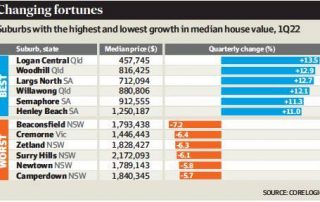
Dwelling values have dropped in nearly two in five Sydney suburbs during the first three months of the year, while almost half of all Melbourne suburbs analysed posted price declines as the market downturn gathers pace, data from CoreLogic shows.

Of the 917 Sydney suburbs analysed, 354 logged a fall in median dwelling values. House prices in 189 Sydney suburbs have slumped, while 165 unit markets weakened during the same period.

In Melbourne, dwelling values across 303 suburbs have dropped during the same period, with 154 house markets and 149 unit markets recording price falls.

Eliza Owen, CoreLogic’s head of research, said the largest price decreases were recorded across some of the more expensive suburbs in Sydney and Melbourne.

Inner Sydney suburbs Beaconsfield, Newtown and Camperdown notched up some of the sharpest house price falls of 7.2 per cent, 5.8 per cent and 5.7 per cent respectively.

In Melbourne, Cremorne posted the largest house price decline of 6.4 per cent, followed by South Yarra with a 4.8 per cent fall and Toorak with a 4.4thper cent drop.

‘‘High-end and inner-city areas are emerging as the first suburbs to experience this shift in market conditions,’’ Ms Owen said. ‘‘It is likely that slightly tighter lending conditions and higher average fixed rates are hitting the very top of housing markets first.

‘‘These same areas are seeing some of the bigger jumps in advertised stock levels too, so as we see new demand for housing in these areas decline buyers have more choice, more time for decision-making, and more power at the negotiating table.’’

Melbourne-based buyer’s agent Cate Bakos of Cate Bakos Property said worries about the rate hikes and global uncertainty were keeping some buyers at bay.

‘‘The constant talk about interest rate increases are making people nervous,’’ she said. ‘‘We’ve also got the federal election, which brings another level of uncertainty, compounded by the war in Ukraine, which are all impacting buyer’s confidence.’’

Sydney-based buyer’s agent Dan Grantham said many Sydney buyers had also pulled back.

‘‘Buyers are not as motivated as they were only a few weeks ago,’’ he said. ‘‘Many have decided it’s best to sit back and wait until after the election and when the first interest rate hike occurs to see how things play out.’’

By contrast, all the 337 Brisbane house markets analysed recorded a rise in median values, and only one out of 171 unit markets posted a decline. In Adelaide, all the 314 house markets in CoreLogic’s analysis racked up price increases and only two out of 105 unit markets fell.

‘‘We’ve already seen a little bit of a slowdown in the rate of quarterly growth across Brisbane and Adelaide, which suggests the rate of growth may have peaked, but I don’t think these cities will move into a decline for quite a few months,’’ Ms Owen said.

‘‘Depending on how the market reacts to a rise in interest rates, we could see these markets slow down around June, when many economists expect the cash rate to rise.’’

In Canberra, dwelling values in seven out of 134 house and unit markets analysed recorded price declines, while six out of 55 house and unit markets across Hobart posted a drop. Across Perth, 13.4 per cent of all suburbs analysed recorded a decline, while 18 per cent logged price falls in Darwin.

As the housing cycle moved into a downswing , more suburbs were likely to record a drop in the median values.

‘‘I think capital growth will be really hard to pinpoint in the context of rising cash rates, but there are markets that could hold much steadier amid a cash rate increase,’’ she said.

‘‘I suspect these will be some of the relatively affordable markets on the periphery of areas that have been popular with internal migrants, such as the hinterland of the Gold Coast or Sunshine Coast.

‘‘I think somewhere like Parramatta in Sydney will be interesting to watch. The ongoing development of infrastructure, people gradually returning to offices, and the return of overseas migration could help to stabilise this market.’’

Median house prices fall in 40pc of Sydney suburbs2022-04-26T11:41:17+10:00

Americans tap their homes to boost wealth

Investing As US prices rise, home equity helps boost owner portfolios.

The US housing boom is creating a new class of real estate tycoons with an easy source of financing: their own homes.

Soaring prices have showered property owners with record equity windfalls, sending cash-out refinancings to levels not seen since the peak of mid-2000s housing frenzy. For some people, that means cash for a remodel or vacation. But others are putting that money to work by buying second, third or even 10th houses.

‘‘With the pandemic, everything is skyrocketing,’’ said Keshav Agrawal, a 33-year-old Californian who extracted $US300,000 ($403,000) from his family’s Orange County home in late 2019 and put the money towards five rental properties in lower-priced Atlanta.

Those houses have doubled in value. And Agrawal, who started his cash-out foray with $US150,000 in credit card debt and little savings, is peeling off their equity to buy more.

‘‘I’m growing exponentially off of one refinance,’’ he said.

Across the US, newbie investors are trying to harness the power of home-price inflation to grow fast and get rich by becoming landlords. They’re contributing to soaring values, especially for starter homes that are in short supply. But even that can work in these buyers’ favour – as long as they’re willing to pay up – because Americans getting priced out of homeownership are in turn fuelling demand for rentals.

Cash-out refinancings let investors tap into their home equity to fund more purchases. For US landlords and second-home owners, these loans more than doubled in the fourth quarter from a year earlier to $US8 billion, the highest level since 2006, says data provider Black Knight.

Wall Street has also jumped in to finance investor deals with flexible underwriting and higher rates than conventional mortgages.

While the number of investors is hard to pinpoint, the make-it-big strategy is everywhere, touted at meet-up groups, by get-rich gurus and on media such as the BiggerPockets podcast, which gave it a name: Buy, rehab, rent, refinance, repeat, or BRRRR for short. Surging prices provide even greater support to grow faster, stacking one mortgage on top of the last. That creates risks should the red-hot housing market sputter.

‘‘While leverage can turbocharge your returns when prices are on the way up, it accelerates losses when prices go down,’’ said Greg McBride, chief financial analyst at Bankrate.com.

‘‘If there is a downturn in the economy and all of a sudden the tenants are not paying their rent, that creates a cash-flow issue.’’

Investors have had a growing influence on the US housing market, as tech-fuelled home flippers like Opendoor Technologies and publicly traded rental companies such as Invitation Homes compete for properties. But even in areas where prices have increased the most, such as Phoenix, Atlanta and Tampa, Florida, mum-and-pop landlords far outnumber the institutional ones.

In Phoenix, 32 per cent of single-family purchases in January were by investors with fewer than 10 properties, up from 28 per cent a year earlier, data from John Burns Real Estate Consulting shows. By comparison, large investor purchases accounted for 12 per cent of transactions.

‘‘Young investors are doubling down, refinancing their first investment to get a down payment for their second,’’ said John Burns, founder of the Irvine, California-based company. ‘‘It’s like they don’t know there was a downturn in the late 2000s.’’ The boom in real estate investment may not end with a crash – at least not on the scale of the one that led to the financial crisis.

For one thing, the almost $US10 trillion in tappable US home equity provides a cushion for homeowners and their lenders. Underwriting standards for investment purchases are also far stricter than in the 2000s, typically requiring down payments of 20 per cent or more.

And even as rising interest rates and Russia’s war in Ukraine bring uncertainty to the global economy, there’s little to indicate the American housing market will slow down soon. The same dynamics sending property prices higher for years have only strengthened as the Millennial generation reaches peak home-buying age and inventories just get tighter.

‘‘I’m always thinking about what happens if there is a downturn,’’ said Grace Gudenkauf, who quit her job as a mechanical engineer in Cedar Rapids, Iowa, to focus on real estate investing. ‘‘But the housing shortage is so extreme that I don’t think it will be soon.’’

Last year, Gudenkauf, 24, bought a fixer-upper with her boyfriend for $US82,000 and invested another $US36,000 to renovate it. It appraised for $US185,000, allowing her to pull out $US129,500 with a cash-out refinance to buy more. The couple now owns 11 properties with 20 units.

Gudenkauf essentially extracts cash from one home to use for another, also tapping private loans designed for investors. Small landlords can finance as many as 10 properties using conventional financing, but they face tough underwriting standards that factor in a borrower’s ability to repay. For those willing to pay a higher rate, companies such as Finance of America, which counts Blackstone as its largest shareholder, and Deephaven Mortgage, owned by investment company Pretium, have loans with more flexible terms.

These loans are often packaged and sold into the secondary market. Alternative financing for rental and vacation homes ballooned last year to almost $US12 billion, roughly quadrupling since 2018, data on residential mortgage-backed securities from Kroll Bond Rating Agency shows.

David Greene, a police officer turned investor who co-hosts the BiggerPockets real estate podcast and author of the book Buy, Rehab, Rent, Refinance, Repeat: The BRRRR Rental Property Investment Strategy Made Simple, said the method works, but only if investors educate themselves. ‘‘Leverage always helps the wise and hurts the foolish,’’ said Greene, who also has his own mortgage company and sales team. ‘‘Give a nail gun to a good contractor and they’ll build faster. Give a nail gun to a little kid, they’ll hurt themselves.’’

After a stint of unemployment during the pandemic, Jordan Pavao, a Massachusetts construction labourer, began to follow the BRRRR strategy, which he learnt from real estate personalities on Instagram. He was four payments behind on his pickup truck and the bank kept calling, he said.

He had dabbled in real estate before, buying a three-family home eight years ago and then moving into his own house in 2019. But in 2021, he decided to sell that home and buy a second multifamily property. A couple of rehabs and refinances later and he now has three three-family homes and is getting ready to buy a fourth.

Pavao, 31, said he already makes as much on the homes as he does in his construction job. Last month, he got his licence to sell real estate so he could help Boston investors buy in his town of Fall River, a blue-collar area near the Rhode Island border that is slated next year to get its first commuter rail stop.

Now the ‘‘Working Class’’ tattoo on his right arm – illustrated with a zombie with a flat cap and a cigarette dangling from its mouth – may no longer apply.

‘‘My idea of it is it’s blue-collared until death and even then you’re still working,’’ Pavao said of the tattoo. ‘‘Real estate will hopefully prevent this from being my fate.’’

In California, Agrawal is thinking big.

He pulled out $US200,000 from two of his West Atlanta townhouses and bought another one and a nearby office building.

‘‘I want to be a 100-millionaire and I am thinking about how I can get there in a short amount of time,’’ Agrawal said.

‘‘At the end of the day, the only thing that made me real money is real estate. This is the one true fact.’’

Americans tap their homes to boost wealth2022-04-26T11:38:32+10:00

Investors return as rents soar up to 20pc

Rebound Vacancies below 1 per cent and strong demand is driving renewed interest, writes Duncan Hughes.

Residential rents rising as fast as property prices are attracting investors seeking higher yields, a hedge against inflation and generous depreciation and tax breaks. House rents in some of Australia’s capital cities have risen between 15 and 20 per cent during the past 12 months as supply fails to keep pace with a sharp rise in demand, particularly in higher-density, regional capitals.

‘‘This will attract more investors into the market,’’ says Louis Christopher, chief executive of SQM Research, which monitors property markets.

Investor borrowing, which was running out of steam in February after increasing around 116 per cent in the 12 months to last May 31, is expected to rebound even more strongly as competition grows, says buyers’ advocate Cate Bakos.

Andrew Wilson, chief economist for My Housing Market, a property consultancy, says stock surpluses are being rapidly absorbed around inner-city Melbourne, Sydney, and Brisbane.

‘‘Investor interest is accelerating because of capital growth, rising yields and high demand,’’ says Wilson.

According to SQM analysis, national residential property vacancies are about 1 per cent, the lowest in 17 years and half the amount for the same time last year.

Vacancy rates in Sydney and Melbourne are 1.6 per cent and 1.9 per cent respectively, while in Brisbane, Adelaide, Canberra, Darwin, and Hobart they have fallen below 1 per cent, its analysis shows.

Rents for apartments in Sydney’s central business district have jumped 5.5 per cent in the past 30 days. In Melbourne, rents are up more than 7 per cent in the same period.

In some areas surrounding regional and state capitals, there are no rental properties available. Rosalie Day, managing director of Bell Real Estate, which covers three postcodes around Gembrook, some 65 kilometres south-west of Melbourne, says: ‘‘There are no rentals. If we put anything up for rent, it goes straight away.’’

Day blames restrictive local council regulations, high state government taxes and rising property prices, which have encouraged many landlords to sell.

Many landlords also decided to sell because of issues caused by a freeze on rental increases and tenant evictions during the COVID-19 lockdown.

SQM’s Christopher adds: ‘‘What is happening is unprecedented. A shortage of properties is causing market rents to explode’’. He expects rental prices this year to increase faster than house prices.

In 2021 national house prices rose about 22 per cent, the biggest increase since 1989, says Shane Oliver, chief economist for AMP Capital. This stemmed from record low mortgage rates, home buyer incentives, the pandemic driving a switch to housing, a lack of supply, and fear of missing out.

Demand for rental homes is this year expected to increase because of the strengthening economy, easing of COVID-19 restrictions, and the return of high levels of migration and students, says analysis by the National Housing Finance and Investment Corporation, a government think tank that monitors housing demand, supply, and affordability.

Adding to the pressure in NSW and Queensland is homelessness caused by flooding.

Buyers’ agent Bakos says it’s unusual for investors to enjoy both rising income and capital gains. She adds: ‘‘Many investors turn to bricks and mortar if nervous about the stock market or global outlook.“

Confidence is also boosted by the absence of any federal election policies that might lead to a cutback on generous negative gearing concessions or depreciation allowances.

Property is also an effective hedge against inflation, according to Cushman & Wakefield, a global commercial real estate company. Its analysis shows every 1 per cent increase in inflation is associated with a 1.1 per cent increase in total property returns (capital growth and income).

Investors account for about one-third of mortgages, an increase of about seven percentage points over recent months but below the decade average level of 35 per cent, says CoreLogic, which monitors property markets.

Lenders are easing tough borrowing terms for investors, say mortgage brokers.

‘‘They are lowering interest rates and improving terms, such as allowing more rental income to be included in the loan eligibility assessment,’’ adds Phoebe Blamey, director of Clover Financial Solutions, a mortgage broker.

The accompanying tables from Canstar, which monitors rates, shows the cheapest deals for investors seeking principal-and-interest or interest-only loans.

These rates are typically about 130 basis points lower than average loans on offer.

‘‘This highlights the importance of shopping around for the best deal,’’ says Belinda Williamson, Canstar group manager.

Average investor loan sizes increased to more than $556,000 from about $477,000 in the 12 months ended February 28, says Tim Lawless, CoreLogic’s research director.

‘‘Investor lending growth is biggest in areas where housing prices are generally lower than Sydney and Melbourne,’’ Lawless says. These include south-east Queensland, inner-city Brisbane and Adelaide. AFR

Investors return as rents soar up to 20pc2022-04-19T16:23:33+10:00

Premium suburbs lead price growth

House prices in some suburbs on Sydney’s northern beaches and the Gold Coast have doubled every three to four years in the past decade, fuelled by low levels of stock and a growing number of affluent buyers, data from Suburbtrends shows.

The more expensive housing markets with the median price above $2 million also outperformed, gaining 13.3 per cent each year on average in the past 10 years. This is more than twice the capital growth of 4.8 per cent posted by the affordable end of the market with a median price under $500,000.

‘‘The premium end of the market performed strongly in the past decade, driven by scarcity, being located near the beach or the harbour,’’ said Kent Lardner, director of Suburbtrends.

‘‘Housing inventory levels in these suburbs remained very low, especially in recent years. The increasing levels of wealth and low interest rates have also created near perfect conditions.’’

The number of ultra-rich Australians with net worth of $US30 million ($40 million) or more surged by 124 per cent over the past five years, and they allocated nearly a third of their wealth to their homes or second dwellings last year, according to estate agency Knight Frank.

House prices in suburbs within the Manly area such as Balgowlah, Balgowlah Heights, Clontarf, Fairlight, Manly and Seaforth surged by 21 per cent each year on average during the past decade – essentially doubling every three years and five months.

House values in the Broadbeach area on the Gold Coast have also doubled within four years, after surging 19 per cent each year on average in the past decade.

House prices in Broadbeach Waters, Burleigh Heads, Burleigh Waters, Mermaid Beach, Miami and Broadbeach jumped by 42 per cent to $1.6 million in the past year.

‘‘Many of the commutable coastal locations boomed in the past 10 years, and in the case of those near Sydney, we did see the ripple effect shifting demand from the eastern suburbs, spreading over to the north shore and up to the Central Coast,’’ Mr Lardner said.

‘‘It is normal to see price gaps start to close between markets when this happens, but the premium markets kept on growing at phenomenal rates as well.’’

A separate analysis by CoreLogic found the top-performing market segments were generally skewed towards houses over units.

‘‘The stronger long-term performance for houses is a trend we have seen historically and is likely a reflection of the underlying land value being driven higher by scarcity factors,’’ said Tim Lawless, CoreLogic’s research director.

‘‘House values will probably continue to appreciate faster than unit values due to the scarcity of supply and what is likely to be persistently strong demand for lower density housing options.’’

Hobart outperformed other cities, with dwelling values surging 101.8 per cent across the greater capital city region over the 10 years to March. Sydney was the only city to record a higher 10-year growth rate, with housing values increasing by 109.5 per cent, according to CoreLogic.

Perth and Darwin were the weakest housing markets over the past decade, as values moved through a long-running downturn, Mr Lawless said.

But Mr Lardner said worsening affordability and higher interest rates could slash capital growth by more than half in the next 10 years as buyers grapple with bigger household debt and lower borrowing capacity.

‘‘Australia’s property market bull run may end this year as the two decades of falling interest rates are about to end,’’ he said.

Shane Oliver, AMP Capital chief economist, said falling demand due to lower immigration could also weigh on house price growth in the coming decade.

While immigration was starting to pick up, he said, ‘‘it may not get back to the highs we saw pre-pandemic, so the underlying level of demand for housing may not be as strong as it has been’’.

Premium suburbs lead price growth2022-04-19T16:04:48+10:00