AmcoTax.Admin

About Angela Shannon

This author has not yet filled in any details.
So far Angela Shannon has created 101 blog entries.

Highly leveraged areas likely to fall faster

House prices in areas where a large portion of households took low-deposit mortgages could be at risk of faster and bigger declines if homeowners find it tough to meet their increased mortgage repayments, experts say.

‘‘Highly leveraged areas tend to be more sensitive to changes in the credit environment, so we might start to see evidence of a decline in property prices sooner rather than later,’’ said Eliza Owen, CoreLogic’s head of research.

While not all highly leveraged homeowners were vulnerable to the rising interest rate, they were generally considered high-risk borrowers as they have taken out a large loan relative to the amount they initially had saved, said Nerida Conisbee, Ray White chief economist.

‘‘Rising rates are likely to place more pressure on homeowners who purchased on a high loan-to-value [LVR] loans, so technically, areas where people have high leverage are likely to be at risk of greater falls in pricing if people find it difficult to pay off loans,’’ she said.

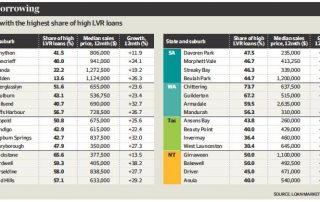
Analysis by mortgage brokerage Loan Market found that about one in three borrowers in Queensland, ACT, Western Australia and the Northern Territory took out a mortgage with a deposit of 15 per cent or less last year.

In NSW and Victoria, one in four homebuyers had borrowed on a low deposit, 29.3 per cent in South Australia and 21.8 per cent in Tasmania.

In NSW, Hunter Valley suburbs Bellbird and Aberglasslyn were the most exposed, with 69 per cent and 51.6 per cent of homebuyers borrowing on low deposit to afford the rapidly rising house prices in the area. In Victoria, more than two in five homebuyers in Bendigo and Hepburn Springs and more than half in Leopold may be vulnerable to rising interest rates.

More than half of homebuyers in Brisbane suburbs Carseldine and Bald Hills took out high-LVR loans while almost two-thirds in Blackstone in the Ipswich area have borrowed large amounts relative to value of the property.

‘‘These are the areas where risks would show up,’’ said Shane Oliver, AMP Capital chief economist.

‘‘When households are these highly leveraged, it’s usually a sign that the budget is fairly stretched as well.

‘‘Hopefully, the banks have done their serviceability tests appropriately and people haven’t lied in making their loan applications, but still, high leverage is usually a sign of high risk.’’

People with high LVR mortgages were also more likely to fall into negative equity if the property market fell, as expected, said Sally Tindall, director of research at Rate City.

‘‘Borrowers who can keep up with their mortgage repayments don’t have to worry about selling at a loss, but being in negative equity can lock people in ‘mortgage prison’ until they get a decent amount of equity behind them,’’ she said.

Homebuyers who have used maximum borrowing capacity may not be able to refinance to a cheaper rate, as the new lender will assess their ability to repay the debt on rate higher than they were on originally, said Alan Hemmings, chief executive of HomeLoanexperts.
Highly leveraged areas likely to fall faster2022-05-20T15:54:20+10:00

House rents jump 20pc despite a rise in vacancies

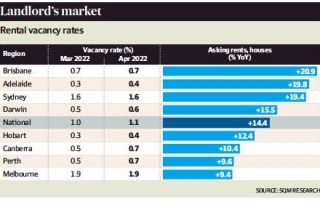
The squeeze on rental accommodation around the country eased slightly in April, with vacancy rates rising 0.1 percentage points to 1.1 per cent in the first increase since the start of the year.

But the improvement in vacancy rates has not made renting any easier for tenants, with asking rents climbing higher as demand continues to outpace supply, data from SQM Research shows.

Louis Christopher, managing director of SQM Research, said more property owners were responding to the tight rental market and leasing their properties again after taking them off the market during COVID-19.

Vacancy rates held steady at 1.6 per cent and 1.9 per cent in Sydney and Melbourne respectively, but they are still at their lowest levels in years. Brisbane’s vacancy rate of 0.7 per cent was the lowest on record.

Rental markets in Perth, Canberra, Adelaide, Hobart and Darwin posted up to 0.2 percentage point increases in vacancy rates during the month, but most are still at their tightest levels in decades.

Some of the tightest regional rental markets also eased slightly. Vacancy rates in the Blue Mountains, Hunter region and the Central Coast in NSW rose by 0.20 percentage points to 0.7 per cent, 0.8 per cent and 0.7 per cent respectively.

The Gold Coast also recorded a 0.2 percentage point rise in vacancy rate to 0.5 per cent. On the Sunshine Coast it was up by 0.1 percentage points to 0.6 per cent, and climbed by 0.5 percentage points to 2.1 per cent in Byron Bay.

‘‘While the small increase in vacancy rates means rental conditions have not deteriorated further, it is still very much a landlord’s market,’’ Mr Christopher said.

‘‘There are still far more would-be renters than landlords at this stage that’s why we’re still seeing rents continuing to rise strongly around the country.

‘‘Landlords are very confident at the moment in terms of lifting rents, and they’re getting that rise.’’

In the past 30 days, landlords nationwide have lifted their asking rents by another 1.4 per cent, after increasing by 2.4 per cent in the previous month.

Asking rents for Sydney houses jumped by 19.4 per cent over the year to May 12, and Melbourne climbed by 9.4 per cent. High rental demand for Brisbane houses triggered a 20.9 per cent rise in asking rent, 9.6 per cent increase in Perth, 19.8 per cent in Adelaide, 10.4 per cent in Canberra, 15.5 per cent in Darwin and 12.4 per cent in Hobart.

‘‘We’re not seeing any slowdown in the rise in rents, particularly across Sydney, Melbourne and Brisbane,’’ Mr Christopher said.

‘‘These three cities are recording some of the fastest increases in rents because of the imbalance between rental demand and supply. So, I think rents are going to continue to rise for the foreseeable future.’’

In Sydney’s eastern suburbs, asking rents jumped by 19.3 per cent over the year. They climbed by 11.5 per cent in the inner west, by 6.4 per cent on the northern beaches and by 13.3 per cent in the CBD.

In Melbourne’s inner east, asking rents rose by 9.4 per cent and were up by 11.3 per cent on the Mornington Peninsula.

Asking rents on the Gold Coast rose by 28.2 per cent and by 16.5 per cent in inner Brisbane.

House rents jump 20pc despite a rise in vacancies2022-05-20T15:49:42+10:00

These lenders will save you money

Refinancing Home owners looking for a better rate should not overlook smaller outfits they’ve never heard of, writes Lucy Dean.

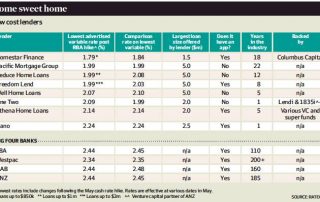
Borrowers looking for a better rate may hover over low-cost lenders such as Athena, Nano and One Two before moving on due to their unfamiliar names, but doing so may close them off to opportunities to save thousands of dollars.

While the idea of moving to a lesser-known lender may not sit well with some borrowers, home owners should remember that when it comes to risk, it is the lender who loans the money – not the other way around, says RateCity research director Sally Tindall.

‘‘Borrowers on the hunt for ultra-low rates sometimes hover over the low-cost lenders, but quickly move past them, based on their unusual names,’’ she says.

‘‘However, if people have the time, it’s worth probing just a bit deeper into their background because often their origin and history might surprise you.’’

For example, many of these cheaper lenders have been in the market for more than a decade, with Homestar Finance founded in 2004 and Reduce Home Loans in 2010. Newer lenders such as Athena, Nano and Tic:Toc have been set up by former bank executives from NAB, Westpac and Bendigo and Adelaide Bank.

‘‘These non-bank lenders have helped drive prices down across the entire home loan market, particularly since the start of COVID-19 when record numbers of borrowers switched lenders to get themselves into a better financial position,’’ Tindall says.

‘‘Even if people don’t end up switching over to a low-cost lender, they can still use these low rates in their research to get a benchmark of what’s competitive and what is not.’’

Mortgage broker and founder of Madd Home Loans, George Samios, says his firm is refinancing about $20 million a week after the Reserve Bank’s decision to raise rates.

‘‘Everyone’s looking at their loans now,’’ Samios says.

Any borrower who hasn’t heard from their lender in the past 12 months should be analysing their current deal and working out if they can get a better one, he says.

‘‘If you don’t review your loan once a year, you’re losing thousands of dollars. That is the biggest takeaway point.’’

Samios says it is worth considering a broker because they will negotiate with lenders to get the best rate. Every loan he has written in his 20-year career was negotiated to get the best deal.

Going through a broker can mean some borrowers who have the right amount of equity could get better deals at the bigger banks, which are now also trying to compete on price.

Generally speaking, any variable loan with an interest rate beginning with a 3 or 4 (per cent) means the borrower is ‘‘being severely ripped off’’, Samios adds.

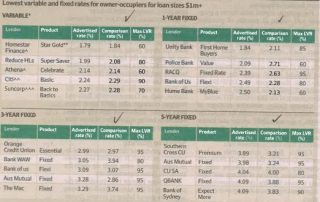
Switching a $2 million home loan from the average 3.17 per cent variable rate to one of the lowest variable rates would save home owners as much as $41,446 over two years, RateCity analysis found.

That is based on the average 2.10 per cent variable rate across three of the cheapest lenders.

A borrower with a $1 million mortgage who refinanced to a 2.02 per cent interest rate, based on the average of the three cheapest lenders for that loan size, would save $21,522 over two years.

They are huge savings, but borrowers still need to check the fine print – no matter who they are refinancing with.

‘‘What you should be really careful about is the terms of the loan,’’ says University of NSW business school professor Richard Holden.

‘‘The history of the subprime crisis in the US went well beyond subprime to people with really good credit ratings who got things like adjustable rate mortgages and didn’t pay attention to the fine print, which said, ‘It’s going to go up 25 basis points a quarter after the adjustable rate period ends’.’’

He says borrowers need to make sure they understand the differences between their current and new loan.

‘‘These smaller lenders probably aren’t going to make big inroads into the market by offering a higher interest rate, so it’s natural that they’re going to offer a lower interest rate,’’ he says. ‘‘You just want to make sure that you’re not paying for it in some other way.’’

But he adds that borrowers need to be equally aware of the risks that come with inertia and simply choosing to stay with their lender.

One difference between a larger lender and a smaller lender is often in the level of customer service provided, adds Tindall.

‘‘That’s not to say one is better than the other. Often it comes down to your needs and your personality,’’ she says.

‘‘Smaller lenders typically have fewer resources. However, you might find you like their more personalised customer service style. You won’t know unless you test it out, so do exactly that.’’

She suggests potential refinancers ring the call centre at their prospective lender and ‘‘ask some tricky questions’’, take a look at their website or use their online chat service to see how easy key information is to find.

For example, if information about fees and charges is hard to find, that can be a red flag.

‘‘Customers looking for an offset account should be aware some low-cost lenders offer ‘offset’ facilities where the money isn’t held in a separate bank account,’’ she adds.

‘‘While this may not worry some customers, people who like the idea of keeping their money separate from their home loan might prefer to use a more traditional offset account.’’

It is also a good idea to read the reviews of what real customers are saying.

‘‘Doing this research will also help you feel prepared and informed and that’s important,’’ Tindall says. ‘‘The bottom line is, it’s important to be happy with your home loan provider, otherwise you could end up feeling uneasy for years.

‘‘If you fundamentally like the idea of having your home loan with a bank that offers a suite of other products and at least a handful of bricks-and-mortar branches, there are still plenty of competitive deals at your disposal.’

These lenders will save you money2022-05-17T09:07:02+10:00

Rising rents drive home buying

Rapidly rising rents could push some aspiring homeowners to pull the trigger on buying a home, despite higher mortgage rates and inflated house prices, experts say.

Many home buyers had been priced out of the housing market as the widespread boom triggered a 27.8 per cent rise in median dwelling values nationwide since the pandemic. But renting has also become unaffordable, and in many cases even more so than buying.

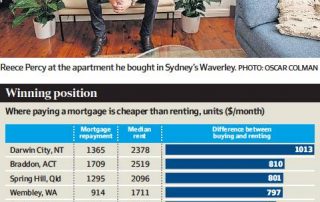
In more than one in four markets across the capital cities, paying a mortgage on an average home is cheaper compared with paying rent, analysis by CoreLogic shows.

A total of 274 suburbs are more favourable for buyers than renters, including 201 unit markets and 73 house markets.

Across 20 unit markets and one house market in Sydney, buying is cheaper than renting; in Melbourne, 20 apartment markets favour buyers more than renters.

In western Sydney, buyers of median-priced units in Auburn are better off by $318 each month compared with renting, and they are ahead by $266 in Rosehill and by $254 in Mays Hill. It is cheaper to pay a mortgage than rent in Sydney’s inner suburbs Roseberry and Mascot, where buyers can save $203 and $190 on average each month, respectively.

The monthly mortgage repayments for units in Melbourne’s inner-city suburbs Carlton and Docklands are cheaper than renting by $533 and $422, respectively. In Perth, buyers in Wembley and West Leederville are better off by $797 and $785, respectively.

Darwin is the most favourable market for buyers – the monthly mortgage repayments on a median-priced unit are cheaper by $1013 compared with renting.

The calculation took into account the current median values and median weekly rental valuation, assuming the latest average mortgage rate from the RBA for new owner-occupier variable loans of 2.49 per cent with a 20 per cent deposit over 30 years. No other fees or transaction costs were considered.

‘‘It depends on the individual’s situation, but broadly speaking, it’s probably more challenging to rent, with rapidly rising rents in many parts of the country, increased competition for rents with holiday-makers and overseas arrivals,’’ said Eliza Owen, CoreLogic’s head of research.

‘‘And although interest rates are rising, they are still pretty low, and in some markets prices are starting to fall.

‘‘This could be a bit of a ‘sweet spot’ for first home buyers who have been saving up their deposit.

Sydney-based first-home buyer Reece Percy was among those who jumped the gun in the past few months.

‘‘I was tired of renting and paying the landlord’s mortgage, so I decided to buy a one-bedroom apartment in the eastern suburbs,’’ he said.

‘‘I looked over the long-term and realised I would be better off buying because I would be building my own asset base.

‘‘I much rather spend my money paying for an asset that will grow in value over time. I plan to hold it over the long term because I believe time in the market beats timing the market.’’

Jack Henderson, Sydney-based buyer’s agent with Henderson Advocacy, said the rising rents were a big factor motivating aspiring homeowners such as Mr Percy to take the plunge.

‘‘Housing costs are going up whether you’re renting or looking to buy, but for those who have saved the deposit, soaring rents could potentially push them to take the plunge and buy their home,’’ he said. ‘‘I think with rents continuing to rise, people may feel more comfortable spending that money on their own property than paying other people’s mortgage.’’

Rents nationwide have jumped by 2.7 per cent in the three months ended April – faster than the 1.9 per cent gain for house prices, data from CoreLogic shows. Over the year, the median dwelling rent climbed 9 per cent.

‘‘Rent rises probably do have a bit further to go,’’ Ms Owen said. ‘‘Upward pressure on rental values could persist amid higher wages growth, the return of overseas arrivals to Australia, and the lag at which rental supply responds to increases in demand.’’

Although surging rents might eat into savings and make it harder to get over the deposit hurdle, the cooling property prices triggered by rising interest rates make it a much easier time to buy, said Nerida Conisbee, Ray White chief economist.

Rising rents drive home buying2022-05-17T09:06:03+10:00

Ease the rate-rise squeeze

Home loans Whether you’re an owner-occupier or investor (even via your DIY super fund), you can use these strategies to help handle interest rate rises, writes Duncan Hughes.

A mortgage-holder with a $1 million home loan on the average variable rate could insulate themselves against the equivalent of several Reserve Bank of Australia cash rate increases by switching to the cheapest variable rate on offer.

It would take more than four rates rises equivalent to this week’s 25-basis-point increase to bridge the gap between the cheapest and average rates on offer, analysis shows.

Before this week’s increase, the average owner-occupier borrower with a 25-year variable rate home loan was paying around 2.92 per cent, or 113 basis points higher than the lowest variable rate.

With lenders passing on the rate rise later this month, the same borrower is expected to pay around 3.17 per cent, or 118 basis points higher than the lowest variable rate on offer.

The lower rate would save a borrower nearly $10,000 in the first year, or $21,500 over two years, according to analysis by RateCity, which monitors savings and borrowing rates.

Bankers warn borrowers there could be a string of interest rate rises over the next year, with RBA governor Philip Lowe saying the cash rate could rise from 0.35 per cent to 2.5 per cent.

The big banks have also updated their cash rate forecasts, with CBA expecting 1.6 per cent by next February and NAB citing 2.6 per cent by August 2024.

A cash rate of 2.6 per cent would mean an increase in monthly repayments of $1350 for a borrower with a $1 million, 25-year principal and interest mortgage.

But other bankers, such as Macquarie bank’s global head of strategy Viktor Shvets, believe deteriorating economic conditions will force central banks to consider ‘‘backpedalling’’ by reducing rates within 12 months.

Mortgage brokers are urging borrowers to ‘‘calmly consider their options’’ and not rush into more expensive alternatives, such as switching from a variable to a fixed rate. Some lenders are increasing fixed rates by more than 50 basis points.

‘‘Borrowers are clearly concerned about the future and how several rate rises will squeeze household budgets,’’ says Phoebe Blamey, director of Clover Financial Solutions, a mortgage broker.

‘‘But many are in a strong position to manage those increases because of increasing savings in offset accounts when rates were low, and a readiness to find a cheaper rate,’’ Blamey says.

Residential property borrowers have made the most of record low rates to squirrel away a record $232 billion in offset accounts (an increase of nearly 15 per cent, or $30 billion) in the past 12 months as insurance against higher rates.

Maile Carnegie, ANZ group executive Australia retail, says around 70 per cent of accounts are ahead on repayments – many of them by two years or more. Household deposits are also at record levels.

Whether you’re an owner-occupier, investor or own a property via a self-managed super fund, here’s how you can lessen the impact of rate rises.

Switch your loan

A borrower with a $1 million mortgage could recoup the costs of switching from the new average variable rate of around 3.17 per cent to the cheapest variable rate on offer within a couple of months.

Costs in switching to a 25-year principal and interest loan would include a $350 discharge fee from the former lender, around $300 in state government fees and upfront fees on the new loan of around $930.

The savings (after costs) of switching from the average to the cheapest variable rate are around $833 a month, RateCity says.

Mortgage brokers warn some nervous borrowers are so concerned about a string of rate rises they are considering paying an extra 100 basis points plus switching fees for the supposed security of a fixed mortgage rate.

‘‘Keep your eye on what is best for your finances,’’ says Christopher Foster-Ramsay, principal of mortgage broker Foster Ramsay Finance. ‘‘Don’t be distracted by guessing what rates will do,’’ he adds.

Some borrowers could be forced to review their borrowing because of changed financial circumstances, such as a job loss or having misrepresented their income, or savings, to the lender. For example, around 37 per cent of homebuyers overstate their financial position when applying for a home loan, according to investment bank UBS. Key issues borrowers need to consider: What rates are on offer and how rising rates will affect repayments and household budget. Can extra repayments be made before the next rate rise? Fees and charges and how long it will take to recoup in lower interest repayments. Breaking a fixed rate can cost thousands of dollars, plus establishment and annual fees with the new lender. Ask for a detailed breakdown before agreeing to the loan, including application, settlement and discharge fees. Some low fixed rates roll to high variable rates after the fixed term, which will also affect the comparison rate.

State government fees vary between states, but expect to pay between $300 and $500.

Check the small print conditions to make sure the loan is portable so could be switched to another property.

What are the loan features? Does it include an offset account and allow additional payments?

Is the lender flexible in case of unexpected events? For example, some lenders offer short-term repayment ‘‘holidays’’. Alternatively, does it accept reduced payments instead of full suspensions, or a combination of both?

Check the level of support, such as call centres, a branch network or internet access.

Too late to fix

Property investors have ‘‘missed the boat’’ for fixed rates and should instead shop around for cheapest variable rates, financial and mortgage advisers say.

An investor with a 20 per cent deposit will pay around 2.59 per cent for a principal-and-interest variable loan from CBA, or around 56 basis points lower than a comparable interest-only mortgage, RateCity says. (These rates have yet to be adjusted following the cash rate rise.)

By comparison, some banks charge 4.39 per cent for a three-year fixed rate or 4.89 per cent for five years.

Alex Jamieson, founder of AJ Financial Planning, says: ‘‘The best time traditionally to fix rates is in the middle of a recession, when interest rates have been cut and the recovery phase is just about to start. That’s not now. Investors considering a fixed-term mortgage have missed the boat. Variable is the way to go.’’

While fixed-rate loans offer some certainty about repayments, they often don’t allow extra payments, are costly to exit and have fewer loan features, such as offset accounts or redraw facilities.

Investors pay a premium of 33 basis points on existing home loans and a 29 basis-point premium on new loans, RBA analysis shows.

Higher rates are unlikely to deter long-term investors seeking higher yields and long-term capital gains, particularly when national property vacancies are less than 1 per cent, the lowest in 17 years, according to SQM Research, which monitors property markets.

Analysts expect rents to rise rapidly in tight rental markets, particularly after the ending of rent caps and eviction controls in the pandemic. These are likely to offset the impact of higher mortgage repayments when rates begin to rise.

Tim Lawless, research director at CoreLogic, which monitors property markets, says while higher rates will discourage some investors, there are others attracted by strong tenant demand, despite low rental demand from foreign students and the soaring cost of building materials and labour shortages.

Every capital city in Australia has vacancy rates below 2 per cent, with Melbourne’s the highest at 1.9 per cent, or less than half what it was about 12 months ago, adds SQM Research.

National gross yields posted a small gain to 3.23 per cent during March, the first since August 2020, and are outperforming capital growth of 2.4 per cent, according to CoreLogic.

As to whether investors are better off on interest-only or principal-and-interest loans, AJ Financial Planning’s Jamieson says a typical long-term investor with a $1 million portfolio is better off paying down the principal and lowering debt using a principal-and-interest loan.

SMSF strategies

Trustees of self-managed super funds (SMSF) investing in property should undertake a full review to ensure there is sufficient liquidity to deal with any financial pressure from rising rates and costs.

SMSF specialists warn increasing expenses might require trustees to increase member contributions, raise rents or sell fund assets to meet increasing liabilities, such as paying pension benefits.

Julie Dolan, head of SMSF and estate planning for KPMG Enterprise, says: ‘‘Trustees should play it safe and have a couple of years’ rental income in the fund as a buffer.’’

Dolan says the likelihood of more interest rate rises over coming months could create stress in funds facing rising expenses without readily available liquid assets, such as listed shares that can be sold, or available cash.

Demand for residential and commercial investment properties jumped during last year’s property boom by around 22 per cent to almost $66 billion, according to analysis by the Australian Taxation Office.

The value of property in SMSFs also rose by about 22 per cent to a record $140 billion, thanks to rising prices and investments, the analysis shows.

Falling property prices and rising interest rates could undermine a fund’s investment strategy and increase taxes if a liquidity squeeze forced a fire sale of a property to meet funding obligations.

For example, capital gains tax on a property sold within 12 months of purchase would be 15 per cent, or 50 per cent higher.

The economic slowdown and rising costs are having an impact on many SMSFs. Auditors have reported more than 40,000 breaches of the law involving SMSFs during the past 12 months amid ‘‘heightened levels of financial stress’’ across the economy, such as the impact of COVID-19 and renewed guidelines intended to increase compliance of the $860 billion DIY sector.

Graeme Colley, executive manager of technical and private wealth for SuperConcepts, a specialist SMSF adviser and trustee group, says funds should be diversified across a range of asset classes to avoid unnecessary risks if an investment fails.

KPMG’s Dolan recommends a fund review to consider the asset mix along with expenses, ranging from interest rates to maintenance, sources of income and capacity to boost liquidity, debt that needs to be repaid and repayment strategy over coming years.

SMSF property loans are ‘‘limited recourse’’, which means the banks can claw back only the specific asset purchased if the loan defaults.

Loan repayments must come from the fund, which means there must be sufficient liquidity or cash flow to meet loan repayments.

Strategies to ensure adequate liquidity to meet rising mortgage rates include:

Rent increases. Record low rental vacancies mean landlords have an unprecedented opportunity to raise rents.

Increase contributions. If rental income does not cover rising rates, contributions can be made to the fund – but these are capped at $27,500 a year (for pre-tax contributions) and $110,000 a year (for contributions with no tax deduction).

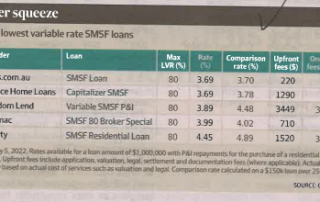
Shop around for a cheaper loan. Big lenders, such as Commonwealth Bank and Westpac, no longer offer SMSF loans. Rates from smaller lenders are typically higher, with some having upfront fees of more than $3000 and annual charges of about $400.

Negative gearing

Negative gearing, or debt strategies used by investors to cut tax, is expected to increase as rising interest rates push up costs for landlords, finance specialists say.

Record-low interest rates resulted in the proportion of the nation’s landlords being negatively geared falling to around 20-year lows, ATO analysis shows.

But Shane Oliver, AMP Capital chief economist, says: ‘‘It will probably rise as rates rise.

‘‘The collapse in mortgage rates relative to property rental yields made it harder to negatively gear properties as the interest cost in many cases fell below the property’s net income,’’ Oliver says. ‘‘With rates on the rise again, negative gearing will become easier to achieve.’’

Investor confidence is being partly sustained by the absence of any federal election policies that might lead to a cutback on generous negative gearing concessions or depreciation allowances.

Investors spearheaded demand for residential property loans last year, despite it being difficult to derive much benefit from negative gearing.

‘‘Investors may have been buying in anticipation that the value from negative gearing from a tax perspective will return,’’ Oliver says.

The proportion of Australia’s 2.3 million landlords who are negatively geared was around 60 per cent in 2019, about the same as the previous two years and the lowest since 2003, according to ATO data.

The data shows that in 2019 around 1.3 million landlords made rental losses, while 922,175 (or around 40 per cent) were in a neutral position or made a gain. When losses on an investment property are greater than the gains, the losses can be used to reduce tax on wages or other income.

Analysis by Jeremy Goldschmidt, chief executive of RentBetter, a DIY platform for property investors seeking to cut out professional managers, estimates that average rental properties around Australia are losing their owners more than $1000 a month, despite negative gearing concessions.

Goldschmidt says many landlords fall back on tax deductions rather than looking for more effective ways of cutting expenses and boosting returns.

‘‘Good investing requires close management of expenses. Effective landlords will be looking for ways to manage down other expenses rather than rely on tax deductions,’’ Goldschmidt says.SI

Ease the rate-rise squeeze2022-05-13T14:14:11+10:00

Sellers rattled as rate rise sparks house sales dive

Auction clearance rates fell sharply across most capital cities as the first interest rate rise in more than 11 years unnerved buyers who are worried about the impact of higher mortgage costs on their household budgets.

The slowing market also spooked vendors who have started to pull out in droves, data from CoreLogic shows.

A week after the RBA raised the official cash rate, Sydney’s preliminary auction clearance rate dropped by 3.6 percentage points to 58.7 per cent, the weakest result in two years.

In Melbourne, early results showed the clearance rate tumbled by 3.8 percentage points to 64.6 per cent, the lowest preliminary result since December.

Average preliminary results across all capital cities dropped 2.5 percentage points to 64.7 per cent, the lowest level this year.

‘‘The interest rate decision has put further pressure on the housing market, which was already slowing prior to the rate rise,’’ said Tim Lawless, CoreLogic’s research director.

‘‘Rising interest rates and high inflation are eroding household balance sheets, which is causing buyers to pull back.

‘‘The correlation between clearance rates and the pace of value growth is really strong, so the falling auction clearance rates portend declines in prices, particularly in Sydney and Melbourne.’’

SQM Research managing director Louis Christopher, said the rise in the cash rate and the prospect of further interest rate increases had turned sentiment towards the housing market negative.

‘‘Fewer buyers would enter the market as it becomes more difficult to qualify and service a big mortgage,’’ he said.

‘‘The overall hurdle rate to test home loan applicants will go up and disqualify an increasing number of would-be home buyers and investors, and this in large part is what is going to drag the market down for the rest of 2022 and perhaps beyond.’’

SQM Research is expecting Sydney house prices to decline by 7 per cent this year, Melbourne by 8 per cent and nationwide by 4 per cent.

As Sydney’s clearance rates continue to weaken, more vendors are withdrawing from the auction market, according to CoreLogic. The proportion of homes withdrawn this week has surged to 25 per cent, the highest level since April 2020, around the start of the pandemic.

‘‘We’re seeing more auctions being pulled from the market and not being rescheduled,’’ said Mr Lawless.

‘‘Since the middle of February, more vendors are shunning the auction market. People who have been looking to sell their home by auction are simply pulling out of the market as conditions start to deteriorate.’’

Sydney-based auctioneer Clarence White said it was becoming harder to get buyers to bid at auctions.

‘‘I’ve really noticed that when there are only a small number of bidders, like what we’re seeing now, people back away very quickly and they hesitate to bid,’’ he said. ‘‘Buyers’ confidence is very low at the moment.’’

Jack Henderson of Henderson Advocacy said vendors were also becoming nervous about selling.

‘‘There are a lot of anxious sellers in the marketplace and some are probably making irrational decisions around the price that they’ll take for a property,’’ he said.

‘‘For buyers, this opens up a great opportunity because this is the peak of the uncertainty for both vendors and other buyers, which means you can take advantage of people’s emotions as a buyer.’’

In contrast to the weaker auction results in Sydney and Melbourne, Adelaide posted an 81.2 per cent preliminary clearance rate, the highest across all capitals. Canberra cleared 75 per cent, while 62.7 per cent sold at auctions in Brisbane.

Among the sales in Brisbane was a five-bedroom house in Ashmore on the Gold Coast that sold for $3.65 million at auction.

Sellers rattled as rate rise sparks house sales dive2022-05-13T13:55:34+10:00

WHY INTEREST RATES WILL KEEP RISING

Stormy waters Everyone, from the Reserve Bank to economic commentators, has reached a consensus that Australia is in for a sustained period of increasing rates, writes John Kehoe.

The global inflation wave has washed on to Australia’s shores, right in the middle of the federal election.

The price pressures and looming interest rate rises have exposed that the Coalition and Labor do not have a serious economic plan to deal with inflation. Rather, the government is pouring another $5.6 billion of ‘‘cost of living’’ cash hand outs and tax refunds on to the inflation bonfire.

The election pork will add to inflation pressures that have been underestimated by both the Reserve Bank of Australia and Treasury. The RBA boldly declared at the start of the pandemic that inflation would not be sustainably high enough to lift the 0.1 per cent cash rate until at least 2024 and last December said the market should not expect rate rises in 2022.

But times have changed. Inflation hit 5.1 per cent in the March quarter, the highest annual rate since the 10 per cent goods and services tax was introduced in 2000-01. Wholesale electricity prices have doubled over the past year and will soon begin flowing through to retail power prices, due to the soaring cost of coal and gas triggered by the war in Ukraine.

The government rightly points out much of the price pressures are due to international forces out of its control, including war driving up the global oil price and supply chain disruptions from the pandemic, particularly in the manufacturing hub of China.

Nevertheless, home-grown price pressures are also building due to strong demand from cashed up consumers and the economy running near full capacity, as evidenced by a firming in inflation of non-tradable items and services. Food, housing, transport and education prices are rising.

The RBA will soon begin raising interest rates, either next week or in early June, and keep raising the cash rate in the months ahead. It is a welcome development that the cash rate will finally be lifted from an emergency low of near-zero. The economy, with a low 4 per cent unemployment rate, has rebounded from the pandemic due to $314 billion of federal government stimulus.

To be sure, controlling inflation is predominantly the remit of the independent central bank. But despite economic management rhetoric from the government and cost of living complaints from Labor, neither side of politics is offering a comprehensive economic policy plan to contend with inflation and productivity.

Dan Andrews, a former Treasury, RBA and OECD official, says, ‘‘if the inflation tide has turned, then the imperative is to boost supply via productivity improvements’’.

‘‘The chickens are coming home to roost,’’ says Andrews who is now program director at the e61 Institute. ‘‘The supply side productivity agenda has been neglected for some time. Reforms matter now more than ever given that inflation typically arises from strong demand pushing up against supply constraints in the economy.’’

To lift chronically weak productivity growth of the past decade, economists nominate reforms to the tax system, boosting competition against incumbent firms to allow the growth of more innovative firms, improving energy and climate policy to lift investment, enhancing workplace relations and labour mobility, and better regulation to reduce red tape barriers. But these areas are largely off the table among a political class that believes voters are not up for a difficult national conversation.

There is also no plan from the Coalition or Labor to rein in structural budget deficits which will further fuel demand pressures in the economy if inflation persists more than previously thought. Barrenjoey chief economist Jo Masters says: ‘‘There is no real talk of any serious reform and everyone is small target on the economy.’’ She adds: ‘‘The inflation cycle makes it imperative to lift real wages through productivity-enhancing reforms.’’ And: ‘‘Economists are exhausted talking about it.’’

Labor’s economic plan this week pledged more spending on childcare, aged care, clean energy and to support pay rises for aged care workers, while unveiling a modest $5 billion in savings over four years on ‘‘waste and rorts’’. Shadow treasurer Jim Chalmers argues cheaper childcare will reduce family costs and inject more productive female workers into the workforce.

The Coalition is largely running on the economic performance during the pandemic, with little new policies. The 22.1c a litre petrol excise cut for six months, while politically understandable when prices were above $2 a litre, will only artificially and temporarily reduce inflation.

More than half of businesses have experienced cost increases over the past three months and a majority of firms passed price increases on to their customers, an Australian Bureau of Statistics survey reported this week. Coles chief executive Steve Cain says he is receiving price rise requests from suppliers. Moreover, the two-year closure of the international border and broader pandemic concerns have reduced the flow of labour around the world. Unions and workers are starting to demand larger pay rises, to catch up to inflation. Outlook Economics director Peter Downes says the low 4 per cent unemployment rate is starting to generate wage pressures, a factor the RBA would be picking up in its business liaison.

RBA governor Philip Lowe in early April signalled he would like to see both inflation and wages rising before lifting the 0.1 per cent cash rate. The next wage price index print is due on May 18 and average earnings data in the national accounts on June 1.

If Lowe holds true to his public statements about the bank’s ‘‘reaction function’’ being wages, then a pre-election rate rise is not on, and the RBA would wait until June. Treasurer Josh Frydenberg publicly reminded the RBA of this framework this week – a move Chalmers said undermined the independence of the central bank.

But the big 5.1 per cent jump in annual inflation and 3.7 per cent rise in underlying inflation will force the RBA to consider moving the first rate increase forward to next week. A gentle 0.15 of a percentage point rise to 0.25 per cent is a live option.

Outlook’s Downes says: ‘‘There is no point waiting any longer.’’ He adds: ‘‘Knowing what we know now, they should have started raising rates at the start of the year. The longer the RBA waits the higher they will have to raise rates later.’’

He says Australia can and should avoid repeating the ultra-high 8.5 per cent inflation rate of the United States ‘‘without having to raise rates too much’’.

Money market traders have priced in a 2.5 per cent cash rate by the end of the year, implying rate rises every month for the rest of the year.

Commonwealth Bank of Australia economist Gareth Aird argues high household debt levels will limit RBA increases to about 1 per cent by December.

The Morrison government would obviously prefer the RBA wait until after the election to raise rates, while Labor would welcome a pre-election rate rise to drive home its cost of living pitch to voters.

But sensing the RBA might move next week, the government has warned that the economic uncertainties caused by inflation and rate rises mean now is not the time to risk handing the economy to an inexperienced Labor government.

Morrison also makes the point that it’s very different to when the RBA raised rates in the 2007 election campaign – a move that upset then prime minister John Howard and treasurer Peter Costello. Back then rates were already at 6.5 per cent and Howard had pledged to keep them low. .

Andrews recalls the RBA’s interest rate hiking cycle in 1994, when the RBA raised the cash rate from 4.75 per cent to 7.5 per cent in six months. Then, Australia was on the cusp of a productivity boom thanks to the internet revolution and economic reforms of the Hawke-Keating governments in the 1980s and 90s. Andrews says productivity was one of the factors why the RBA didn’t keep hiking rates beyond 1994.

‘‘That expanded the speed limit of the economy and inflation was brought under control,’’ he says. ‘‘We’re in a very different place right now because we haven’t done substantive structural reform.’’

WHY INTEREST RATES WILL KEEP RISING2022-05-03T09:42:36+10:00

Low demand to eat into house prices

Lower demand for housing as a result of higher interest rates and tighter lending is more likely to trigger faster and deeper price falls than any widespread mortgage defaults caused by the rising cost of credit, experts say.

‘‘An increase in the official cash rate would reduce demand for new mortgages and therefore property prices,’’ Eliza Owen, CoreLogic’s head of research, said.

‘‘Higher mortgage rates might put some people off purchasing while prices are still quite high, so prices are more likely to come down off the back of successive increases in the cash rate.’’

Some economists are forecasting interest rates to rise by 1 percentage point by the end of the year and by another percentage point next year, with the first increase tipped to come as early as Tuesday.

A calculation by comparison site Rate City shows that a 1 percentage point rise in the cash rate would slash borrowing capacity for someone earning $100,000 a year by $75,600 and a couple earning a combined salary of $150,000 by $111,100. A 2 percentage point lift would limit a single borrower by $139,700 and would cut a couple’s mortgage amount by $205,400.

‘‘Anyone borrowing at capacity will see their budget shrink, which could be enough to cool things down, particularly in property hotspots such as Sydney and Melbourne,’’ Sally Tindall, RateCity research director, said.

‘‘Rising interest rates will significantly decrease how much the bank will let people borrow. This will have a flow-on effect on property prices, as many prospective buyers will no longer be able to bid as high.’’

SQM Research managing director Louis Christopher said rising mortgage rates and higher assessment rates could knock potential buyers from the market.

‘‘Buyers tend to stay away from the housing market when rates are rising, but more people are going to be rejected by the banks because they haven’t met the higher servicing test,’’ he said. ‘‘Fewer buyers will definitely qualify for a loan if interest rates rise by 2 per cent.’’

Rough estimates by AMP Capital suggest that a 1.5 percentage point to 2 percentage point rise in mortgage rates would reduce home buyer borrowing power and the ability to pay for a house by 10 to 15 per cent. ‘‘Demand for housing is going to be affected immensely, simply because people won’t be able to borrow as much as they did in the past,’’ Shane Oliver, AMP Capital chief economist, said.

‘‘This will have a greater negative impact on prices than defaults by existing mortgage holders because many households are already ahead of their repayments and still pay lower interest rates than new borrowers.’’

Maree Kilroy, senior economist with BIS Oxford Economist, said the buildup in household savings and strong economy would reduce the risk of homeowners defaulting on their loans.

‘‘The risk of homeowners defaulting, which would cause prices to fall more than expected, will likely be mitigated by a strong jobs market,’’ she said.

‘‘We expect the unemployment rate forecast to hold below 4 per cent and almost two-thirds of owner-occupiers have increased their mortgage payment buffers since the onset of the pandemic.’’

Low demand to eat into house prices2022-05-03T09:39:38+10:00

Rate rises threaten property funds’ stellar results

Tipping point The double-digit growth in unlisted real estate funds thanks to cheap money could be coming to an end, particularly for newer releases, writes Duncan Hughes.

Unlisted property funds have blitzed other asset classes to generate returns of more than 20 per cent over one and five years by using record low interest rates to invest in retail, commercial and industrial properties.

But some analysts are concerned that accelerating performance with high levels of gearing could create problems for recently launched funds, with tight lending conditions if interest rates begin to rapidly rise.

Unlisted property funds generated returns of almost 22 per cent in the year ended December 31 (the most recent analysis) compared to about 20 per cent for real estate investment trusts (REITs) investing in local property listed on the Australian Stock Exchange and about 18 per cent for shares.

‘‘The period of turbo-charged growth fuelled by cheap money will end as interest rates rise,’’ warns Dugald Higgins, head of responsible investment and real assets at Zenith Investment Partners.

Kevin Prosser, research manager of direct assets at Lonsec, an investment and ratings group, says overall gearing is ‘‘reasonable’’ at 40 per cent to 45 per cent of assets under management.

A high gearing ratio means a trust has a larger proportion of debt compared to equity. A low gearing ratio means the trust has a small proportion of debt versus equity.

Prosser says managers are aware of the potential impact and many have hedged against the risk for up to three years, fixed rates with their lenders or are reviewing potentially vulnerable variable costs.

Potential problems are likely to come from recently launched funds involved in construction projects that might not have hedged their borrowing and are facing rising costs, or disruptions, because of shortages in the building sector, say analysts.

There are estimated to be about 600 unlisted property funds with assets totalling about $20 billion, says Zenith’s Dan Cave, a senior investment analyst.

At least 30 funds are estimated to have been launched in the past 18 months with assets totalling about $3 billion. These include about 12 office funds, five retail and four industrial funds with the remainder a mixture of sectors.

Listed property trusts and unlisted funds are similar to the extent that investors contribute capital for a share of the assets either in shares (for listed) or units (unlisted).

Investors receive income (called distributions) and, if asset values increase, a capital gain on their original investment from either the rising share price (for listed) or the sale of the asset (for unlisted).

Listed funds typically yield 3-6 per cent and unlisted about 6-8 per cent. The premium is because there is little or no liquidity.

Property Funds Association analysis shows that unlisted funds rebounded from the pandemic, helped by low rates, economic growth and a recovery in corporate earnings.

Performance was underpinned by buoyant rental income that was boosted by recovering rental incomes for assets that had been affected by the COVID-19 lockdown.

Surging property prices for industrial and logistical property, particularly warehouses, more than doubled total returns to about 30 per cent.

Prime industrial rents are expected to increase about 11 per cent this year (more than double the growth in 2021) and to keep rising at double-digit rates over the next three years as the e-commerce boom drives up demand for warehouse space, analysis by CBRE and JLL shows.

Total returns for offices nearly doubled to more than 9 per cent as employees returned to work as lockdowns eased.

Retail, which slumped by more than 10 per cent in the pandemic, bounced back to post 6 per cent growth.

Strong price growth means capitalisation rates (a key measure for investors calculated by dividing net operating income by property value) are at historic lows for most markets.

Investment adviser Alex Jamieson, founder of AJ Financial Planning, says investors need to consider the impact of rising interest rates, particularly for aggressively geared funds involved in building projects under pressure from sharply rising costs.

Interest rate increases are likely to be rolled out over the next year or two and for many funds the impact could be offset by earnings recovery as the economy strengthens, according to analysts.

For example, higher wages might be inflationary but could boost demand for retail assets as retail spending among low and middle income earners increases.

But Zenith’s Higgins says: ‘‘There are many funds we feel that are high-risk propositions when considering that we are probably coming out of a high-growth environment and entering a period where the easy gains from rising markets will be harder to come by.’’

Higgins believes many smaller operators are underestimating the challenges and costs involved in achieving the higher benchmarks for sustainability required by tenants and potential future buyers.

‘‘We are essentially at a point where any company or fund that cannot demonstrate deep environmental, social and governance credentials, which naturally spans a wide range of sustainability and social issues, will simply be ‘uninvestable’ to institutional investors,’’ he says.

‘‘We know from experience that many businesses with less in the way of resources to devote to these disciplines are increasingly at greater risk of being stranded by capital markets that are demanding greater transparency on how these issues are addressed.

‘‘These views are likely to increasingly flow down to retail investors as scrutiny on these

Rate rises threaten property funds’ stellar results2022-04-29T13:28:50+10:00

Fears of emerging markets debt crisis

Emerging market funds are being hit with increased withdrawals as investors worry that soaring food and oil prices will fuel social and political tensions, while rising interest rates in the United States will make it harder for cash-strapped governments to meet hefty debt repayments.

For the past few decades, investment managers have touted the benefits of investing in emerging markets, claiming that their higher economic growth rates translate into bigger opportunities for local companies, and that falling trade barriers would improve their access to developed markets.

But returns have been disappointing over the past decade. Most emerging market index-linked funds have delivered average annual returns of less than 4 per cent over the 10-year period.

But investors fear that the outlook is becoming even bleaker for emerging markets, as Russia’s invasion of Ukraine is propelling food and energy costs even higher, at a time when the US central bank is pushing up interest rates, which has caused global financing conditions to tighten.

Investors are worried that emerging countries will be hit by a wave of social unrest as global food prices have climbed to their highest ever level after Russia’s invasion of Ukraine.

Soaring prices for cooking oils, cereals and meats meant that food commodities cost a third more than the same time last year, according to the UN Food and Agriculture Organisation.

Russia’s invasion of Ukraine has disrupted the supply of key commodities, including wheat, corn, barley and sunflower oil.

(Over the past five years, the two countries together have accounted for almost 30 per cent of the world’s wheat exports, 17 per cent of corn, 32 per cent of barley (a crucial source of animal feed), and 75 per cent of sunflower seed oil, an important cooking oil.)

The war has helped push cereal prices up 17 per cent over the past month, while the cost of vegetable oil has jumped 23 per cent.

The surge in food costs has a bigger impact in less affluent countries. In advanced economies, food typically accounts for less than 20 per cent of consumer spending. In developing countries, a much higher proportion of the household budget is spent on food.

Even before the war, food prices were pushing higher, following serious droughts and floods in major food producing regions, and because of shipping delays and rising freight costs caused by the coronavirus pandemic.

There are growing fears that food prices will push even higher, as the war in Ukraine makes it unlikely that more than one-third of the country’s cropland will be planted this year.

Meanwhile, many countries are bracing for smaller harvests as farmers reduce their use of fertiliser, the price of which has climbed to a record high amid a steep drop in Russian supply. Russia is the world’s largest fertiliser exporter, accounting for about 15 per cent of global supply.

At the same time, rising energy costs will exacerbate cost-of-living pressures in emerging markets given that energy typically accounts for between 5 per cent and 10 per cent of measured inflation in these countries.

The oil price surged above $US100 a barrel for the first time since 2014, and natural gas prices vaulted sharply higher following Russia’s invasion of Ukraine. At present, oil is trading just under $US100 a barrel.

Some emerging economies which are major exporters of fossil fuels – such as Saudi Arabia and Malaysia – benefit from soaring energy prices, which lift their export revenues and boost government revenues.

But emerging countries that are dependent on energy imports – such as India, Thailand and Turkey – face a blowout in their import bills and higher domestic inflation.

Investors also fret that emerging markets will be the most serious casualties from tighter US monetary policy.

Last month, the US Federal Reserve raised official interest rates for the first time since 2018, and pencilled in six more rate rises this year.

The Fed has also signalled that it plans to shrink its $US9 trillion ($12.15 trillion) balance sheet at a rapid rate, which will lead to a significant tightening in global financial conditions. And this will likely make it more difficult, and more expensive, for emerging markets to refinance their growing debts.

According to a World Bank report, Finance for an Equitable Recovery, released in February, emerging economies are taking longer to recover from the pandemic than advanced economies.

‘‘The evidence available so far suggests that the economic effects of the pandemic will be more persistent and severer for emerging economies,’’ it says.

‘‘For example, after the collapse in per capita incomes across the globe in 2020, 40 per cent of advanced economies recovered and exceeded their 2019 output level in 2021.

‘‘The comparable share of countries achieving per capita income in 2021 that surpassed their 2019 output is far lower for middle-income countries, at 27 per cent, and lower still for low-income countries, at 21 per cent, pointing to a slower recovery in poorer countries.’’

The World Bank report also notes that governments in many emerging countries introduced unprecedented emergency support measures – such as cash transfers to households and credit guarantees for businesses – to cushion the economic impact of the pandemic.

But this has had the effect of causing the debt levels of many developing countries – which were already at record highs before the pandemic – to balloon even further.

‘‘The pandemic has led to a dramatic increase in sovereign debt,’’ the report says.

‘‘The average total debt burdens among low- and middle-income countries increased by roughly 9 percentage points during the first year of the pandemic … compared with an average increase of 1.9 percentage points over the previous decade.’’

And, it says, interest payments in emerging economies have been rising even before the Fed raises interest rates.

‘‘Although interest payments in high-income economies have been trending lower in recent years and account, on average, for a little over 1 percentage point of GDP, they have been climbing steadily in low- and middle-income economies.’’

The problem is that these interest payments will increase further as the Fed pushes US interest rates higher.

What’s more, much of the borrowing is denominated in US dollars, and the greenback tends to rise in tandem with higher US interest rates.

This means that emerging markets could be hit with another shock, as their local currency depreciates against the US dollar, which will make their debt repayment even more onerous.

Fears of emerging markets debt crisis2022-04-26T12:09:55+10:00