AmcoTax.Admin

About Angela Shannon

This author has not yet filled in any details.
So far Angela Shannon has created 101 blog entries.

Home sellers slash prices in sudden halt to boom

The turn in the US housing market has been sharp and swift. Just ask Karlyn and Jack Stenhjem, would-be downsizers who dropped the asking price for their home near Seattle by almost $US100,000 ($147,000) since May.

The brick Everett, Washington, house, with private access to lakes and trails, is now available for $US899,000, a price that makes Karlyn Stenhjem ‘‘cringe.’’

‘‘Two months ago our house was valued at $US1.1 million on Zillow,’’ she said. ‘‘When you look at the map of listings now, the little red dots are on top of the other little red dots.’’

The pandemic housing boom is careening to a halt as the fastest-rising mortgage rates in at least half a century upend affordability for homebuyers, catching many sellers wrong-footed with prices that are too high. It’s an astonishing turnaround. Just a few months ago, house hunters felt pushed to make offers within days, waive inspections and bid way above asking. Now they can sleep on it and maybe even shop for a better deal.

It doesn’t mean real estate is heading for a crash on the order of 2008. But when a market reaches these heights, even a drop toward normalcy will feel steep. And of course, a recession could make it worse.

‘‘The housing market is absolutely in need of a reset,’’ said George Ratiu, senior economist at Realtor.com. ‘‘Overheated markets are unsustainable. Prices will have to adjust. We’re seeing the slowdown in growth already. The question is whether prices drop or move sideways.’’

Home listings, while still low, increased in June at the fastest pace in records dating to 2017, according to data released this week from Realtor.com. The cooling is particularly pronounced in pandemic boom areas such as Las Vegas, Denver and California’s Riverside and Sacramento, as well as further east in Austin, Texas; Raleigh, North Carolina; Nashville, Tennessee; and Tampa, Florida.

Sellers with lofty ambitions are having to pare expectations. In the Austin, Phoenix and Las Vegas metro areas, almost a third of listings in June had price cuts, the Realtor.com data show.

Soaring borrowing costs are only part of the issue. Stock-market turmoil and recession fears do little for buyer confidence. And with the country now in a form of Covid normalcy, many of the people who were apt to make pandemic-inspired relocations have already done so.

In Naples, Florida, agent Jennifer DeFrancesco is advising some sellers to drop prices. The flood of calls from buyers in the Northeast have eased. They don’t feel as flush or flexible now that crypto and stock markets are tumbling and employers are demanding more office presence. And those who felt stifled by Covid restrictions in New York and Boston aren’t as antsy to move now that most mandates have lifted, DeFrancesco said.

‘‘In the month of May, everything came to a screeching halt,’’ DeFrancesco said. ‘‘We have a rule of thumb that says if you don’t have any showings in 14 days, it’s suggested that you’re 10 per cent overpriced.’’

Read more about how bubbly housing markets are flashing warning signs

Older buyers are especially worried because they depend on their stocks and savings to live, said Carolyn Young, broker associate with Christie’s International Real Estate Sereno in the East Bay region outside of San Francisco. The buyer pullback has been dramatic for homes at a 55-and-over community in Brentwood.

She has reduced prices by $US50,000 to $US100,000 because cuts that are quick and substantial get buyers in, she said.

‘‘For sellers, it’s devastating, especially if they bought something else earlier and paid too much for that,’’ Young said.

Still, most sellers are in a position to reap big profits because they’re sitting on a mountain of equity. In May, US single-family house prices jumped almost 45 per cent from May 2020, the biggest two-year increase on record, according to an analysis of National Association of Realtors data going back to 1968. That capped off a decade of rapid gains.

That means even if homeowners lose jobs in a recession, they’re unlikely to be forced to sell at a loss, limiting the prospects of a widespread foreclosure crisis. And unlike the subprime loans that tanked the economy 14 years ago, the latest boom was built on ultra-low mortgage rates, not risky lending, with demand far outstripping supply.

With inventory climbing from drastically low levels, prices in many areas are apt to keep rising, just at a slower pace.

Still, the housing downturn will have economic ripple effects. Fewer buyers means less money spent on landscapers and home decor. It’s also a hit to the real estate industry, with agents and mortgage brokers laid off by the thousands.

Home sellers slash prices in sudden halt to boom2022-07-07T12:44:59+10:00

Sydney eyes 10pc fall in prices

Sydney house prices have dropped by 1 per cent through May in the largest monthly decline since January 2019.

The result was worse than for any month during the pandemic as deteriorating affordability and the recent rate rise accelerated the housing correction, data from CoreLogic’s home value index shows.

‘‘The biggest monthly fall in Sydney was 0.9 per cent, in July 2020, so you have to go back to the macro-prudential tightening which occurred through 2017 to 2018 to see this amount of price decline,’’ Shane Oliver, AMP Capital’s chief economist, said.

‘‘If the pace of the price drop continues to accelerate to, say, 1.5 per cent a month, then we’re looking at a 10 per cent or greater decline this year. You can’t rule out price drops accelerating because of the interest rate shock.’’

Sydney prices, including May’s result, have already fallen by a total of 1.5 per cent since February, CoreLogic data shows.

Tim Lawless, CoreLogic’s research director, said the speed of the decline has been building momentum since the first month-on-month decline was recorded in February, at 0.10 per cent.

‘‘Through the previous downturn, which commenced in mid-2017, it took the Sydney market 15 months for the monthly rate of decline to reach 1 per cent, so we are seeing a sharper deceleration in market conditions,’’ he said.

‘‘The market is probably declining more rapidly due to a few factors, including higher levels of housing debt and higher interest rates, so households are likely to be more sensitive to higher mortgage rates and the sharp drop in consumer sentiment from previously high levels.’’

During that previous downturn, the sharpest monthly decline was recorded in December 2018, when Sydney prices dropped by 1.8 per cent.

‘‘Prices steadily accelerated to get to that point as there was not any shock moment back then, like with higher interest rates,’’ Dr Oliver said.

‘‘The tightened lending standards cut off or reduced the supply of credit, so it only affected new borrowers. But now, with higher interest rates, it affects everyone – both new and existing borrowers, so there is more risk. It’s a different ballgame.’’

Melbourne is also on track to post a deeper price fall of 0.7 per cent during the month, and combined capitals by 0.3 per cent.

While Brisbane will probably post solid growth of 0.8 per cent in May, this is less than half the 1.7 per cent monthly growth recorded in April and way down from last December’s peak of 2.9 per cent.

CoreLogic will release its May home value index today.

‘‘The strength in the other cities is no longer enough to hold up the national average, so it seems that nationally prices have turned as well,’’ Dr Oliver said. ‘‘But there’s still a long way down for prices to fall as the Reserve Bank continues to hike rates.

‘‘We’re looking at another rate rise in June and several more by year-end, which would really put a brake on the property market – not because people will default on loans, but because buyers won’t be able to borrow as much.’’

Mr Lawless said there were clear signs vendors were struggling to get a sale as buyers pulled back.

‘‘Auction clearance rates in the major auction markets of Sydney and Melbourne are now tracking well below average,’’ he said.

Sydney eyes 10pc fall in prices2022-06-08T18:34:15+10:00

Negative equity risk rises as house prices fall in 307 Sydney suburbs

Home owners who bought in Sydney or Melbourne in the past few months are facing a heightened risk of falling into negative equity, especially if they bought their properties with a low-deposit mortgage, experts say.

The warning comes after house price drops accelerated in Sydney and Melbourne in the past three months, with median values falling by 1.3 per cent each, data from CoreLogic shows.

House prices in more than half of all Sydney suburbs are now lower than they were three months ago, or a total of 307 house markets racking up quarterly losses. Nearly six in 10 unit markets in the city also notched up a quarterly decline.

In Melbourne, two-thirds of all house markets analysed, or a total of 255 suburbs, posted a drop in prices, while more than half of all unit markets in the city have fallen in value in the past three months.

AMP Capital chief economist Shane Oliver said people who fall into a negative equity position could find themselves stuck for a long time.

‘‘If interest rates do come back down again, property prices could rise, but I think there is a possibility that we’ve seen the bottom of interest rates, so they won’t go back to the previous lows,’’ he said.

‘‘Therefore the upswing we may start to see in 2024 won’t be particularly strong, and therefore negative equity may continue for a while longer.’’

Negative equity occurs when a home owner owes more to the bank than their property is worth, usually triggered by a sharp decline in values.

Homeowners who fall into negative equity will often find it difficult to refinance or upgrade their property.

‘‘Those people who bought in our two major capital cities of Melbourne and Sydney in the last few months are the most likely to be vulnerable right now, especially if they have purchased with a 90 per cent to 95 per cent home loan, which many buyers have done,’’ said Margaret Lomas, founder of Destiny Financial Solutions.

So capital city buyers who are heavily mortgaged will be the ones who suffer the most.’’

However, being in negative equity does not automatically mean home owners will lose their homes, said Sally Tindall, director of research at Rate City.

‘‘Borrowers who keep up their monthly repayments and aren’t looking to move or refinance might not even realise their equity has gone backwards,’’ she said.

Negative equity risk rises as house prices fall in 307 Sydney suburbs2022-06-08T18:33:30+10:00

Five key drivers behind the great Aussie house price correction

The great house price correction has begun: the all-regions (metro plus non-metro) national dwelling value index published by CoreLogic declined by 0.1 per cent last month, which is the first time it has fallen since the short-lived, pandemic-induced correction that ended in September 2020.

The real devil is in the detail, however, with much larger losses being recorded by Australia’s two biggest cities, Sydney and Melbourne, where home values declined by 1 per cent and 0.7 per cent, respectively, in May alone. Unsurprisingly, dwelling values also fell in contiguous Canberra, albeit by 0.1 per cent only.

Sydney dwelling values have now dropped 1.6 per cent since their technical peak in February (the market started flatlining in November 2021). Home values in Melbourne have also corrected almost 1 per cent since their own January apogee.

In past cycles, we have seen the vanguard cities of Sydney and Melbourne lead the way. This is, once again, the prevailing dynamic: dwelling values in Brisbane, Adelaide, Perth, Darwin and Hobart continue to climb, although the Brisbane boom does appear to be grinding to a halt.

There have been a number of key drivers of the great Aussie house price correction. First, there has been a massive increase in fixed-rate borrowing costs, with the typical, three-year fixed-rate jumping from circa 2 per cent one year ago to 4.5 per cent.

This process commenced in November as a result of the Reserve Bank suddenly dropping its commitment to not raise interest rates until 2024, and its so-called yield-curve target whereby it kept the interest rate on the 2024 government bond at 0.1 per cent in line with its target overnight cash rate.

A second driver has been market perceptions that the RBA would start raising rates this year, which penetrated the popular consciousness in late 2021 after the RBA dumped its forward guidance about not lifting off until 2024. A series of increases this year were fully priced by markets in November 2021, which was widely communicated by the media.

A third headwind has been the RBA commencing its monetary policy normalisation process with an inaugural 0.25 percentage point cash rate increase in May 2022 (one month ahead of the explicit plan it outlined in April, which targeted a first rise in June), resulting in variable-rate home loan costs increasing by the same margin.

A fourth factor has been RBA governor Philip Lowe advising the public in May that he expects to lift his target cash rate to at least 2.5 per cent, which would mean that discounted variable-rate home loan costs will rise from circa 2 per cent before the RBA’s May increase to 4.5 per cent once the cash rate hits 2.5 per cent.

Financial markets have a much more aggressive view: they are pricing in a terminal RBA cash rate of 3.7 per cent, which would imply that discounted variable-rate home loans will increase to 5.6 per cent.

Finally, there has been a generic increase in lenders’ funding costs. This includes both banks and non-banks. Funding costs were unusually low as a result of the RBA lending the banks $188 billion at a super-cheap cost of between 0.1 per cent and 0.25 per cent annually. This facility is no longer available and will have to be repaid over the next few years.

Funding costs have, as a consequence, started to mean-revert, and it is reasonable to assume that some of these expenses will be passed on to borrowers in the form of out-of-cycle hikes imposed by lenders. These should, however, be neutralised by the RBA: any extras that lenders pass on to borrowers are increases the RBA will not need to impose itself (given the RBA is practically targeting a given level of borrowing rates).

Last October, we expected at least another 5 per cent worth of capital gains at the national level before the Aussie housing market started to roll over (CoreLogic’s index delivered 5.4 per cent between 1 November and 30 April).

We argued that after the RBA begins lifting rates in mid-2022 at the earliest (having planned to kick off in June, they got the yips and started in May), the first 100 basis points of rate increases would trigger a subsequent 15-25 per cent correction in national home values. This would be the largest draw-down on record. Care of CoreLogic, we now know that the great Aussie housing correction has indeed begun.

Although capital losses might suck for homeowners, they have banked capital gains of 37 per cent since the RBA first cut its cash rate below 1.5 per cent in June 2019 (it is currently 0.35 per cent after the 0.25 percentage point hike in May).

If we are right and national values correct 15-25 per cent over the coming years, it will be modest payback in the scheme of things.

We further believe this correction will be orderly given the overall strength of the economy, which is likely to be supported by a number of factors.

These include: a low and competitive Aussie dollar, helping exporters and import-competing industries; very strong population growth, powered by skilled and unskilled migration, which will drive aggregate demand; a revolution in business borrowing as companies seek to invest in their productive capacity, given ongoing supply-side constraints coupled with a huge increase in re-shoring of supply chains as economies decouple from China; elevated prices for all of Australia’s key exports, including agriculture, iron ore, natural gas, and coal; and ongoing fiscal stimulus as a result of structural deficits at the federal level, which are being reinforced by the need to spend vast sums on national security, and robust infrastructure investment programs from both the Feds and the states.

One dynamic that is not especially well understood is how the public purse profits from inflation. In the case of the states, they capture GST revenue, which is a direct inflation tax. They also earn payroll tax revenue, which is a wage tax. Obviously, the Feds get the benefit of income taxes that climb as wages rise.

Upside surprises to tax revenues are a key reason why federal and state budget deficits have been massively revised down for the current financial year, as we long expected.

There is also no shortage of demand for government debt securities, as Victoria underlined with a record new bond deal on Thursday. Treasury Corporation of Victoria launched dual-tranche 2028 and 2030 floating-rate notes that attracted an unprecedented $8.1 billion of demand, allowing TCV to ultimately print a record $4.4 billion across the two FRNs (we bought both).

This was a smart trade: Victorian taxpayers are paying only circa 1.3 per cent annual interest on the FRNs compared with the 4.2 per cent they would pay on a normal 10-year fixed-rate bond. Judging by what taxpayers are doing with their own money, it is also what they want: almost all new home loan approvals today are for discounted floating-rate mortgages that cost 2.25 per cent, half the price of the typical three-year fixed-rate loan that charges 4.5 per cent annually.

The key investors in the FRNs were banks, which will need to buy between $315 billion and $570 billion of government bonds over the next 2.5 years to meet the regulator’s liquidity requirements. Although there had been some debate as to the magnitude of bank demand for government bonds, TCV’s transaction put that subject to bed.SI

Five key drivers behind the great Aussie house price correction2022-06-08T18:32:42+10:00

What to do when your fixed rate ends?

Mortgages These five options show how you can save $35,000 over two years by making the right choice. Duncan Hughes reports.

Carla Allen is one of hundreds of thousands of borrowers facing the challenge of what mortgage to choose as her cheap two-year fixed rate on a Sydney northern beaches apartment comes to an end.

Allen, a senior human resources adviser with an engineering company, knows the wrong choice could add an extra 40 per cent to the cost of remortgaging her home.

‘‘I’m a little surprised how quickly rates have turned around,’’ says Allen, who has switched to a variable rate loan of 2.44 per cent with Athena Home Loans, a small lender backed by AustralianSuper and Macquarie Bank. Her previous fixed rate with ING of 2.09 per cent has more than doubled to 4.69 per cent.

Record numbers of borrowers are approaching the end of their fixed terms and are set to switch or roll into their lender’s default rate as rising cash rates and bond yields rapidly push up the costs of borrowing.

Investment bank UBS estimates borrowers with $350 billion of fixed-rate loans could receive a 20-40 per cent mortgage shock when they roll into higher rates over the next few years.

Leading mortgage broker Australian Finance Group estimates a record $37 billion of fixed-rate loans on its books will mature over the next three years (that’s three times higher than average), according to chief executive David Bailey.

But a Mortgage Choice survey finds more than half of borrowers are not aware of the rate they are paying or whether they intend to re-fix their rate or choose a variable rate loan.

The following five scenarios provided by RateCity, which monitors rates and fees, covers some options faced by a fixed-rate borrower ending their loan this week.

The scenarios are based on an owner-occupier paying principal and interest on a 25-year, $1 million loan fixed for two years in 2020 at the average big four bank rate of 2.27 per cent. The assumption is that the cash rate rises from 0.35 basis points to 2.25 per cent by May 2023, which is based on projections by Westpac.

In scenario one, the borrower takes no action and lets the loan roll on to the revert rate, which is 3.66 per cent and forecast to rise to 5.56 per cent over the next two years. This would result in repayments of $95,000 in interest and fees over the two years.

Under scenario two, the borrower would negotiate to refix for two years with one of the big four banks. The rate of 4.17 per cent is based on the average of the big four’s lowest two-year fixed rates of between 2.42 per cent and 4.32 per cent. Total repayments after two years would be around $76,000.

Scenario three involves the borrower renegotiating to the big four banks’ lowest variable rate, which is on average 2.42 per cent but forecast to rise to 4.32 per cent in two years. It would result in repayments of around $71,000 over the two years.

In scenario four, the borrower refinances to one of the cheapest variable rates from any lender, currently under 2 per cent but rising to almost 4 per cent over two years. Repayments would be about $64,000 over that time.

Under scenario five, the borrower would refix for two years on one of the cheapest rates on offer, currently 3.24 per cent. Repayments over the two years would total around $60,000.

‘‘Variable rates look more attractive than fixed rates right now. However, borrowers should remember these rates are not going to stay low for long,’’ warns RateCity research director Sally Tindall. ‘‘The cash rate could rise to over 2 per cent by May next year. People need to factor this in.’’ Chris Foster-Ramsay, principal of mortgage broker Foster Ramsay Finance, says borrowers should be ready to renegotiate a cheaper rate.

He says low-risk borrowers with steady income, a good record of repayments and more than 20 per cent equity in their property should be about to knock off one or two percentage points.

Record numbers of borrowers have flooded into fixed-rate loans over the last two years as rates for top one-, three- and five-year fixed loans fell below 2 per cent for a $1 million borrower with a 20 per cent deposit seeking a 30-year loan.

In the past year, the average two-year fixed rate for a principal and interest owner-occupier loan has more than doubled to 4.14 per cent, according to Canstar, which monitors rates. The most expensive two-year rate is more than 6 per cent. SI

What to do when your fixed rate ends?2022-06-08T18:31:36+10:00

Former RBA economist slams bank’s pandemic response

The Reserve Bank damaged its credibility by miscalculating the inflationary effects of the pandemic, acting too slowly to tame rising prices and poorly communicating its intentions to the market, according to a former RBA senior economist.

Jeremy Lawson, chief economist for UK-based fund manager abrdn, which last year rebranded from Standard Life Aberdeen, where he also heads its research institute, worked at the RBA for seven years until 2008.

The RBA has echoed errors from other central banks around the world, notably the Federal Reserve, in waiting too long to act to temper swiftly rising prices, he said.

‘‘The credibility of the RBA has been damaged,’’ Mr Lawson told AFR Weekend. ‘‘Central banks really misdiagnosed just how this pandemic would influence the inflationary environment.’’

Among the RBA’s biggest mistakes has been its communications, according to Mr Lawson, who is the latest in a line of economists to criticise the bank for claiming that rates were unlikely to rise until ‘‘2024 at the earliest’’ in monetary policy statements.

‘‘They were obviously trying to underpin confidence that rates would remain low for an extended period of time, especially early in the pandemic, but it came across as a promise,’’ he said. ‘‘That communication was too strong in an uncertain environment.’’

The idea that rates would remain near zero for years may not have convinced professional investors, but everyday borrowers may have loaded up on debt that will become increasingly difficult to service as interest rates rise.

‘‘It’s one thing for markets to be thrown around by these things, but individuals, they make day-to-day decisions based on things that they might get in a headline,’’ he said. ‘‘If [rates increase] rapidly, that can have really foul consequences for people.’’

Mr Lawson’s comments come weeks after RBA Governor Philip Lowe admitted the central bank’s pandemic guidance that interest rates would not rise until at least 2024 was an ‘‘embarrassing’’ error and it ‘‘should have done better’’.

Dr Lowe said an internal RBA review of its so-called forward guidance during the pandemic would be conducted and findings made later this year.

Next week, the central bank is set to increase rates for just the second time since 2010 after last month’s 25-basispoint increase that lifted the cash rate to 0.35 per cent from its pandemic level record low of 0.1 per cent.

Economists are divided on whether the bank will raise by a further 25 basis points when it meets on Tuesday or push through a more aggressive 40-basis-point increase that would bring the rate to 0.75 per cent.

Mr Lawson said the RBA should move aggressively to tame the swift increase in consumer prices in the same vein as central banks in the US, Canada and New Zealand, which have each increased rates by 50 basis points this year. ‘‘It’s increasingly likely they’ll go in larger jumps, which is the right thing to do. Then, depending on how the economy, the housing markets, and how forward indicators evolve, maybe they can justify a pause.’’

‘‘[If they] go at 25, 25, 25, then they only get to where they need to be sometime in 2023. That’s taking too long.’’

He thinks the Australian cash rate will peak at 2.75 per cent in the current hiking cycle, a forecast roughly in line with three of the four major banks.

Commonwealth Bank remains an outlier: its economists expect a shallower tightening cycle with a terminal rate of 1.6 per cent early next year. Investors hold a more bullish outlook, however, with bond market pricing implying the cash rate will increase to 3.6 per cent over the next 12 months.

The global wave of rising interest rates across developed market economies to dampen inflation will increase the likelihood of recession in the coming years, which has become abrdn’s base case scenario.

Former RBA economist slams bank’s pandemic response2022-06-08T18:29:50+10:00

Soaring construction sector costs hit home

Property Supply chain shortages are creating headaches for builders.

Building a home became a lot pricier for one Metricon customer when the company called and asked for an extra $100,000 to build a dwelling that was approved, but not yet started.

It was a shock and gave no confidence about when their knock-down-and-rebuild project would be complete, one of the Sydney-based couple said.

‘‘Their reason was that the previous pre-site manager underestimated the cost,’’ he said. ‘‘I find this to be the most ridiculous excuse to recoup money from us.’’

An underestimate may not be so far from the truth. Figures this week showed the cost of a new house rose by a record $76,715 in April from a year earlier due to the global supply chain crisis sparked by the pandemic and worsened by the war in Ukraine and further omicron COVID-19 restrictions in China, as well as surging local demand.

Whether Metricon and other home builders will be able to recoup these higher costs, however, is unknown. Another Sydney Metricon customer who AFR Weekend spoke to on Friday – who had not been asked for extra – said his contract gave the company no pathway to renegotiate.

The company, which in March tried to renegotiate contracts with Queensland clients – a move it reversed after the state government said there was no legal basis for clients to pay more – said it would not attempt to alter ‘‘valid’’ contracts with customers.

‘‘Metricon is committed to fulfilling every valid contract in which a fixed price has been agreed,’’ said Patrick Eather, the company’s general manager for NSW.

But with supply shortages affecting the whole sector, rather than just one company, there’s no guarantee any other builder could take on a Metricon job any more cheaply than the country’s largest home builder.

A rule of thumb in a new home build is that materials account for 45-50 per cent of total costs, labour 35-40 per cent and profit margin 15-20 per cent – excluding land, taxes and other charges.

Wholesale, or producer price figures for the March quarter show the biggest material cost increases over the four quarters were in reinforcing steel, which rose 43.5 per cent, structural timber, which jumped 39.2 per cent, and plastic pipes and fittings, which gained 26.5 per cent.

The construction industry early on anticipated that the pandemic would push up costs of materials and labour, and it was right.

Shortages of materials across the board were surging by mid-2021 – a little-known polystyrene product used in housing slabs called waffle pods was particularly hard to come by – and in February, Simonds Group plunged to a first-half $5.2 million loss as a result of crimped supply of materials and labour, along with COVID-19 restricting on-site activity.

In March, the invasion of Ukraine dealt a further blow to already-stretched global supply chains, when retailer Bunnings ordered suppliers to stop buying ‘‘conflict timber’’ from Russia in the wake of declarations earlier that month by global forestry bodies about timber from that country and its ally Belarus.

Housing Industry Association numbers show that home building-related trades costs rose 2.1 per cent in the March quarter and were up 5.1 per cent from a year earlier. Bricklayers, carpenters and painters showed the most cost increases.

The big exception to rising prices across the board was a 12 per cent drop in the cost of trades for site preparations. This reflected the hangover from a year earlier, when home buyers and builders rushed in the March quarter to kick off construction of their HomeBuilder-subsidised dwellings, HIA executive director for industry policy Geordan Murray said.

‘‘There was a massive spike as everybody tried to get their slab down,’’ Mr Murray said.

The rising costs are now depressing home building. Activity in both house-building and apartment construction fell in May, industry figures published in the Ai Group-HIA performance of construction index show, as disrupted supply, cost increases and difficulty filling positions pushed out project completion times.

‘‘Some house builders reported falling demand by customers concerned about price escalation and higher interest rates,’’ the PCI report said.

One positive sign is that the pace of growth in building cost inflation may now have peaked.

‘‘The cost of materials isn’t going to increase in the next 12 months like it did in the past 12 months,’’ said HIA chief economist Tim Reardon.

That doesn’t mean costs will fall, but simply that the rate of gain will slow, he said. This creates a separate concern.

The delays pushing out new already-contracted housing work could encourage the RBA to raise rates higher that it would have otherwise done – because the sector will keep ticking over employing people and obscuring the effect of rising rates on the rest of the economy, Mr Reardon said.

‘‘They risk overshooting,’’ he said. ‘‘The lag between rate rises and a decline in housing starts is more than 12 months, whereas in 2010 it was about six months. There’s just that much work in the pipeline.’’

Soaring construction sector costs hit home2022-06-08T18:28:18+10:00

Old listings surge in sluggish times

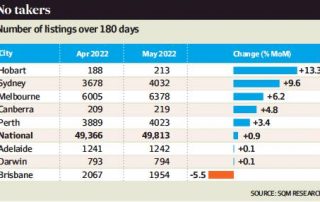
Old listings rose sharply in Sydney and Melbourne last month as vendors struggled to find a buyer within a reasonable timeframe amid falling demand, data from SQM Research shows.

The number of Sydney homes on the market for six months or longer surged by 9.6 per cent to 4032 in May, and in Melbourne by 6.2 per cent to 6378. The build-up in older listings will put further pressure on prices as the housing market moves into a correction.

Nationally, there are 49,813 homes languishing on the market for at least 180 days.

SQM Research managing director Louis Christopher said the number of older listings would increase as interest rates rose and fewer buyers could enter the market.

‘‘Older stock levels are likely to increase from here because there’s a wide gap between buyers and sellers at the moment,’’ he said.

‘‘There are fewer buyers compared to available stock, which means older stock is piling up, and it’s taking longer to sell property.’’

In Sydney’s inner west, the number of homes on the market for at least six months jumped by 18.6 per cent. In the eastern suburbs it climbed by 11.4 per cent and on the northern beaches by 24 per cent. Old stock in inner east Melbourne rose by 5 per cent and in the city’s north-west by 11 per cent.

In Perth, old stock levels rose 3.4 per cent to 4032. In Canberra, they went up by 4.8 per cent to 219 and in Hobart by 13.3 per cent to 213. The number lifted slightly in Adelaide and Darwin but dropped by 5.5 per cent in Brisbane.

‘‘This straight away indicates that a large number of properties are increasingly struggling to sell within a reasonable timeframe,’’ Mr Christopher said.

‘‘A rise in old listings is normally suggestive of impending slower market conditions, and we’ve seen this occur every market slowdown.’’

Although new listings fell sharply across the country last month as vendors held off before the federal election, new stock levels were set to rise in the coming months, Mr Christopher said.

‘‘In the month following an election, there’s generally a bounce in new listing activity, and I think we’re getting that,’’ he said.

‘‘I expect to see a jump in new listings from here onwards, even as we have now reached the quieter winter months. SQM Research has recorded a surge in new auction listings, hence why we have this view.’’

Last month, listings less than 30 days old fell by 4.8 per cent in Sydney, by 6.7 per cent in Melbourne and by 10.6 per cent in Canberra. Hobart had a 28.2 per cent slump, in Darwin it was 8 per cent and Brisbane fell 0.7 per cent. Nationally, new stock fell 5.9 per cent.

Despite the weaker selling conditions, vendors were far from being forced to sell, Mr Christopher said.

‘‘Sellers or property owners can afford the current rate rise and probably be able to afford the rate increases we’re about to have,’’ he said.

‘‘I don’t think we’ll see a big rise and forced sales activity until we see the average lending rate get above and beyond 6 per cent . . . I think we’re going to see many would-be sellers hold back until they believe that the downturn has come to an end.’’

Old listings surge in sluggish times2022-06-08T18:26:50+10:00

Regional house prices still growing strongly

The housing boom is far from over in the regions, with prices in some areas expected to rise by another 20 per cent this year as demand continues to outstrip supply, experts say.

House prices in some popular regions, such as the Gold Coast and Sunshine Coast in Queensland, Shepparton in Victoria and Hunter Valley in NSW, had already shot up about 10 per cent since the start of the year, said Ray White chief economist Nerida Conisbee.

‘‘At the rate prices are rising in these areas, it’s quite possible for them to climb by around 20 per cent this year,’’ she said.

‘‘Many regions are still on track for a 10 per cent rise this year, so I think the housing boom is definitely not over for areas that are relatively close to capital cities.’’

CoreLogic research director Tim Lawless said while growth rates were clearly easing from record levels across most parts of regional Australia, prices were still rising strongly.

‘‘We’ve already seen regional housing values across Australia increase by 6.6 per cent over the first four months of the year, so a further net growth of 4.4 per cent over the next eight months doesn’t seem unreasonable, especially considering the quarterly growth rate of 4.7 per cent over the most recent three-month period,’’ he said.

‘‘This is well above average and in anyone’s book, a very strong rate of growth. Anecdotally, we are still seeing strong demand for regional housing supported by high internal migration rates.’’

The number of homes available for sale across the regions is sitting at 40 per cent below the five-year average, and 20.5 per cent lower than a year ago, data from CoreLogic shows.

At the same time, sales activity lifted by about 20 per cent above the five-year average across the regions.

‘‘Clearly we are still seeing a disconnect between available supply and demonstrated demand,’’ Mr Lawless said.

‘‘We are continuing to see advertised stock levels remain extraordinarily low across regional Australia and settled sales activity looks to be holding firmer relative to the capitals.

‘‘Arguably, some regional markets will be somewhat insulated from a material downturn in housing values due to an ongoing imbalance between supply and demand.’’

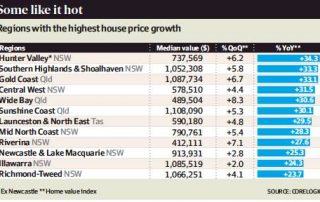
The Hunter Valley region in NSW, excluding Newcastle, was the best performing market in the past 12 months, with an annual growth rate of 34.3 per cent, followed by Southern Highlands and Shoalhaven, both also in NSW, with gains of 33.3 per cent.

Gold Coast posted a 33.1 per cent rise in house values, while the Sunshine Coast rose by 30.1 per cent.

Affordability was a big factor pulling buyers into the regions, although some of the most popular locations, such as Southern Highlands, had already become unaffordable, Mr Lawless said.

In the Newcastle and Lake Macquarie region, house prices are still $250,000 cheaper than Sydney, while the Illawarra region’s median dwelling value is $143,000 lower.

In Geelong in Victoria, dwelling values are $5350 cheaper relative to Melbourne and $203,000 lower in Ballarat.

Areas that offer a blend of affordability and commutability to the major capitals were likely to provide some of the strongest growth opportunities this year, Mr Lawless said.

‘‘Toowoomba is a good example of an affordable market that is within a two-hour drive of a major capital city,’’ he said.

‘‘With a median house value of $537,897, it’s also very affordable and well-placed to benefit from the strong population growth evident across south-east Queensland.’’

Regional house prices still growing strongly2022-05-20T15:59:06+10:00

Rate rise won’t dent blue chip confidence

At almost exactly the same time the Reserve Bank was pressing the button on its first interest rate rise in 11 years yesterday, Seven Group chief executive Ryan Stokes was revealing a ‘‘stronger for longer’’ infrastructure boom was gathering pace across the nation, just as commodity prices keep the good times rolling for Seven’s WesTrac heavy equipment division.

A few hours earlier, Wesfarmers chief Rob Scott had declared his confidence that the lowest unemployment rate in decades, rising incomes and an enlarged savings pool meant Australia’s household and housing sectors – so vital to the health of his Bunnings chain – could withstand rates rise.

And Mirvac boss Susan Lloyd-Hurwitz pointed to unheard of tightness in the industrial property sector, a recovering office and retail market, and positive medium-term outlook for apartments.

So while the RBA’s unexpectedly large interest rate rise might have underscored the growing challenge of inflation, the mood from company chief executives at the Macquarie Australia Conference in Sydney was clearly optimistic.

Supply chain dislocations and labour shortages are presenting real challenges, and cost pressures keep building, but an environment of strong demand is allowing most companies to pass through these inflationary pressures and underpinning confidence.

The conference, which brings together investors and companies across 103 presentations and close to 1000 one-on-meetings, is being held in-person for the first time since 2019, and it was no surprise to feel a real buzz in the room.

Not only has the Australian funds management community come out in force, but a strong contingent of international investors has made the trek to Australia for the first time since the pandemic struck in early 2020.

As always, the outsider view is interesting. For these international investors – it is understood the big names visiting include T Rowe Price, Fidelity and GIC – the Australian market can play a range of roles in a portfolio.

For example, the ASX is exposed to China, but has less of the volatility and geopolitical risk that the market has seen in recent times. It’s experiencing a level of inflation, but much less in the United States, where anxiety about earnings and valuations is growing.

And it offers great exposure to the commodities thematic that has become so popular (perhaps even overcrowded) since Russia invaded Ukraine.

The companies presenting at the conference would have given these international investors plenty to think about.

Wesfarmers, which sits across a big chunk of the Australian economy – retail, the industrial sector via its chemicals business, small business via its Officeworks and workwear divisions, and resources and energy via its new lithium project – painted a picture of broad economic resilience, even as inflationary pressures continue to build.

CEO Scott said while rate rises ‘‘obviously puts a lot of focus back on the housing market’’, the conglomerate remained ‘‘very confident about the Australian housing market and household spending generally’’.

‘‘Low unemployment and household savings, combined with a structural benefit as people spend more time working from home, provides a strong base for future investment in and around the home,’’ he said.

Real wage growth, Scott pointed out, was good for the economy and good for Wesfarmers. And while inflation created challenges for the broader economy, it would give smart companies that can limit cost rises the chance to take market share from competitors.

Mathematics says higher interest rates puts downward pressure on asset prices, but Charter Hall managing director David Harrison downplayed the impact, arguing sensible market participation would take a long-term view on rates like they do through every cycle.

Higher borrowing costs could also create opportunities, as corporates with ‘‘lazy’’, asset-heavy balance sheets consider options such as sale and leaseback arrangements.

This thread was also picked up by Lloyd-Hurwitz, who reminded the conference that there was still a level of post-lockdown demand flowing through the economy.

‘‘There are so many decisions that corporates didn’t make over the last two years that will need to be made.’’

For Mirvac, that manifests in the office sector, where demand for quality assets (read the latest and greatest) remains high.

Stokes presented another picture of broad economic strength. With strong iron ore, coal, nickel, copper and lithium activity expected to continue, the outlook for Seven’s WesTrac division – which sells Caterpillar heavy equipment and parts – looks sound.

In infrastructure, where Seven’s Coates equipment hire business is a major player, an estimated $1.1 trillion of infrastructure spending over the next five years is expected to underpin strong demand.

Stokes says that while Infrastructure Australia expects spending to peak in 2023, ‘‘our expectation is that this wave of infrastructure investment will run stronger for longer’’ due in no small part to shortages of specialist skills.

The challenge of labour was a constant refrain across the conference. It is clear that pressures are intense in nearly every sector and calls for immigration to open up to plug gaps are likely to grow louder.

As Reserve Bank governor Philip Lowe warned markets to prepare for the cash rate to rise from yesterday’s new level of 0.35 per cent to 2.5 per cent, ASX investors were given a little taste of the sectors likely to feel the most pressure from rising rates, with technology and real estate sold off.

No surprises there. But investors will need to watch carefully over the coming months to see what impact rate rises have on what ASX companies still believe is a pretty strong economy.

Rate rise won’t dent blue chip confidence2022-05-20T15:57:26+10:00