AmcoTax.Admin

About Angela Shannon

This author has not yet filled in any details.
So far Angela Shannon has created 101 blog entries.

Top central banker’s ‘sobering’ rates warning

Members of embattled super fund EISS could be forced to pay penalties levied against its board of directors, after the industry fund’s union and employer shareholders decided not to use their own money to pay any future fines.

The Australian Prudential Regulation Authority launched an investigation into spending at the Energy Industry Super Scheme (EISS) last year, amid media scrutiny of sponsorship arrangements entered into by its former chief executive, Alexander Hutchison.

APRA declined to confirm this week whether it was still investigating the $6.2 billion fund, which the regulator last year found administered the nation’s second-worst default superannuation product.

Last November, APRA took the unprecedented step of telling EISS to merge, demanding the fund review its expenditure and stop engaging in sponsorship arrangements that were not in its 20,000 members’ best interests.

EISS is the latest superannuation fund to seek court approval to use members’ money to pay fines levied against its directors, appearing at the NSW Supreme Court on Tuesday to seek judicial advice on amending its trust deed.

The move was in response to changes made by the Morrison government, known as the ‘‘Section 56 amendment’’, designed to prevent super funds from using members’ money to pay fines for any wrongdoing. The measure came into effect on January 1, and EISS filed documents in February.

Super funds including Australian-Super and Cbus fronted up to court late last year warning their trustee boards could become insolvent as a result of the change, since fund trustees generally have less than $100 in capital and would not be able to pay multimillion-dollar fines.

In its statement of facts, EISS said it had only $8 in capital and its insurance policy could not prevent it from going insolvent if it copped a non-indemnified liability.

Instead, the fund wants the power to use members’ money to cover fines by charging a ‘‘reasonable’’ fee on EISS’ $6.2 billion pool of retirement savings.

EISS said its seven shareholders had refused to dip into their own pockets to pay any fines the fund may incur.

EISS’ shareholders include energy companies Ausgrid, Transgrid, Endeavour Energy and Essential Energy, alongside the NSW branch of the Electrical Trades Union, the United Services Union and nominees of Unions NSW.

The document notes the cost of an ‘‘unplanned insolvency’’ of EISS ‘‘materially outweighs the cost of the new trustee fee’’, which is the pot of members’ money the fund wants to earmark for paying fines.

‘‘The amount of that fee must be an amount which the trustee determines is reasonable,’’ the document says.

EISS was named and shamed last August by APRA as managing one of the 13 worst-performing MySuper default funds, which triggered a focus on several of the fund’s sponsorship arrangements.

The sponsorship arrangements that have come under scrutiny include a community housing provider with links to a former chairman, Terry Downing, a multimillion-dollar deal with the National Rugby League (NRL), and sponsorship of Ronald McDonald House, where former chief Mr Hutchison’s wife had been employed.

The fund also supported two surf-lifesaving clubs in Maroubra.

APRA has not made any public findings about specific arrangements, but the regulator has told EISS to stop engaging in sponsorships that were not in members’ best interests.

Mr Hutchison resigned in September, along with multiple board directors and chairman Warren Mundy.

EISS has been in merger talks with Cbus since APRA said in November it needed to join forces with a better fund.

A spokesman for EISS said the fund ‘‘continues to work towards a merger with Cbus Super and are finalising a merger implementation plan’’.

Top central banker’s ‘sobering’ rates warning2022-08-30T14:06:58+10:00

Falling house prices a huge danger to JB Hi-Fi

JB Hi-Fi ultimately proved to be one of the COVID-19 winners even though its share price was trashed at the start of the pandemic when a heavy sell-off across the broader sharemarket meant it lost 40 per cent of its value in a couple of weeks to sink to $24.29.

Fear gave way to pragmatism and home cocooning. Spending on the home spiked as people upgraded big-screen televisions, bought new kitchen appliances and spent up on home work-station technology as the at-home lifestyle was forced upon them. The stock recovered strongly.

By March this year its shares had climbed to $55.85. But then a third of its sharemarket value vanished in less than three months as many investors decided this would be as good as it gets, and the dream run may be over.

Sharemarket investors traditionally look nine to 12 months ahead. Crystal ball gazers peering ahead to early 2023 see a household sector grappling with much higher mortgage costs after sharp interest rate rises, soaring energy bills and petrol prices and confidence low as house prices slide.

JB Hi-Fi isn’t giving up, and showed again on July 19 when it released preliminary financial results for 2021-22 just how resilient the business is.

The core JB Hi-Fi brand and The Good Guys appliances stores are exceedingly popular with shoppers. Overall, group revenue rose 3.5 per cent to $9.3 billion from a year ago, underpinned by strong same-store sales growth of 10.9 per cent in its Australian business in the June quarter.

It navigated the COVID-19 pandemic with aplomb, with its online business roaring ahead, up 50 per cent for the year.

But might Australia’s obsession with real estate and the central role a steadily growing residential housing market plays as a bedrock of the economy finally bring a partial unravelling?

Jarden analyst Ben Gilbert says the market seems to have already factored in hefty house price falls, which are a substantial drag on confidence because of the household wealth effect.

‘‘The market appears to currently be pricing a scenario whereby house prices fall greater than 20 per cent and spending falls 10 per cent-plus for household goods,’’ he said.

Economic data is already showing a slowing in consumer spending. Mr Gilbert says there is no doubt that JB Hi-Fi is an ‘‘industry leading retailer’’ but it is facing growing headwinds.

He has an ‘‘underweight’’ rating on the stock and a 12-month price target of $34.90. JB Hi-Fi shares closed on Friday at $44.46.

Mr Gilbert expects September quarter sales on a like-for-like basis to still be ahead of the same time a year earlier, when Sydney and Melbourne were in extended lockdowns and bricks-and-mortar retailing was severely curtailed. But from then on, it will be cycling much tougher sales and profit levels on a comparative basis.

He also points to rising competition from retailers such as Bunnings and Kmart, and online businesses such as Amazon which is steadily building a bigger presence in Australia with wider ranges.

JP Morgan analyst Bryan Raymond has a ‘‘neutral’’ rating on the stock and a 12-month price target of $44. He says it has a resilient business model and that The Good Guys results in the six months to June 30 were particularly impressive.

But he, too, points to a tougher outlook for discretionary retailers as ‘‘significantly higher cost of living and a slowing housing market weigh on spending’’.

Goldman Sachs analyst Lisa Deng has a ‘‘sell’’ rating on the stock and thinks it will sink to $34.90 within 12 months. She said the trading update showed better-than-expected margins but expects pressures to build in this new financial year as the business faces both ‘‘cyclical and structural challenges’’.

UBS analyst Shaun Cousins is sitting on the fence and has a ‘‘neutral’’ rating and a 12-month target price of $42. He said there was caution among investors about how retailers such as JB Hi-Fi, which have ‘‘broadly enjoyed COVID tailwinds, will perform under more difficult conditions’’.

He adds that The Good Guys has gained market share and is delivering stronger sales and higher margins after improvements to its merchandise, range and in-store selling.

Citi analyst Adrian Lemme is a believer and has a ‘‘buy’’ rating on the stock even though he trimmed his 12-month price target to $47 from $52. Mr Lemme said JB Hi-Fi was a strong operator and well-positioned to withstand the drag from increasing cost-of-living pressures in households.

The discretionary retailing sector was ‘‘unloved’’ and on a risk-reward basis JB Hi-Fi was looking more favourable for investors after its share price dropped by one third between March 30 and mid-June, suggesting investors had already factored in a tougher outlook.

Falling house prices a huge danger to JB Hi-Fi2022-07-26T09:19:30+10:00

Taxing homes would fill gap: OECD

Australia’s public purse missed out on $64 billion last year in tax revenue foregone due to the capital gains tax exemption on the principal place of residence, a tax break that entrenched intergenerational and geographic inequality, a new OECD report on housing and taxation says.

Capital gains tax exemptions, which give more benefit to people who have held them for a long time and to owners of properties in sought-after locations, should be capped or at least balanced in part by ‘‘recurrent’’ taxes such as a broad-based land tax, says the

Housing Taxation in OECD Countries

report.

Australia is one of 20 advanced economies in the OECD grouping that allow full and unconditional exemption from capital gains tax on the family home. Even in OECD countries that tax capital gains on primary residences, nine allow full exemptions and another five allow favourable tax treatment.

In the face of a popular tax incentive, the notion to drop it is bold. It goes further than the now-dropped policy of the Labor Party when it was in opposition to end the 50 per cent capital gains tax exemption for investors in property and other assets.

But while most leaders would not go that far, it could also have far-reaching consequences for housing by raising prices further, warned independent economist Saul Eslake.

‘‘It would be a form of political suicide subject to one point,’’ said Mr Eslake, a critic of Australia’s tax incentives that encourage investment in residential property and drive up the price of housing.

‘‘You would then need to allow mortgage interest as a deduction, an expense of earning that income.’’

This would give people even more cash to put into housing purchases, Mr Eslake said.

‘‘It’s an incentive to borrow more,’’ he said. ‘‘That’s why people do negative gearing – imagine being able to do it on your own house.’’

When it comes to residential property, Australia is just above the OECD average of 68 per cent, with 68.5 per cent of household wealth tied up in the owner-occupied and ‘‘secondary real estate’’ investment property, holiday homes and farmland.

However, it is second only to Luxembourg for average housing wealth in both types.

The OECD argues in favour of removing or capping mortgage interest relief for owner-occupied housing and says capital gains on secondary residential property – or investment properties – should be taxed.

But the Paris-based organisation says capping CGT exemptions for primary residences has the potential to reduce distortions and improve equality while also raising revenue, especially at a time of falling home ownership among younger people.

‘‘Capital gains tax exemptions for the main residence reinforce intergenerational and geographical inequality, given that gains have been concentrated among older generations and specific geographical areas,’’ the report says.

‘‘Older households are characterised by high homeownership rates and housing wealth and have enjoyed significant growth in property prices.’’

The unprecedented gains in residential property values – which have outstripped inflation and wage growth – over the past three decades were due to historically low levels of interest rates and unlikely to be repeated, meaning future home owners will not reap the same benefit, it says.

‘‘Homeownership rates are falling among younger generations, in part due to property value increases that have made it increasingly difficult to access the housing market,’’ the report says.

‘‘Even if younger households are able to access the housing market, they may not experience the large gains of previous generations. Many countries have also witnessed stark differences in the regional distribution of capital gains, with households in large metropolitan areas benefiting from the most significant property price growth on already highly valued property.’’

The report argues in favour of broad-based land taxes on real estate and the elimination of transaction-based taxes, such as stamp duty, saying it would increase efficiency in the housing market.

Tax incentives for energy-efficient housing renovations could also be better targeted to ensure that they reach low-income households, the report also says.

‘‘This could contribute to greater emissions reductions and enhance the equity of tax incentive schemes,’’ it says.

Taxing homes would fill gap: OECD2022-07-25T13:03:17+10:00

China is stumbling into its own destabilising mortgage disaster

The Chinese authorities’ drift on managing bad debts feels eerily like the impending subprime crisis in 2008.

It is spreading like wildfire. Home buyers in China are refusing to pay the mortgage on properties they have bought but that their financially strapped developers can’t finish. Some say that they will resume payments only when construction restarts.

The protest involved more than 100 delayed projects as of July 13, up from 58 projects the previous day.

The frustrated buyers accuse the developers of misusing sales proceeds and the banks of failing to safeguard their loans.

China has never seen anything like this. As in the United States – until the 2007 subprime crisis – the possibility of troubles in the mortgage market was vanishingly small.

But this mortgage strike isn’t entirely unpredictable. Home buyers have every reason to be angry. Most of the projects were begun by developers who have defaulted.

China Evergrande Group led the pack, accounting for an estimated 35 per cent of the total projects that faced mortgage revolts, data compiled by capital management company CLSA of Hong Kong shows.

One such project in eastern Jiangsu province was launched before the COVID-19 pandemic. Construction has been suspended since August, while property values in its neighbourhood have come down by about 10 per cent. In other words, not only did the affected households see their wealth dip, they can’t move in and enjoy their new apartments either.

Over the years, with consent of local governments, the likes of Evergrande and Country Garden Holdings fed the residential housing boom through a pre-sales model: apartments are bought long before they are completed. Now the builders don’t have money to finish these projects.

Granted, developers’ debt woes were met with protests in the past – from suppliers, employees, all the way to hapless retail investors who had bought their wealth management offerings. But this new development is something entirely different.

It opens a Pandora’s box and poses a direct threat to the stability of Chinese banks. The Ministry of Housing and Urban-Rural Development held talks with financial regulators and major banks last week to discuss the mortgage boycotts.

Unless President Xi Jinping’s government stops this stampede, a collapse of the banking system on the scale of Lehman Brothers in the US in 2008 is very much on the cards. China is unprepared for such a big chunk of its bank loans to go sour.

According to Autonomous Research, banks have about 62 trillion yuan ($9.1 trillion) of exposure to the property sector. More than half is in the form of mortgage loans. At China Construction Bank, one of the world’s largest banks, mortgages account for more than 20 per cent of total assets.

Until last week, China’s middle class were excellent customers, dutifully paying their monthly bills. The government’s social credit system – a national credit rating and borrowing blacklist – has worked well; bad credit can even hamper one’s ability to travel on high-speed rail. But what if some are just fed up and willing to walk away from their obligations?

We’re not talking about one or two delinquent developers. In the past year, 28 of the top 100 developers have defaulted or asked their debt holders for extensions, data compiled by CLSA shows.

Collectively, they account for about 20 per cent of China’s total property sales. Money is even tighter now. In the first half of the year, property sales plummeted 72 per cent from a year ago, further eroding their cash flow.

A CLSA monthly survey on the status of Evergrande projects gives us a glimpse of how many unfinished sites there are across China. As of June, more than half of Evergrande’s projects were under construction halts.

CLSA estimates that about 840 billion yuan in mortgages is tied to abandoned sites across China.

It is worth asking how we even managed to get to this point, especially for a government that is obsessed with stability.

All we have seen is policy inertia. Developers have been in distress for more than a year now, but there has been no progress in restructuring their finances. Local officials have been unwilling to make difficult decisions, write off bad debt and reach resolutions.

Unable to shed financial burdens, builders cannot focus on operations. They become zombies, and their construction sites turn into ghost towns.

In 2008, I worked at Lehman Brothers in New York and witnessed first hand how the subprime mortgage crisis dragged down the venerable bank – and threatened the entire industry. This environment is starting to feel eerily similar.

BLOOMBERG OPINION

Shuli Ren is a Bloomberg Opinion columnist covering Asian markets.

China is stumbling into its own destabilising mortgage disaster2022-07-22T16:08:11+10:00

Bond purchasing has cost the RBA $37b: Westpac

Westpac chief economist Bill Evans estimated the Reserve Bank’s balance sheet has suffered $37 billion in losses from its bond purchasing, but the toll would have been higher had it capitulated and embraced unconventional monetary policy earlier.

It would have cost a further $11.6 billion had the Reserve Bank not adopted the more deliberate policy of implementing a yield target back in March 2020. Its formal quantitative easing, or QE, policy started in November 2020.

As global central banks raise interest rates aggressively to bring down inflation, Mr Evans questioned whether they acted appropriately in deploying QE ‘‘at a time when supply was the dominant constraint to activity’’.

The severity of today’s inflation challenge is a consequence of those policies.

‘‘Boosting demand in the face of constrained supply is the classic scenario for pressuring inflation,’’ Mr Evans said. However, the Westpac chief economist endorsed the Reserve Bank’s resolve in adopting its yield target in the face of widespread use of QE by other central banks, describing it as both cost effective and imaginative.

The Reserve Bank has pledged a review of its pandemic response.

‘‘Perhaps the RBA will be the first central bank to recognise that bond buying was not a necessary policy during COVID,’’ Mr Evans said. ‘‘All central banks are now facing the cost of their policies with massive mark-to-market losses on their balance sheets which are now materialising as negative cash flows and will extend for years to come.’’

The value of the Reserve Bank’s purchases was $281 billion. Mark-to-market returns ascribe a present valuation to those bond holdings, adjusting for the sell-off in bond prices which has taken place against a backdrop of rising inflation and monetary tightening.

If held to maturity, a bond investor will always recover the face value of their investment separate to the benefit of coupon payments.

Bond purchasing has cost the RBA $37b: Westpac2022-07-22T15:59:35+10:00

Financial advisers question Hostplus returns

Critics question why Hostplus was crowned Australia’s best balanced superannuation fund over one and 10 years, saying the rankings rely on unpublished valuations of unlisted assets akin to ‘‘marking your own homework’’.

Only three of more than 70 MySuper funds – the balanced options defaulted into by about 14 million workers – made money for members in the year ended June 30, says a SuperRatings report published by The Australian Financial Review on Friday.

Hostplus, the $82 billion hospitality industry super fund, topped the ranking with a return in its balanced option of 1.6 per cent. It also retained its spot as market leader over a 10-year outlook, with an average return of 9.7 per cent a year.

Sam Sicilia, the fund’s chief investment officer, attributed the result in part to investments in unlisted assets, especially infrastructure projects such as airports, bridges and seaports that had ‘‘monopolistic’’ and ‘‘inflation beating’’ characteristics that protected the portfolio against the global sell-off in bond and equity markets.

But some financial advisers, who under law are the only individuals who can recommend a consumer invest in a particular super fund, have questioned the role played by the valuations of these unlisted assets, which are done behind closed doors and are not released to members or the public.

Chris Brycki, founder of investment adviser Stockspot and a funds management market analyst, said members were ‘‘completely in the dark’’ about funds’ unlisted asset valuations.

‘‘Many funds never reveal either the frequency or methodology of the so-called independent valuations,’’ he said.

‘‘The problem here is that it’s highly questionable whether Hostplus have revalued all of their overweight unlisted assets . . . to reflect current public market valuations. It’s the same as someone marking their own homework and then bragging about being top of the class.’’

If Hostplus is overvaluing its private equity investments, which make up 8 per cent of the fund, then it could have an ‘‘overstated’’ impact on balanced returns, Mr Brycki added.

In May 2020, research house Lonsec (which owns SuperRatings) downgraded Hostplus’ balanced option from ‘‘recommended’’ to ‘‘investment grade’’. The Lonsec review found the fund suffered from ‘‘high, structural allocation to illiquid assets’’, ‘‘greater liquidity risks’’, and ‘‘management costs at the higher end’’.

Mr Sicilia said he was familiar with the criticism, and had been ‘‘attacked’’ on Twitter by some who believed the fund had too much exposure to unlisted and illiquid assets (meaning they are difficult or time-consuming to sell).

But he was adamant that unlisted investments were critical in defending member savings against the volatility in public sharemarkets.

‘‘I don’t care about liquidity,’’ he said, adding that he did care about ‘‘liquidity management. I don’t want the listed version. I want the unlisted version, with the expert valuation.’’

As the superannuation system matures, funds need to remain focused on how they value their assets, said SuperRatings executive director Kirby Rappell.

The firm receives returns from funds and monitors fund websites, and reviews information against public disclosures and its own data.

‘‘As part of our ratings review process, we seek to build an appropriate understanding of funds valuation processes and oversight,’’ said Mr Rappell.

Wealth adviser Steve Blizard, of Roxburgh Securities in Perth, said he did not trust industry funds when it came to closed-door valuations. He said league tables can be misleading as they rely on internal metrics and data.

Financial advisers question Hostplus returns2022-07-22T15:55:48+10:00

New research shows you don’t need $1m in super to retire

New analysis challenges the widely touted view that couples need $1 million in super to enjoy a comfortable retirement lifestyle, with Choice spin-off Super Consumers Australia saying retirees with low spending patterns can potentially bow out of the workforce with $88,000 in super, without their living conditions deteriorating.

The new research analysed pre-retiree and current retiree spending patterns to determine what it takes to live a ‘‘low’’ spending, ‘‘medium’’ spending and ‘‘high’’ spending lifestyle in retirement.

A single pre-retiree aged 55-59 who plans to spend around $55,000 a year in retirement is considered to have a ‘‘high’’ level of spending, and as such needs to save $745,000 by the time they’re 65, the analysis found, based on this retiree owning their home, or not paying rent or a mortgage.

But if they’re planning a lifestyle with a medium annual spend of $44,000, they’ll need $301,000 and if they’re planning ‘‘low’’ spending of $34,000 a year, they’ll need $88,000.

All cohorts are assumed to also receive the age pension, which is expected to make up 91 per cent of income for retirees within the low-spending cohort.

Meanwhile, single retirees aged 65-69 with medium- to high-level spending patterns require between $258,000 and $743,000 by the age of 65.

Couples aiming for similar lifestyles will require between $352,000 and $1.02 million in savings, the research found. Single retirees planning a more modest annual spending need $73,000 by the time they’re 65, while couples need $95,000.

Super Consumers Australia suggested its medium-spending target of $258,000 in savings by retirement would provide a single person a comfortable retirement. However, that figure is at odds with ASFA’s Retirement Standard, which suggests a single person will need $545,000 to achieve a comfortable retirement.

‘‘Having credible targets, based on actual spending, means people can confidently spend and get on with enjoying their retirement,’’ said Super Consumers Australia director Xavier O’Halloran.

The high, medium and low savings targets are based on what people tend to spend in retirement, and include a ‘‘buffer’’ to provide confidence that their savings can weather market turmoil and are based on growth asset allocation assumptions of a 60/40 split and a mean one-year nominal net return of 5.60 per cent.

Mr O’Halloran took aim at the common belief that retirees need $1 million in superannuation.

Noting that couples with high spending patterns will need around $1 million to maintain their standards in retirement, he added that the message that all retirees will generally need $1 million to retire is ‘‘actually quite harmful’’.

‘‘That can lead to over-saving, it can lead to them making sacrifices during their working life that they don’t need to make, if they just want to maintain their standard of living.

‘‘It also sees some people in that higher bracket pass away with a significant amount of savings still left over.’’

New research shows you don’t need $1m in super to retire2022-07-22T15:54:08+10:00

Small business pays the cost of rising wages

Average pay rates among small businesses have grown by more than 4 per cent this year off the back of the tightest labour market in decades, according to new research.

Data on more than 130,000 small to medium businesses using technology software firm Employment Hero shows the average hourly rate of 1.75 million employees increased 1.4 per cent between May and June, and 4.3 per cent since January.

The company’s inaugural SME index suggests labour shortages in low-paid jobs such as hospitality have started to bite.

Employment Hero chief executive Ben Thompson said changes in average rates could be influenced by lack of staff as much as wage growth.

‘‘We’ve seen a lot of change in industry engagement – people moving from hospitality and retail into knowledge work – and if that means we’ve seen some senior roles with high salaries terminated through resignation and moving from one sector to another, then that could definitely affect the average rate of pay,’’ Mr Thompson said.

‘‘For example, in healthcare if you saw a lot of highly experienced mature-age nursing staff resigning due to COVID burnout that could lead to a decrease in the average wage.’’

The report found retail, hospitality and tourism experienced an increase in average hourly rates of 4.7 per cent from May to June.

However, healthcare suffered a decrease in its average rate of 4.2 per cent. Agriculture, mining and energy experienced the biggest fall, 11.6 per cent.

Overall, the Employment Hero report found medium-sized firms, which also experienced the biggest increase in staff, were driving the most recent surge in average hourly rates.

Small businesses (fewer than 20 employees) and large businesses (more than 200) had their average hourly wage growth marginally decline.

Asked how they would deal with this year’s minimum wage increase of up to 5.2 per cent, about 24 per cent of 500 respondents said they would ‘‘have to review prices’’ and 16 per cent said they would need to work more hours.

About 11 per cent said they would have to let staff go and 10 per cent planned to outsource work locally. About 7 per cent said they would seek to identify cost savings outside of pricing and staffing changes.

The report follows an analysis by JP Morgan economist Jack Stinson last week that suggested wage growth was still tepid because vacancies were concentrated in industries such as hospitality that also had the lowest margins.

‘‘Such firms are less willing to bid wages up to levels above marginal product,’’ Mr Stinson’s analysis said.

‘‘The consistently high level of unfilled vacancies should then be read as a partial signal that firms cannot fill positions at any cost, explaining some of the disconnect between very low unemployment and middling wage growth.’’

Whitehaven Coal chief executive Paul Flynn told The Australian Financial Review his ASX-listed company had been relying on paying retention bonuses ‘‘on a quarterly basis, just to make sure people stay put because the market is very, very tight’’. ‘‘All the miners are running hard and then the government is competing for the same labour with all the infrastructure building they have got going around the country … so the government is contributing to a lot of the inflationary pressure by their own actions here so that is challenging for us,’’ he said.

Small business pays the cost of rising wages2022-07-22T14:58:31+10:00

Home prices on track for 20pc fall as rate rises bite

Thanks to the Reserve Bank of Australia’s extraordinary decision to hammer unsuspecting households with 125 basis points of mortgage rate increases in just two months (from May 4 to July 6), which will likely be upsized to 175 basis points of rises at its next meeting, Sydney house prices are falling at a 20 per cent-plus annualised pace.

Using the daily hedonic index data published by CoreLogic, which is the RBA’s preferred housing benchmark, this column finds that the rolling 30-day change in Sydney home values has dropped precipitously from 2.83 per cent in August 2021 to minus 2.21 per cent as at July 11. That means residential real estate in Sydney is declining at an annualised rate comfortably north of 20 per cent.

While this housing crash appears to have shocked many analysts and economists – and the millions of unwitting families relentlessly advised by the RBA in 2020 and 2021 to borrow and spend as much as possible because Martin Place had committed not to lift interest rates until 2024 at the earliest – it is, regrettably, smack bang in line with the central case that this column outlined late last year.

In June, Sydney home values plunged 1.6 per cent. They have fallen at an even more rapid rate over the first 11 days of July, slumping by another 0.7 per cent.

Melbourne dwelling values are closely tracking Sydney prices, albeit with a lag. In June, Melbourne home values fell 1.1 per cent, and they have lost another 0.4 per cent in the first few weeks of July.

Sadly, this reaffirms our dour October 2021 forecast that local house prices would correct 15-25 per cent after the first 100 basis points of the RBA increases, smashing consumer and business confidence (already near GFC lows) and adversely affecting consumption across the economy.

This has slowly become a consensus economist view, although there are some spruikers who claim house prices will continue climbing because higher interest rates have no impact on them.

It’s also worth noting that we are not perma-bears when it comes to Aussie housing. On the contrary, we were the most bullish forecasters in early 2020 when everyone else was expecting prices to drop 10-20 per cent.

While the RBA is setting itself up to increase rates by another 50 basis points in August in response to lagged inflation data heavily influenced by temporary supply-side shocks, we project that the record collapse in the value of Aussie households’ most important asset will ultimately act as a constraint on the extent to which Martin Place can continue to lift rates. After preemptively over-egging policy despite no evidence of a wage/price spiral, there is every chance the RBA will be forced to cut rates in 2023. (Recall the latest CBA data on real-time wage growth suggests it remains very sluggish.)

Aussie households face multiple headwinds: the fastest interest rate increases in a quarter of a century, which are crushing disposable incomes; a massive, albeit hopefully temporary, reduction in real wage growth as a result of a one-off increase in inflation attributable to a conga line of supply-side shocks; a record decline in the value of their largest asset, the owner-occupied home; the largest decline in the value of their superannuation savings since the GFC; and finally, the spectre of fiscal policy dragging on growth as both the federal and state governments eventually turn their focus to budget repair and the need to raise taxes.

On this final point, there have been some interesting developments. This month Victoria commendably raised $7.9 billion from the partial sale of VicRoads. Treasurer Tim Pallas confirmed the funds will go to the state’s new Future Fund that will be used to pay back the tens of billions of dollars of COVID-related debt that Victorian taxpayers have accumulated since 2020. This is modelled on NSW’s excellent Debt Retirement Fund, which NSW has already tapped for $11 billion to help repay its COVID-19 debt bill.

Following the budgets released by the five largest states, we know that the official debt issuance task will be $75.6 billion for the 2023 financial year, which is $10.1 billion less than the $85.7 billion these states forecast for FY23 at the time of their FY22 budgets.

If one accounts for the amount of rapid-fire issuance the likes of NSW and Victoria have been able to do via their record floating-rate note deals, which have attracted $17 billion of bids from banks hungry for high-quality liquid assets, the states’ funding task for FY23 falls from the most recent budget estimate of $75.6 billion to just $64 billion. That is, the five largest states have exactly $10 billion less debt to issue in FY23 compared to their official numbers only a month ago. The $64 billion of issuance in FY23 is also a striking reduction from the $93 billion issued in FY22 and the $98 billion supplied in FY21.

Juxtaposed against the modest issuance outlook is the gargantuan demand from banks hunting for liquid assets, which this column has been flagging since late 2021. On our estimates, banks will need to buy $315 billion-$570 billion of government bonds through to December 2024.

This is because they lose $140 billion of liquid assets after the Australian Prudential Regulation Authority’s decision to shutter the banks’ lucrative Committed Liquidity Facility, which we foreshadowed last year, and then another $188 billion of liquid assets once they repay the money they borrowed from the RBA under the Term Funding Facility. Balance sheet growth and bond maturities off the RBA’s balance sheet also drive additional bank demand for liquid assets.

Our liquidity shortfall estimates are based on banks maintaining their liquidity coverage ratios (LCRs) at more than 130 per cent. UBS arrives at a slightly smaller $275 billion-$375 billion estimate assuming banks can drop their LCRs to 125 per cent. CBA’s researchers displayed even more hope, claiming that banks might be able to get away with 120 per cent LCRs.

There are two problems with this. Treasurers at the major banks dismiss any possibility of them lowering their board-mandated LCR targets. And APRA has recently noted quite pointedly that banks have prudently kept their LCRs in excess of 130 per cent in line with global peers.

Despite this extremely positive demand and supply, the states have had to wear an enormous increase in their cost of debt funding, which has more than tripled. The first driver has been the spike in Australia’s 10-year Commonwealth bond yield, which was around 1 per cent last year and has since leapt to about 3.5 per cent.

Rightly or wrongly, the implicitly Commonwealth-guaranteed states borrow at a margin above the Commonwealth yield curve and this spread has jumped from 15 basis points last year to about 60-65 basis points this month, broadly in line with where state spreads traded in the unprecedented financial market shock induced by the pandemic in March 2020.

State bonds are the only bonds we know of in global credit markets that are trading anywhere near their March 2020 spread levels. This is one reason we like holding them. As an example, five-year major bank hybrids spreads are sitting at about 330 basis points above the bank bill swap rate. Back in March 2020, hybrid spreads traded as wide as 850 basis points over this.

So what explains the unusual jump in the states’ spreads above the Commonwealth curve? An equally unusual increase in hedging costs, as represented by ‘‘swap spreads’’, which have exploded to record levels in the post-centralised clearing period. The principal catalyst has been the RBA blowing up global investors who believed that Martin Place would fulfil its commitment not to raise interest rates until 2024 at the earliest.

The RBA had explicitly backed this commitment by fixing the interest rate on the 2024 Commonwealth bond at 0.1 per cent, the same level as its target cash rate. But in October 2021, it suddenly decided to stop defending this ‘‘peg’’, which was arguably the most humiliating experience for a central bank since George Soros rolled the Bank of England in the early 1990s.

As the RBA concedes in a recent report, this damaged its credibility and king-hit global investors that had allocated capital on the assumption that the RBA’s 2024 yield curve target would remain intact.

There has been market chatter that it has taken larger investors until recent days to exit their long, or received, positions in the 10-year Aussie swaps market, which they had been stopping out of since last October. The process of stopping out of these trades over the past eight months has relentlessly pushed local swap spreads higher, eventually to levels that were more than double the previous peaks recorded in the post-clearing period.

The good news is that since these flows have cleared, spreads have started their long process of normalising back towards their fundamental anchor.SI

Christopher Joye is a portfolio manager with Coolabah Capital, which invests in fixed-income securities.

Home prices on track for 20pc fall as rate rises bite2022-07-19T11:14:05+10:00

Distressed home listings jump

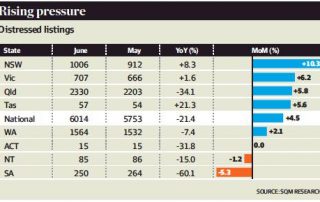
The number of distressed residential listings jumped by more than 10 per cent across NSW in June over the previous month, as vendors struggled to get a sale amid low demand triggered by higher interest rates, poor affordability and rising costs of living, data from SQM Research shows.

Louis Christopher, managing director of SQM Research, said the number of distressed listings would rise to pre-pandemic levels in the months ahead as interest rates lift higher.

‘‘With ongoing rises in interest rates and the end of the COVID-19 relief period within the banking sector, I expect to see distressed listings activity return to levels recorded prior to COVID-19, when it rose to 15,000 nationwide,’’ said Mr Christopher.

More than 1000 homes across NSW were listed under distressed conditions during the same period, with 2330 in Queensland, 1564 in Western Australia and 707 in Victoria.

There were 250 distressed listings in South Australia, 85 in the Northern Territory, 57 in Tasmania, and 15 in the Australian Capital Territory, taking the nationwide tally to 6014 – a 4.5 per cent rise from the previous month.

A distressed residential property listing occurs when a property must be sold quickly, and often results in a financial loss for the seller who must accept a lower price than would normally be the case, said Mr Christopher.

Distressed listings often include key words such as ‘‘mortgagee in possession’’, ‘‘bank forced sale’’, ‘‘desperate vendor’’, ‘‘selling below cost’’, ‘‘must sell’’, ‘‘liquidation’’, ‘‘fire sale’’, ‘‘price reduction’’ and ‘‘motivated vendors’’.

The Gold Coast has the highest number of distressed listings, with 315 homes, followed by the Central Coast in WA with 201, and Queensland’s Sunshine Coast with 185.

A total of 260 properties have been listed as ‘‘mortgagee in possession’’ or ‘‘bank forced sale’’, while 582 were listed as ‘‘bargains’’. Prices were reduced across 1442 listings, while 1426 listings were tagged as ‘‘priced to sell’’ and 1046 were listed as ‘‘motivated sellers’’.

Sydney-based buyer’s agent Jack Henderson of Henderson Advocacy said vendors who had bought a new home but not sold their existing property were the most desperate to sell.

‘‘We’re seeing a rise in these types of vendors, who made large financial commitments and can no longer afford to hold both properties,’’ he said.

‘‘They’re being forced to sell at a price they’re not happy with at all because they don’t have any other options.’’

Amanda Gould, buyer’s agent and founder of HighSpec Properties, said fewer buyers were willing to enter the market as prices continued to drop.

‘‘Buyers are a lot more picky than they have ever been,’’ she said. ‘‘Unless it’s a complete bargain, they’re not interested.’’

The dwindling number of buyers has prompted many vendors to pull out of the market, with new listings falling by 9.4 per cent over the month in Sydney and by 14.4 per cent across Melbourne. Nationwide, listings under 30 days have dropped by 5.4 per cent to 70,885.

But the low absorption rate fuelled a rise in the number of listings over six months, which has lifted by 1.6 per cent nationwide.

‘‘The fall in new listings was a result of reduced vendor confidence in the strength of the housing market, as well as seasonal factors whereby the winter period normally records a decline in residential property sales activity, particularly for Sydney and Melbourne,’’ said Mr Christopher. ‘‘The rise in older listings reveals that the slowdown in the housing market is driven by lower buyer demand. Going forward, we expect July to record similar trends of lacklustre activity and more rises in older listings.’’ Kent Lardner, founder of Suburbtrends, said the rise in inventory was also typically a sign of a market in distress.

‘‘When the balance of power shifts from sellers to buyers, we tend to see a rise in inventory and when this occurs, the time it takes to sell blows out and falling prices usually follow,’’ he said.

‘‘Right now, inventory is rising in 60 per cent of housing markets and in 50 per cent of unit markets.

‘‘If inventory levels build to more than five or six months, that is where I expect to see double-digit price changes.’’

Distressed home listings jump2022-07-07T12:49:59+10:00